














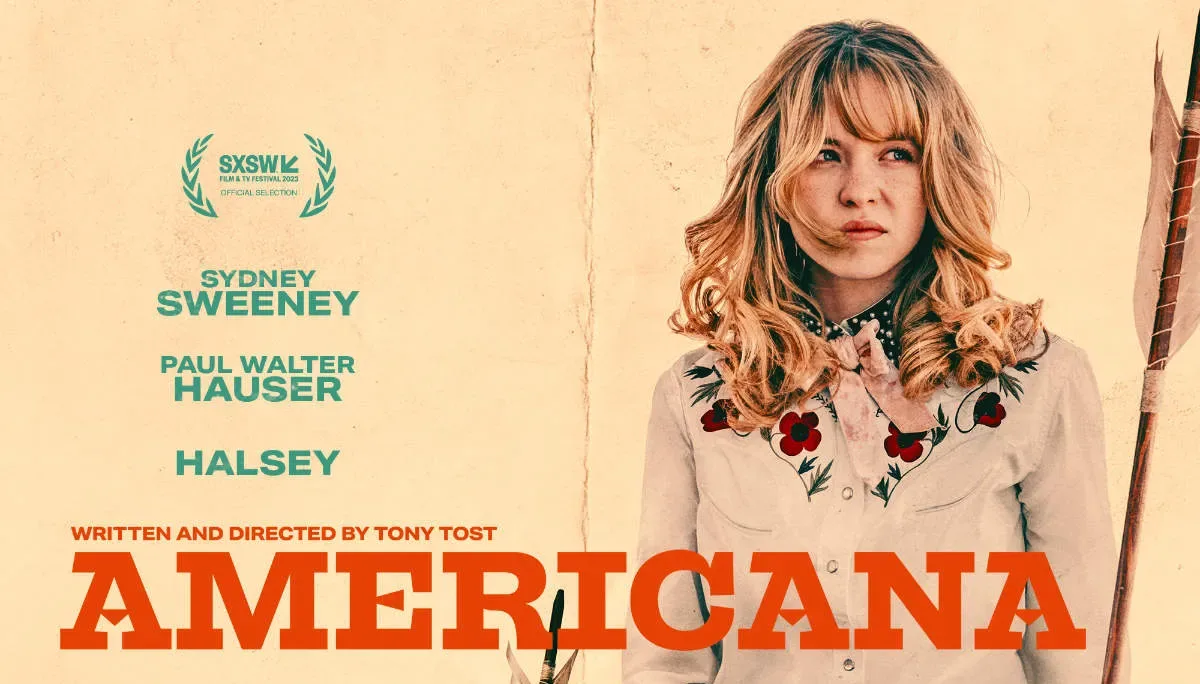

A story is often only as good as the object everyone wants. In Tony Tost’s Americana, that object is a Lakota Ghost Shirt, an artifact of immense spiritual weight said to protect its wearer from harm. When it is stolen in a violent home invasion, it ceases to be a mere museum piece and becomes a narrative engine, activating the quiet desperation of every character it encounters.
Set against the bleak backdrop of modern South Dakota, the film tracks the shirt’s chaotic journey as it passes through the hands of people who see it not as a sacred relic, but as a solution. For some, it represents a half-million-dollar payday. For others, it is the key to reclaiming a stolen heritage. For one woman, it is simply a ticket to a life she can call her own.
The film’s tension is born from this fundamental conflict: what happens when an object of spiritual significance is assigned a market price? The story that unfolds is a multi-lane pile-up of conflicting desires, a frantic chase where every party believes their claim is the most righteous.
A Collision Course of Characters
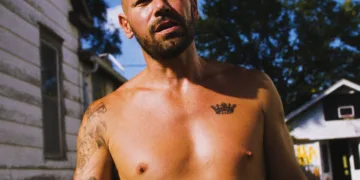
The film’s narrative architecture rests on its ensemble, a collection of souls whose paths would never cross if not for the Ghost Shirt. At the center of the storm is Mandy Starr, a young woman whose tough, Joan Jett exterior hides the scars of a life with her abusive, small-time hood boyfriend, Dillon.
When Dillon brings the stolen shirt home, Mandy performs an act of brutal liberation: she takes a hammer to his head and flees with the artifact and his car. It is a messy, violent declaration of independence, a physical severing from a life of passive suffering.
Her escape is complicated by her bond with Cal, a strange boy she leaves behind who is convinced he is the reincarnation of Sitting Bull. This act injects a raw, personal stake into the chase; she isn’t just running for money, but from a life that is actively trying to kill her.
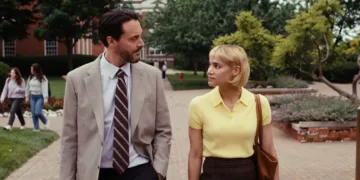
Elsewhere, a sweeter, more naive criminal enterprise is brewing. At a local diner, waitress Penny Jo Poplin dreams of country music stardom, a goal hampered by a stammer that embodies her feelings of powerlessness. When she overhears details of the shirt’s immense value, she recruits Lefty Ledbetter, a lovelorn combat veteran played with a gentle sincerity.
He is a man who craves connection, and she is a woman who craves a voice. Their plan to fund a new life in Nashville provides a necessary counterpoint of hopeful innocence to the film’s grim proceedings. Their fumbling attempts at crime are endearing because they are so clearly out of their depth, two decent people playing a game whose violent rules they cannot comprehend.
Meanwhile, the other claimants close in. Ghost Eye, the deadpan leader of a Native American group, seeks to reclaim what rightfully belongs to his people. His mission is one of historical justice, a stark contrast to the purely transactional greed of Roy Lee Dean, the unscrupulous antiquities dealer who orchestrated the original theft.
Ghost Eye’s weariness feels earned, the weight of generations resting on his shoulders, while Roy Lee’s ambition is pathetically shallow. Tying these threads together is Cal, the boy with the toy bow and arrow. He is the film’s chaotic agent, a walking piece of misplaced mythology whose actions have very real consequences. After being left by Mandy, he finds Ghost Eye’s group and, in his innocence, tells them exactly where his mother is going, ensuring all parties will converge at the same explosive destination.
A Darkly Comic Neo-Western
Tost constructs his story using a non-linear, chapter-based format. This decision is more than a stylistic flourish; it is a calculated narrative device that masterfully controls the flow of information and audience allegiance.
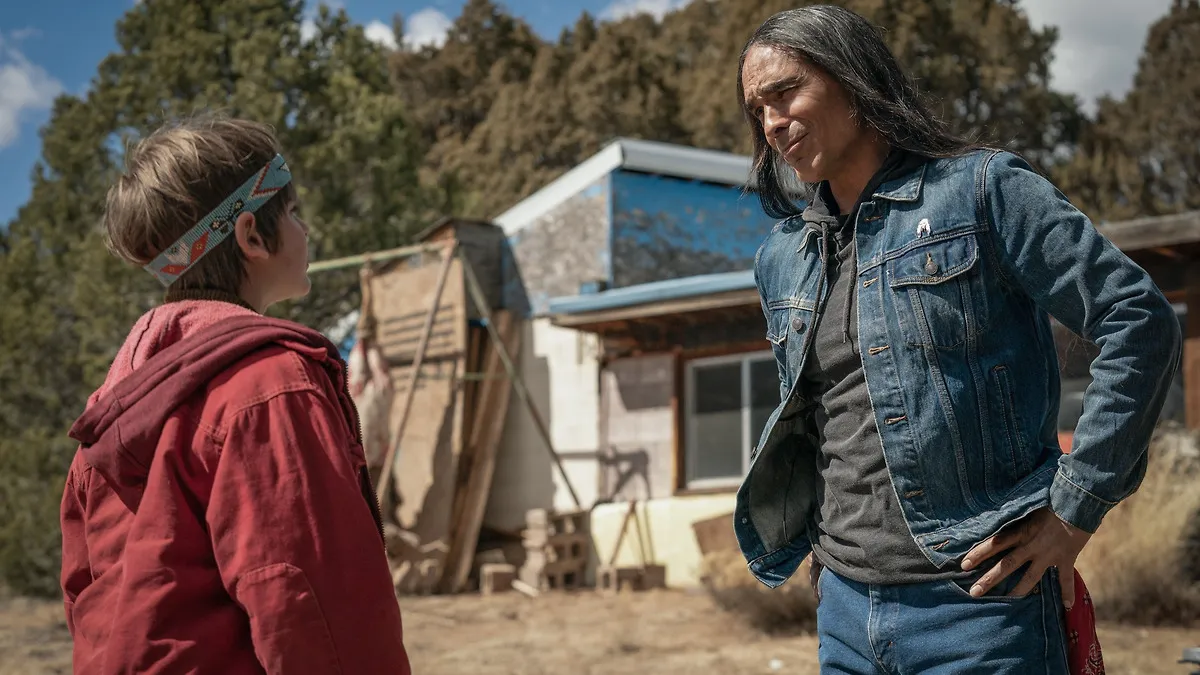
By introducing each faction in its own contained segment—showing us Penny Jo and Lefty’s charmingly awkward date before they hatch their criminal plot, for instance—the film ensures we understand their humanity before we judge their actions. The structure builds a specific kind of suspense, where we know a crash is coming but are unsure of the exact point of impact, creating a tension that is as much about character as it is about plot.
The film’s tone is a carefully managed balance of gritty crime thriller and sharp, dark humor. The dialogue is rapid-fire and witty, but it is punctuated by sudden, shocking acts of violence that prevent the story from becoming a quirky-for-quirky’s-sake exercise.
The high body count and unconventional weapon choices, like compound bows used with deadly efficiency, keep the audience perpetually off-balance, reminding us that these characters’ poor decisions have fatal consequences. This tonal mix feels familiar in the landscape of post-Coen Brothers, post-Tarantino crime sagas, but Tost makes it his own through a genuine affection for his characters’ foolishness.
The visuals reinforce this approach, using the vast, arid landscapes of New Mexico to evoke the classic Western, only to populate that iconic space with people undone by modern anxieties. The dusty roads and wide-open plains are not a canvas for heroism but an empty space where desperate people fight over scraps, a visual metaphor for their marginalization.
An Ensemble In Tune with the Chaos
A film with so many intersecting storylines lives or dies by its cast, and Americana’s ensemble is perfectly calibrated to its chaotic frequency. In her feature acting debut, Halsey gives a remarkably self-assured performance as Mandy Starr.
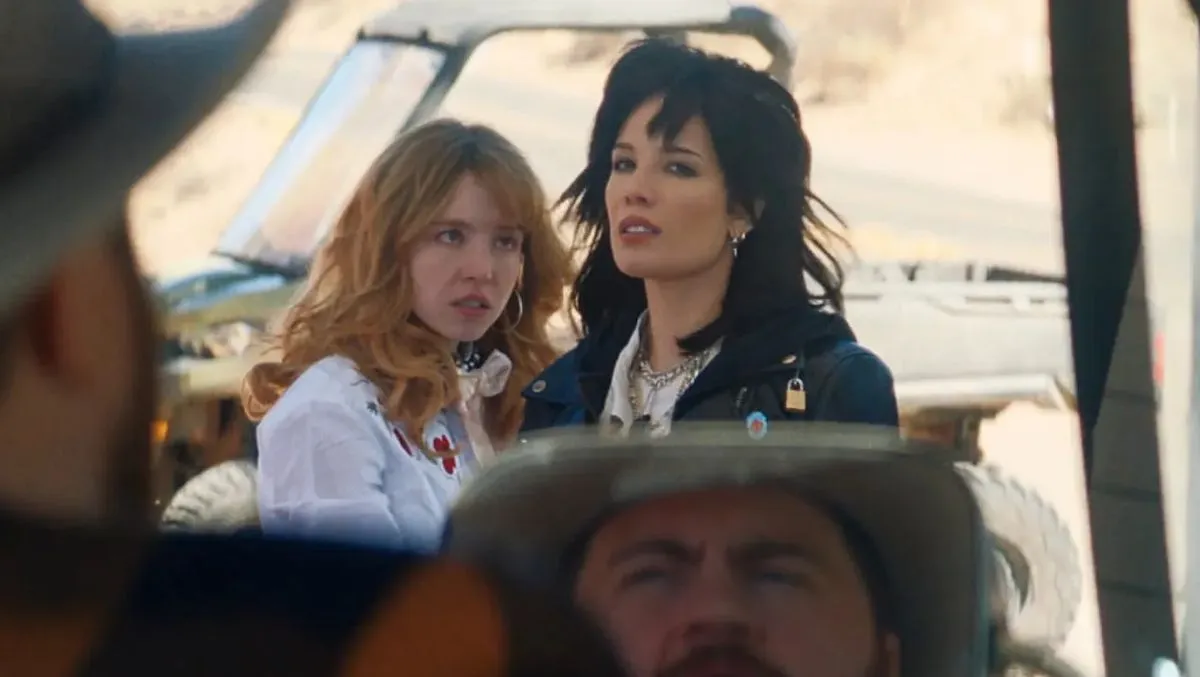
She embodies the character’s hardened exterior and wounded spirit, communicating a lifetime of pain with a defiant stare and a defensive posture. It is a physical performance; you see the weight of her past in the way she carries herself, and the flicker of hope in her eyes when she sees a chance to escape. She holds the screen confidently, proving she can carry a character’s history without needing to explain it.
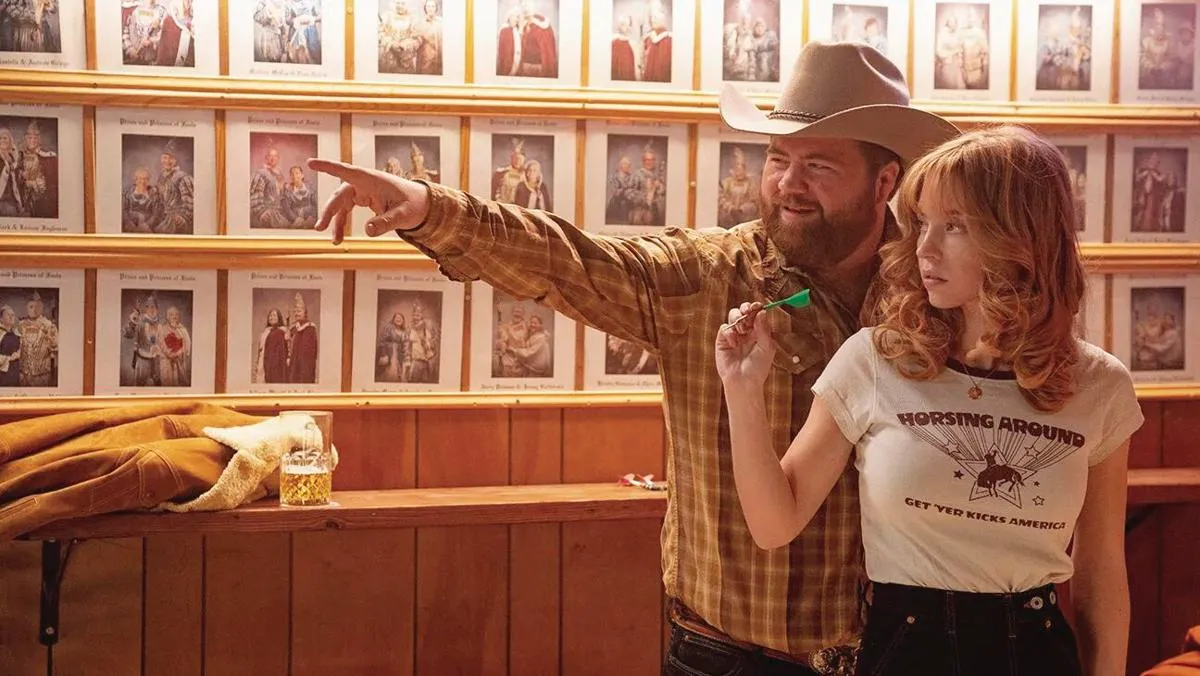
The film’s emotional anchor, however, is the pairing of Sydney Sweeney and Paul Walter Hauser. Sweeney is exceptionally good as Penny Jo, portraying her vulnerability and pluck in equal measure. Her character’s stammer is not a gimmick but a key to her psychology—a physical manifestation of her inability to assert herself, which makes her decision to commit a felony all the more powerful.
Hauser, as Lefty, continues to be one of the most reliable character actors working today, bringing a deep sensitivity and kindness to a man who just wants to love and be loved. His willingness to follow Penny Jo into danger is both touching and troubling. Among the supporting players, Zahn McClarnon is a clear standout. As Ghost Eye, his authority comes from his stillness. While other characters are defined by frantic motion, he is measured, his deadpan wit making his dialogue land with force. He is the face of righteous, anti-colonialist vengeance, and he plays it perfectly. Simon Rex is also effective as Roy Lee Dean, a perfect portrait of smarmy, opportunistic greed.
Deconstructing the American Myth
At its foundation, Americana is a film that actively engages with the legacy of the Western genre, often for the purpose of tearing it down. It uses the familiar framework of a frontier chase to critique the very myths the genre helped create, interrogating its tropes rather than simply inverting them.
The most significant subversion is in its treatment of its Native American characters. Ghost Eye and his men are not background obstacles or spiritual guides for a white protagonist; they are central figures with clear agency and a justifiable cause that feels more legitimate than anyone else’s. The film condemns the romanticized idea of the cowboy, recasting its modern equivalents as either pathetic like Dillon or predatory like Roy Lee Dean.
The Ghost Shirt itself functions as a potent symbol for this critique, highlighting the irreconcilable conflict between an object’s cultural, spiritual value and its assigned monetary worth. The story examines cultural appropriation on multiple levels: the innocent, misguided version seen in Cal, who seeks an identity in a culture not his own, and the cynical, capitalist version of Roy Lee, who sees heritage only as merchandise.
The desperate pursuits of Mandy, Penny Jo, and Lefty are reframed as a violent scramble for the American Dream, a dream that now looks a lot like simple survival. All these threads converge at the film’s climax at a remote, cult-like compound run by Mandy’s father—a fittingly grim location for a final showdown. It is here that the competing claims fueled by greed, desperation, and historical grievance must finally be settled with blood.
Full Credits
Director: Tony Tost
Writers: Tony Tost
Producers: Alex Saks
Executive Producers: Joe Weisberg, Joel Fields, Graham Yost, Justin Falvey, Darryl Frank, Gavin O’Connor, Daniel Sackheim, Chris Long, Stephen Schiff
Cast: Sydney Sweeney, Paul Walter Hauser, Halsey, Eric Dane, Zahn McClarnon, Simon Rex, Gavin Maddox Bergman, Harriet Sansom Harris, Derek Hinkey, Toby Huss, Donald Cerrone
Director of Photography (Cinematographer): Nigel Bluck
Editors: Peter McNulty
Composer: David Fleming
The Review
Americana
With a razor-sharp script and a perfectly calibrated ensemble cast, Americana is a confident and wildly entertaining neo-western. It skillfully balances dark humor with genuine pathos, deconstructing genre tropes while telling a compelling story of desperation and greed. Halsey's stunning debut and the heartfelt chemistry between Sweeney and Hauser are worth the price of admission alone. This is a smart, stylish, and thoroughly satisfying crime saga that announces Tony Tost as a significant new voice in filmmaking.
PROS
- A clever, witty script that balances humor, violence, and heart.
- Outstanding performances from the entire ensemble, with Halsey, Sweeney, Hauser, and McClarnon as standouts.
- Confident and stylish direction from first-time feature filmmaker Tony Tost.
- A thoughtful deconstruction of the Western genre and its legacy.
CONS
- The non-linear, chapter-based structure may feel indebted to earlier films by filmmakers like Quentin Tarantino.
- Its dense plot with multiple intersecting characters could feel slightly overstuffed at times.
- The frequent and sometimes brutal violence, though stylized, may not appeal to all viewers.