




















![Kingdom Hearts Collection [I-III] Review](https://gazettely.com/wp-content/uploads/2026/10/Kingdom-Hearts-Collection-I-III-1-360x180.webp "Kingdom Hearts Collection [I-III] Review: KHII Holds Steady as Newer Entries Fluctuate 37")





Nearly two decades after Hurricane Katrina made landfall, a new five-part documentary arrives not to retell a familiar history, but to reconstruct a specific, human-level timeline of chaos. Hurricane Katrina: Race Against Time sidesteps the expected high-level political post-mortem.
Instead, it builds its narrative from the ground up, using the personal accounts and, most important, the home video cameras of New Orleans residents. The series operates from a clear premise: the storm was a natural event, but the ensuing devastation was a man-made catastrophe.
It presents a stark, intimate portrait of systemic breakdown, where individual acts of resilience stand in sharp relief against a backdrop of ignored warnings and deep-seated inequality. The story it tells is one of a city abandoned not just to the water, but to a profound failure of infrastructure and government.
The Narrative Lens: Personal Testimonies and Unseen Archives
The documentary’s primary narrative engine is its decision to follow a handful of individuals from neighborhoods like the 9th Ward and Tremé. The story is not told by a disembodied narrator but constructed from the direct testimony of its subjects.
We see the disaster unfold through their eyes, listening to their present-day reflections while watching their past selves live through the event. The philosophical insights of community organizer Malik Rahim frame the larger story with hard-won perspective, while the personal camcorder footage of aspiring poet Shelton Alexander provides a startlingly immediate record of a life interrupted.
This structural choice creates a powerful minute-by-minute account of the calamity. It tracks the fateful choices to stay—choices born of defiance, disability, poverty, or a duty to care for elderly relatives—and the desperate treks through fetid, flooded streets that followed.
The result is a story told from the inside out, privileging the voices of those who lived it over the detached analysis of outside experts. The series even borrows a technique from serialized drama, often ending episodes on moments of high tension—the storm passes, but then a shot of gushing water through a levee appears—urging a continued viewing.
What distinguishes the series is its deep reliance on this citizen-shot video. The grainy, disorienting images captured on 2005-era camcorders possess an authenticity that polished news reports from the time cannot match. The series mines this material not just for evidence, but for its aesthetic of chaos.
The unsteady camera movements, the muffled audio of wind and muffled cries, the claustrophobic framing inside a hot attic—these elements combine to create a visceral viewing experience. This archival material, much of it never broadcast, offers an unfiltered perspective on the rising water and the growing sense of isolation.
It is the visual evidence of desperation. The inclusion of first responders—police, firefighters, Coast Guard members—further deepens this ground-level view. They are interviewed not as detached officials but as people who were also victims, their professional duties colliding with their own personal losses.
Hearing then-Police Superintendent Eddie Compass express a mix of regret and justification complicates any simple hero narrative, instead showing individuals caught within a failing system. This choice effectively dissolves the line between responder and survivor, showing how the city’s collapse was total, sparing no one.
Dissecting the Failure: Beyond the Natural Disaster
Race Against Time meticulously separates the hurricane from the flood, presenting the latter as a catastrophe of human error. The series uses clear graphics to demonstrate that the catastrophic inundation of New Orleans was not a simple act of nature but a complex failure of engineering.
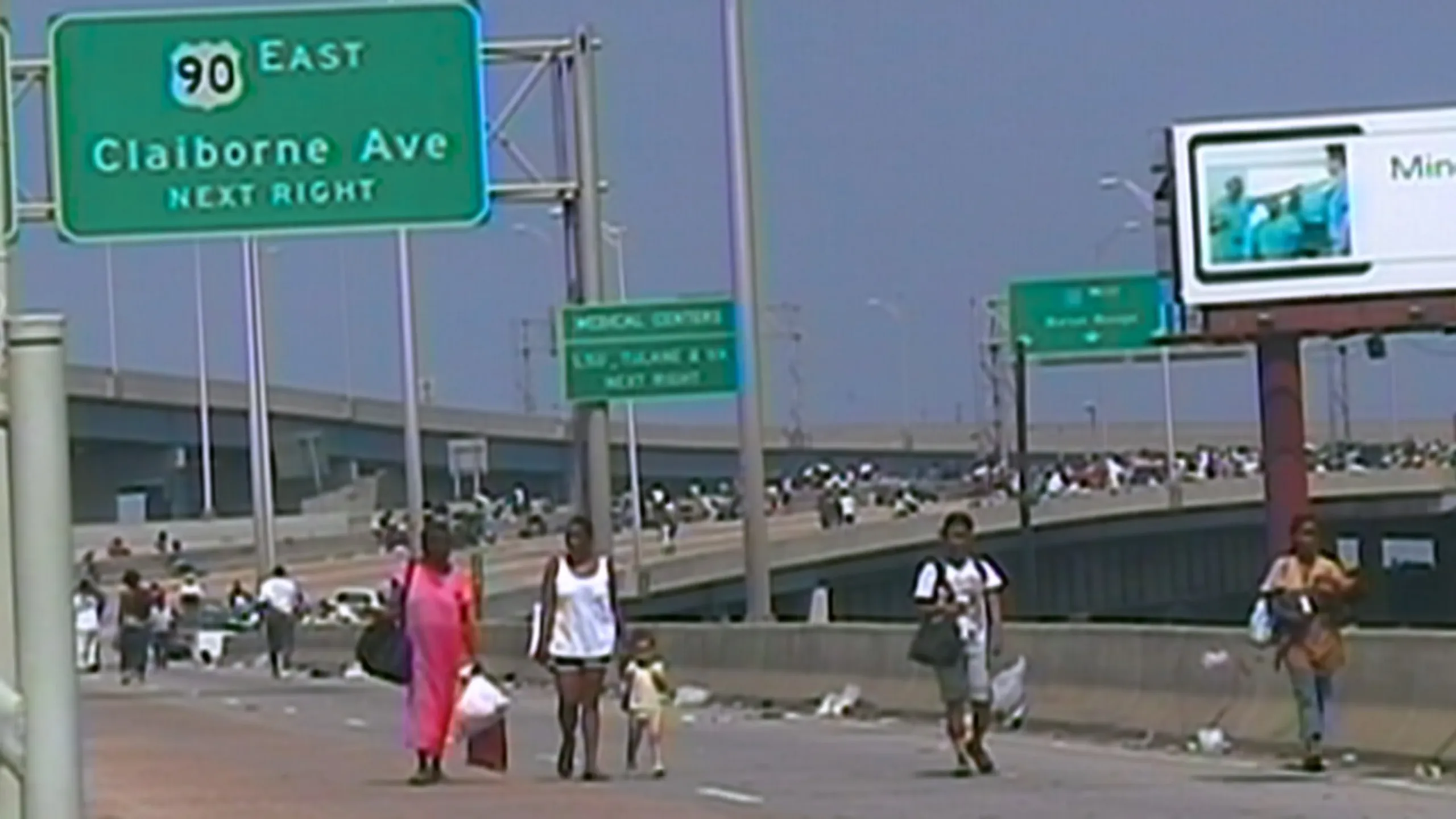
The levees did not just overflow; they breached and collapsed, a direct result of flawed design, poor materials, and decades of prioritizing shipping channels like the Mississippi River-Gulf Outlet over the coastal wetlands that once served as natural storm buffers.
The documentary makes it plain that this specific failure was not unforeseen; it points to a research simulation one year prior that predicted a similar outcome with alarming accuracy. The lessons were documented, then apparently ignored. The narrative then shifts from the physical collapse of concrete and earth to the institutional collapse of government.
The series portrays the official response as a state of near-total paralysis, a breakdown in communication that cascaded from the federal level down to the state and local. Viewers will not find new interviews with high-ranking officials like Mayor Ray Nagin or FEMA Director Michael Brown.
Their absence is a pointed narrative choice. The series refuses to give them a platform to re-litigate their actions, keeping the camera’s focus squarely on the consequences of their inaction. The story of bureaucratic incompetence is told instead by those who witnessed it from within: a lone, frustrated FEMA employee whose emails pleading for help went unanswered; a city spokesperson whose press conferences delivered information that often contradicted the reality on the ground. The series chronicles specific examples of systemic breakdown, from the agonizingly slow deployment of aid to the organizational chaos that left citizens stranded on rooftops for days in the summer heat.
This account is explicitly tied to the city’s social fabric. The documentary connects the disaster’s immense scale to the pre-existing racial and economic divides of New Orleans. Before the storm, the city’s population was 67% Black, and the poverty rate among Black residents was 38%.
The areas that suffered the most catastrophic flooding, such as the Lower Ninth Ward, were more than 90% Black, a direct result of historical segregation. The narrative shows how the inability to evacuate was directly linked to poverty; nearly 40% of the city’s poor Black residents did not have access to a car.
The victims who died were disproportionately Black, accounting for nearly half of all fatalities in Louisiana. The conditions at the Superdome and Convention Center, which became squalid shelters of last resort, were a direct manifestation of this systemic neglect. The story becomes one of who was left behind, making clear that the tragedy’s shape and scope were dictated by class and race long before the storm ever formed.
The Role of the Image: Media, Misinformation, and Memory
The series presents a complex and critical view of how the crisis was documented, creating a visual and ethical dialogue between two forms of media. On one side is the personal footage of community and survival. On the other are the mainstream news reports that quickly fixated on sensationalized accounts of crime and violence. The documentary dissects the language used, showing how television news described Black survivors “looting” grocery stores while white survivors were “finding” supplies.

It argues that these narratives, particularly those centered on the Superdome and Convention Center, were not just inaccurate; they were dangerous. They constructed a false story of rampant lawlessness that recast victims as threats. This perception justified a militarized response when a humanitarian one was required, delaying rescue efforts and creating an atmosphere of fear. The people needing rescue were instead depicted as a mob to be controlled.
Its primary visual style reinforces this theme with deliberate technical choices. The editors constantly cut between the raw, unsteady video from 2005 and pristine, high-definition interviews with the same individuals today. The sound design amplifies the effect; the chaotic, wind-battered audio of the past gives way to the crisp, quiet sound of the present-day testimony.
This technique produces a sense of temporal dislocation, highlighting the vast psychological distance between the traumatic event and the modern effort to process it. The pacing of the edit is also critical, using rapid cuts to convey anxiety and long, lingering shots on a survivor’s face to allow emotional gravity to settle. While the series effectively uses maps to illustrate the flood patterns, its deeper analysis of the city’s socioeconomic geography arrives late.
A viewer unfamiliar with New Orleans might have benefited from this context earlier. Without understanding the map—both physical and social—the individual stories risk feeling like isolated anecdotes rather than pieces of a single, city-wide systemic failure. Knowing the proximity of the breached Industrial Canal to the Lower Ninth Ward is vital information that could have better grounded the opening episodes.
A Warning for Today: The Unlearned Lessons of Katrina
The documentary’s final argument is that Katrina was not an isolated event but a grim precedent, a full-dress rehearsal for future American disasters. Malik Rahim’s observation that New Orleans was “the canary in the American coal mine” serves as the series’ thematic anchor.

The film explicitly links the governmental failures of 2005 to more recent crises, suggesting a national pattern of unpreparedness and inequitable response in the face of growing climate threats. The story of Katrina is presented as a warning that has yet to be fully heeded, suggesting that the systems that failed in 2005 remain largely unchanged. It raises the question of whether disaster response has become more equitable or if the same patterns of neglect simply reappear with different geography.
This idea is reinforced by the depiction of the city’s long-term aftermath. The final episode documents an uneven recovery, painting a “tale of two cities.” It contrasts the restored, economically vibrant, and often whiter sections of New Orleans with the neighborhoods that remain scarred.
We see shots of empty, overgrown lots that serve as silent memorials for houses and lives that never returned. The statistics are stark: a decade after the storm, the city’s Black population had decreased by almost 100,000, while its white population had returned to near pre-Katrina levels.
This visual and statistical evidence makes a quiet but firm statement about who was able to come back and who was priced out or left behind by the recovery. The series offers no simple solutions. Its purpose is to be a passionate, detailed reminder of a specific American tragedy—a lethal mix of storm, failed infrastructure, and official neglect. In an era defined by short attention spans, this five-hour commitment to detail is itself an act of resistance. It insists that memory is a civic duty and that forgetting is a form of complicity.
Hurricane Katrina: Race Against Time premieres on National Geographic on July 27, 2025, with the first three episodes airing back-to-back. All five episodes will be available to stream on Disney+ and Hulu on July 28, 2025.
Full Credits
Director: Traci A. Curry
Producers: Simon Chinn, Jonathan Chinn, Myles Estey, Ted Skillman, Ryan Coogler, Zinzi Coogler, Sev Ohanian, Peter Nicks, Kalia King, Sean David Johnson, Carolyn Payne, Kelli Buchanan
Executive Producers: Simon Chinn, Jonathan Chinn, Myles Estey, Ted Skillman, Ryan Coogler, Zinzi Coogler, Sev Ohanian, Peter Nicks, Kalia King, Sean David Johnson, Carolyn Payne, Kelli Buchanan
Cast: Shelton Alexander, Lynette Boutte, Lucrece Phillips, Joe Fincher, Ivor van Heerdan
The Review
Hurricane Katrina: Race Against Time
Hurricane Katrina: Race Against Time is a masterful work of archival storytelling. By centering the raw, personal footage of survivors, it constructs an intimate and damning account of systemic failure. While its geographic explanations could have arrived sooner, the series powerfully argues that the true disaster was man-made, delivering a vital, difficult-to-watch chronicle of a national tragedy whose lessons remain urgent. It stands as an essential piece of historical memory, insisting that what happened must not be forgotten.
PROS
- Employs raw, previously unseen survivor footage to create a visceral and authentic narrative.
- Focuses on personal testimonies, giving the story a powerful emotional foundation.
- Clearly dissects the multiple layers of failure, from engineering flaws to governmental paralysis.
- Effectively argues for the storm's contemporary relevance as a warning about systemic inequality and disaster preparedness.
CONS
- Key geographic and socioeconomic context about New Orleans is presented late in the series, potentially lessening the impact of the opening episodes for some viewers.