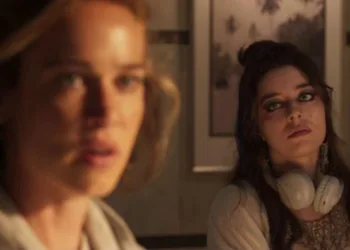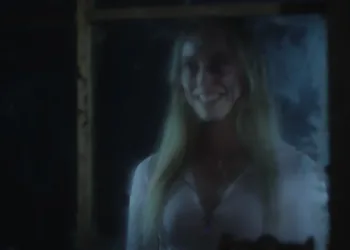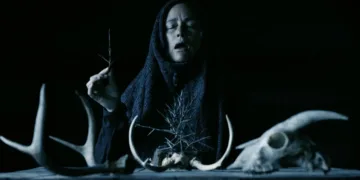


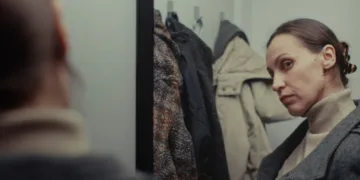













When medicine reaches its limit, where does one turn? This question, once the domain of saints and charlatans, now fuels a billion-dollar wellness industry and a deep societal schism. Mother of Flies posits a darker answer. We meet Mickey, a young woman for whom a cancer diagnosis has become a death sentence, the promises of science having evaporated.
Her last resort is not a sterile clinic but a primordial forest in the Catskills, a place reached only after leaving the highway and its flimsy reassurances behind. She is ferried there by her father, Jake, a man whose love is matched only by his profound skepticism. Their destination is Solveig, a witch—or healer, or something else entirely—who promises a cure.
The film quickly establishes its grim fairytale logic; this is a story steeped in the raw desperation of family sickness, where any hope offered, no matter how suspect, feels like air to the drowning. The transaction feels wrong from the start, a sense that the price for this reprieve will be paid in a currency other than money.
A Biome of One’s Own
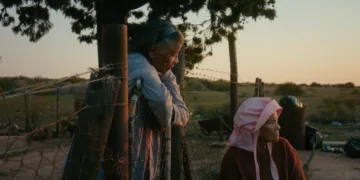
The film’s setting is a character in its own right, a pantheistic entity of immense power and indifference. This is not the welcoming, transcendentalist nature of Thoreau’s Walden; this is the Black Forest of the Brothers Grimm, a place of ancient rules and deep shadows where humanity is an intruder.
The cinematography weaponizes this environment, consistently creating a voyeuristic unease by shooting the characters through a screen of leaves, tangled branches, and glistening spiderwebs. It creates a kind of sylvan panopticon, a sense of being perpetually watched by a non-human intelligence, inducing a claustrophobia in the open air.
Solveig’s home is the heart of this dominion, a masterpiece of what could be called biological architecture. It seems less built and more grown, a knot of wood, moss, and bark that functions as an extension of Solveig’s will. This is a space that lives and breathes with its occupant. This oppressive visual atmosphere is magnified by the soundscape.
The incessant, chitinous buzz of flies—a direct nod to the film’s title and its demonic namesake—is not just background noise; it is a psychological irritant, a constant reminder of decay. The removal of all modern sound creates a sensory vacuum, making the characters more vulnerable to the potent suggestions of the witch and the woods.
Three Faces of Affliction
At the center of this world are three figures locked in a grim orbit, each representing a different facet of the central affliction. Toby Poser’s performance as Solveig is the film’s mesmerizing anchor. She projects a chilling authority, at once a regal queen of her domain and a feral creature of the soil.
The power she wields is left deliberately ambiguous—is it folk magic, potent psycho-pharmacology, or pure psychological manipulation? Her vocal delivery is key, especially when reciting her philosophies in rhyming couplets, a technique that recalls ancient oral traditions and incantations, positioning her as a figure outside of linear time.
Opposing her is John Adams as Jake, a man who stands as a monument to the impotence of modern rationality. He is the archetypal father whose tools—logic, money, anger—are utterly useless here. His journey is a deconstruction of patriarchal protection, his skepticism slowly eroding into a primal, helpless terror.
The early, sometimes stilted interactions with his daughter Mickey only serve to highlight their emotional gulf, a distance that is violently closed when the crisis forces them into a messier, more visceral intimacy. Caught between them, Zelda Adams gives Mickey a devastatingly quiet strength.
Her choice to submit is a profound rejection of the Enlightenment for something far older. Her performance captures the internal war between hope and horror, a battle made manifest on her own ailing flesh.
The Cure Is the Disease
The film’s first half builds atmospheric dread; the second plunges into the abattoir. The folk horror elements give way to a full-throated body horror that treats the human form as a rebellious, fluid, and ultimately horrifying vessel.
The on-screen grotesqueries are a masterclass in abjection, a breakdown of the sacred boundaries between the body’s inside and outside. Solveig’s methods are violent, and the practical effects are gruesomely authentic—a symphony of blood, viscous slime, and other bodily effluvia rendered with stomach-churning verisimilitude.
Her primary instrument, a simple thistle branch, becomes an object of profound menace, used to perform what might be termed ontological surgery on her patient. This physical horror is not an empty shock. It is a direct interrogation of sickness, making the subtext of many medical dramas literal: the cure can be as brutal as the disease.
The hard-rock score from H6llb6nd6r is used like a weapon, short, percussive assaults that slice through the organic soundscape to mirror the violations on screen. Mother of Flies uses its supernatural framework to explore the real terror of watching a loved one disappear into their illness, and it suggests that sometimes the price of survival is a complete loss of self.
“Mother of Flies” is the latest supernatural horror film from the filmmaking trio of John Adams, Toby Poser, and their daughter Zelda Adams. This independent feature, also known as the Adams Family, premiered on July 24, 2025, at the Fantasia International Film Festival. It was acquired by Shudder and is expected to stream exclusively on the platform in 2026. The film has garnered critical acclaim, winning the Cheval Noir Award for Best Film at the Fantasia International Film Festival, making it the first US feature to do so in the festival’s history.
Full Credits
Directors: John Adams, Zelda Adams, Toby Poser
Writers: John Adams, Zelda Adams, Toby Poser
Producers: Toby Poser
Cast: John Adams, Lulu Adams, Zelda Adams, Toby Poser
Editors: John Adams, Zelda Adams, Toby Poser
Composer: John Adams, Zelda Adams, Toby Poser
The Review
Mother Of Flies
A potent and deeply unsettling folk-horror fable, Mother of Flies is a masterclass in atmospheric dread. Anchored by a magnetic, terrifying performance from Toby Poser and unflinching body horror, the film uses its supernatural framework to ask profound questions about sickness, desperation, and the brutal nature of a cure. While its deliberate pace may test some, its thematic weight and visceral power are undeniable, crafting a grim fairytale that lingers long after the credits.
PROS
- A hypnotic and unsettling atmosphere that fully immerses the viewer.
- Toby Poser's commanding, career-best performance as the witch Solveig.
- Stunning production design and expert use of natural forest locations.
- Genuinely disturbing practical horror effects that serve the story.
- A thought-provoking and mature exploration of illness and familial desperation.
CONS
- The deliberate, meditative pacing might feel slow for some viewers.
- Some early dialogue exchanges can feel slightly stilted or improvised.
- Its narrative is relatively straightforward, relying on execution over plot complexity.