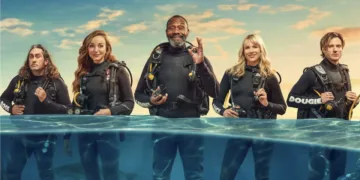





























When a show called Shark! Celebrity Infested Waters lands on the schedule, you steel yourself for the inevitable. The title screams reality TV at its most formulaic: take a handful of familiar faces, drop them into a manufactured high-stakes scenario, and watch the contrived drama unfold.
The premise does little to challenge this notion, flying seven British stars to the Bahamas for the explicit purpose of confronting one of the ocean’s most feared predators. It feels like a concept fished from the bottom of a commissioning editor’s barrel.
But this show pulls off a remarkable bait-and-switch. Timed to coincide with the 50th anniversary of Jaws, its true mission is not to exploit our fear of sharks but to dismantle the very cultural legacy that the film cemented. This is not another series about punishing celebrities; it is a surprisingly thoughtful attempt at rehabilitating the image of a creature long cast as a villain.
A Character Study at 20 Metres
The architecture of any good story rests on its characters, and the producers here have assembled a cast that functions as a fascinating cross-section of human psychology when faced with primal fear. This is less a group of contestants and more an ensemble of avatars for the audience.
The show finds its undeniable emotional spine in actor Helen George. Her fear is not a simple, telegenic phobia of sharks; it is a profound and debilitating terror of water itself, born from a childhood trauma. The cameras capture her struggle with an unflinching but respectful gaze, documenting panic attacks and moments of sheer refusal.
Her journey becomes the central narrative thread, a compelling arc of recovery that feels entirely genuine. It’s a classic narrative of overcoming a foundational wound, but its presentation avoids cheap sentimentality. We are not just watching someone learn to swim with sharks; we are watching someone reclaim a part of their life.
In stark contrast stands comedian Ross Noble, whose excitement for the adrenaline rush positions him as the group’s thrill-seeker. He and fellow comedian Sir Lenny Henry provide necessary comic relief, but their humour serves a structural purpose beyond one-liners about becoming shark-bait. It acts as a pressure valve, diffusing the intense anxiety generated by George’s struggles and making the intimidating environment more accessible.
Their jokes ground the extraordinary situation in a relatable, very British gallows humour. Then there is the surprising “gung-ho” attitude of Rachel Riley, who throws herself into the challenges with an energy that borders on alarming, her arms waving with joy during a feeding. Her fearlessness provides another key point on the spectrum of reaction.
Perhaps the most thoughtful character perspective comes from Paralympian Ade Adepitan. The show intelligently documents the unique physical logistics he faces without being intrusive. His narrative is not about overcoming disability; it is about discovering a new kind of ability.
The weightlessness he finds underwater is presented as a form of liberation, a beautiful counterpoint to the fear driving others. The cinematography in his scenes often emphasizes a graceful freedom of movement, providing some of the show’s most poignant visuals.
The cast is rounded out by the conservation-minded musician Dougie Poynter and actor Lucy Punch, who initially describes sharks as “savage tubes of teeth.” Their gradual conversion from sceptics to advocates demonstrates the show’s persuasive power. The decision to cast these particular celebrities—actors and presenters rather than reality TV regulars—is a deliberate one, lending the entire enterprise a credibility that a different lineup would have lacked.
The Conservation Mission in Disguise
The show’s most clever structural decision is how it uses the celebrity drama as a Trojan horse for its real payload: a powerful conservation message. This series is a nature documentary operating under deep cover, and it executes its mission with remarkable skill.

The editing weaves scientific information so seamlessly into the human story that it never feels like a lecture. One moment we are focused on Helen George’s breathing exercises; the next, we are learning about the bull shark’s bite force or the ecological importance of mangrove forests as shark nurseries. This delicate balance is the work of a production team that understands that education is most effective when it is embedded in a compelling narrative.
This educational mission is embodied by the three experts. While Dr Tristan Guttridge and Danni Washington provide the calm scientific context, it is Australian ex-military diver Paul de Gelder who serves as the show’s moral compass. His introduction is a piece of narrative genius. He appears before the celebrities as a friendly, capable guide, only to then reveal that his missing arm and leg were the result of a bull shark attack. The stunned silence that follows is palpable.
In any other show, this would be the setup for a revenge story or a cautionary tale. Here, it becomes the opposite. De Gelder’s subsequent dedication to protecting the species that attacked him is an astounding subversion of audience expectation. His story single-handedly reframes the entire series, moving it from a conversation about human fear to one about animal preservation.
It’s a testament to the power of a personal story to convey a complex message more effectively than any chart or statistic. The show repeatedly reinforces this message: humans kill millions of sharks a year, while sharks are responsible for a handful of human fatalities. The real monsters, the series quietly suggests, are not the ones with fins.
From Metal Cage to Open-Water Catharsis
The series is structured as a deliberate, five-part pilgrimage, an underwater rite of passage engineered for maximum emotional and visual impact. Each episode marks a new stage in the journey from fear to respect. The technical execution of these set pieces is where the show truly shines. The opening challenge, a descent into a metal cage surrounded by bull sharks, is a masterclass in tension.

The claustrophobic framing from within the cage, combined with the diegetic sound of panicked breathing through the full-face masks, immerses the viewer completely in the participants’ anxiety. The camera work here is all about confinement and the terrifying proximity of the unknown.
From there, the narrative carefully broadens. A sequence involving wading with juvenile lemon sharks in a mangrove forest shifts the tone from terror to tentative curiosity. The moment a small shark gives Ross Noble an “exploratory bite” on the ankle is handled perfectly. It’s a “teaching moment,” as Dr Guttridge dryly calls it, that acknowledges the animals’ wildness without resorting to sensationalism.
It reinforces the show’s honest approach. The visual language evolves with the cast’s confidence. The cramped, shaky shots of the cage dive give way to more stable, wider shots as they dive with dozens of nurse sharks in the open. The turning point is clear.
The entire series builds towards the finale: a cage-free swim with formidable tiger sharks. The cinematography in this final act is magnificent. The producers use slow-motion and a soaring musical score not for melodrama, but to evoke a sense of genuine awe. Wide, majestic shots show the celebrities as small figures swimming peacefully alongside these giant, powerful creatures. The visual storytelling completes the arc that began in the confines of the cage.
The journey from looking out through bars to swimming freely beside the object of fear is a powerful metaphor for the internal transformation we have witnessed. It’s a reminder, much like my own first time snorkelling over a reef, that the world beneath the waves operates on a scale and logic entirely its own, and that fear often dissolves into wonder when you finally take the plunge.
Shark! Celebrity Infested Waters premiered on Monday, July 14, 2025, at 9 PM on ITV1. All five episodes of the series are also available to stream on ITVX.
Full Credits
Director: Mike Judge
Producers: Plimsoll Productions, Iain Thompson (Showrunner)
Executive Producers: Andrea Jackson, Karen Plumb, James Smith, Alan Eyres, Grant Mansfield
Cast: Sir Lenny Henry, Rachel Riley, Dougie Poynter, Lucy Punch, Helen George, Ade Adepitan, Ross Noble
The Review
Shark! Celebrity Infested Waters
Shark! Celebrity Infested Waters masterfully uses its sensationalist premise as a Trojan horse for a thoughtful, compelling documentary on conservation. What begins as a seemingly typical celebrity challenge evolves into a surprisingly moving examination of fear and a powerful plea for one of the ocean's most misunderstood creatures. Anchored by authentic human drama and stunning cinematography, the series succeeds by trading cheap thrills for genuine awe. It’s reality television with a rare and welcome conscience.
PROS
- Intelligently subverts the familiar celebrity reality show format.
- Delivers a strong, effective conservation and educational message.
- Features a genuine and powerful emotional arc, especially from Helen George.
- The personal story of expert Paul de Gelder provides a profound moral anchor.
- Beautiful underwater cinematography captures both tension and awe.
- The cast feels authentic and well-suited for the show's mission.
CONS
- The sensationalist title may mislead viewers or deter its ideal audience.
- Pacing can feel slow for those expecting constant high-stakes action.
- Some repetitive reality TV tropes, like jokes about firing agents, are present.
- The core premise can still feel slightly contrived at moments.