





























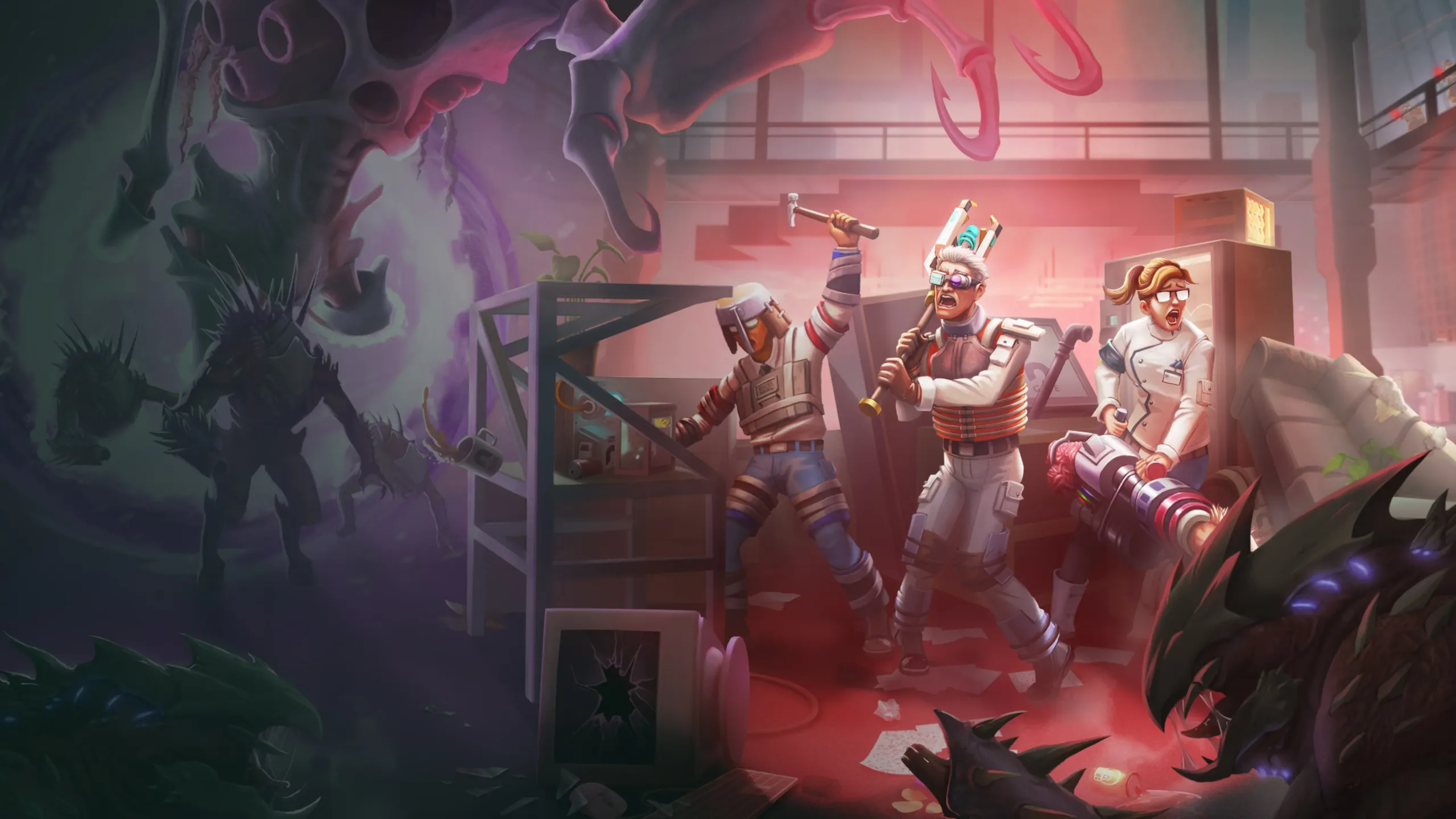

Your first day at the GATE research facility begins with the beige mundanity of corporate orientation and ends in a cross-dimensional cataclysm. This is the premise of Abiotic Factor, a game that functions as a playable archive of a specific 1990s PC gaming culture.
The immediate point of reference is Half-Life, with its cascading disaster in a subterranean lab. Yet, this is not a simple homage. It re-contextualizes that moment of sci-fi terror through the modern lens of the survival-crafting genre. The goal is escape, but the method is pure scientific improvisation. You are not a trained security guard or a silent protagonist of destiny; you are a scientist, armed with a PhD and little else.
The experience is built for collaboration, casting you and your friends as a team of nerds attempting to puzzle your way out of a situation that has spiraled far beyond anyone’s control. The tone oscillates between genuine horror and a satirical critique of workplace bureaucracy, creating a distinct narrative space.
Simulating the Mundane
The game’s survival systems extend a Western design philosophy that seeks to quantify and gamify every aspect of human life. Beyond the expected meters for hunger, thirst, and stamina, the game demands you manage your character’s toilet needs. Ignoring this call of nature has tangible, embarrassing consequences, creating a humbling rhythm of biological urgency.
Sleep is not a simple fade-to-black but a surreal 2D platforming minigame set within your scientist’s dreams, where skillful navigation translates into a more restful state. This hyper-simulationist approach, where even basic bodily functions become interactive systems, contrasts sharply with the more abstract survival mechanics seen in many Japanese-developed games, which often favor thematic representation over literal simulation.
Here, the body is treated as just another machine to be maintained and optimized. The game, however, offers a counterpoint to this cold calculus by rewarding “thriving.” Simple comforts like sitting on a sofa to pause fatigue, warming yourself by a heater to speed healing, or drinking coffee for cold resistance provide real benefits. This aligns the gameplay loop with a gamified version of Maslow’s hierarchy: once base physiological needs are met, the game’s systems push you toward securing safety and psychological comfort.
This philosophy of quantification is central to its character creation. After selecting a profession for starting skill bonuses, you engage in a delicate balancing act with the traits system. Gaining powerful positive traits, such as “Buff Brainiac” for increased carry weight, requires accepting debilitating negative ones like “Narcolepsy,” which can cause your character to fall asleep at perilous moments, or “Weak Bladder,” which makes bathroom breaks a constant tactical consideration.
These are not minor debuffs; they fundamentally shape your playstyle and create personal narratives of adaptation. A narcoleptic scientist might learn to adventure while seated in a rolling office chair to stave off exhaustion, a solution born of desperation and ingenuity.
Progression is handled through a “learn-by-doing” model, where skills improve through use. This system, rooted in a lineage of Western RPGs, frames mastery as an earned consequence of action, a direct reflection of the game’s celebration of practical knowledge and hands-on problem-solving.
Bricolage as Liberation
The crafting in Abiotic Factor is a masterclass in bricolage: the art of creation from a limited and unconventional set of materials. The scientists of GATE are modern bricoleurs, turning the debris of a corporate office into tools of survival. This practice mirrors the post-apocalyptic inventiveness seen in films like Mad Max, but swaps the wasteland-punk aesthetic for a unique brand of cubicle-punk.

Early weapons are assembled from meter sticks, rubber bands, and pressure gauges; armor is fashioned from sofa cushions and office binders. The act of creation grounds you completely in the game’s central fantasy—that of a resourceful intellectual turning the mundane into the miraculous. The narrative of scientists thinking their way out of a disaster finds its perfect mechanical expression in this system.
Discovering a new object sparks an “idea,” which then unlocks a simple minigame where you mentally connect the components to forge a new recipe. Though mechanically trivial, this sequence brilliantly externalizes the “Eureka!” moment, making you an active participant in the process of invention.
The system’s real genius lies in its technological progression, which forms the game’s core loop. Makeshift tools eventually give way to laser turrets, goo launchers, and electromagnetic crossbows. The game intentionally makes conventional firearms rare and difficult to use, with scarce ammunition and characters who are initially inept at handling them.
This design is a powerful statement. It subverts the traditional power fantasy of the American action game, where problems are solved with superior firepower. Here, the standard tools of conflict are largely ineffective. True power comes from understanding systems, experimenting with alien materials, and creating novel solutions.
This focus elevates crafting from a simple resource sink to the game’s primary mode of interaction and expression. You are not just building tools; you are enacting a philosophy where intellect triumphs over brute force, a message made manifest with every strange and wonderful gadget you create.
Hostile Takeover: Building a Home in the Ruins
Base building here is not about colonizing a pristine wilderness, but about reclaiming and repurposing a failed institution. You construct your shelter within the existing, handcrafted architecture of the GATE facility, turning sterile cafeterias and labs into fortified, livable spaces. This framework of creative constraint produces fascinating results.

The process evokes the iconography of the zombie apocalypse film, particularly George A. Romero’s Dawn of the Dead, where survivors find refuge in a shopping mall. Both scenarios are a commentary on finding sanctuary within the very temples of the system that has failed. The act of fortifying a corporate breakroom against otherworldly horrors is laden with a unique thematic tension.
The game reinforces this with the ability to “flatpack” large furniture. Finding a working refrigerator or a vintage arcade cabinet, you can pack it up and relocate it to your base. This is not just logistics; it is an act of reclaiming the symbols of corporate life and rearranging them to serve fundamental human needs for safety and comfort.
This process of domesticating the institutional space is more than cosmetic. The game mechanically rewards your efforts to create a comfortable home. Personalizing your base with found items—dog photos, motivational posters, souvenir mugs—makes the space feel less like a bunker and more like a sanctuary.
This “cozy” factor provides tangible gameplay benefits, such as slowing fatigue, which brilliantly aligns the player’s intrinsic desire for self-expression with the character’s need for psychological stability. Your base becomes a living museum of your group’s journey through the catastrophe.
Each piece of furniture, each decorative trinket, is a relic from the old world, a story of a successful expedition. This act of curating your environment becomes a powerful narrative tool, a way of asserting human identity against the cold, impersonal backdrop of the facility, turning a sterile workspace into a meaningful home.
Mapping the Unknown
The GATE facility itself is a character in its own right, a sprawling entity built on the principles of 1990s level design. In an era before the dominance of the algorithmically generated open world, this space is meticulously handcrafted, full of deliberate choke points, hidden paths, and interlocking loops that reward spatial awareness.

Learning its layout—the maintenance tunnels, the tram system, the security checkpoints—is a key part of the experience. The environment is not static. A strict day/night cycle, tied to the narrative fiction of the facility’s failing power grid, transforms the world at 9 PM.
Lights go out, powered crafting stations cease to function, and more dangerous security bots begin their patrols. By day, you are a scavenger, cautiously pushing into new territory. By night, you are prey, hunkered down in your base or making a desperate, darkened run for resources. This creates a compelling rhythm of risk and reward that dictates the flow of the game.
To prevent the concrete hallways from becoming oppressive, the game offers escape through portals to other dimensions. These journeys function as self-contained short stories or episodes in an anthology series like The Twilight Zone. Each portal offers a dramatic shift in genre and aesthetic.
One may lead to Flathill, a quiet suburban neighborhood blanketed in an eerie twilight and haunted by a colossal, silent monster, transforming the experience into pure survival horror reminiscent of American cinematic surrealism. Another drops you onto a runaway train locked in a perpetual loop, a high-concept action sequence that tests your combat and crafting skills under immense pressure.
These worlds serve a critical gameplay function, offering unique and replenishing resources unavailable in the main facility. They also demonstrate a sophisticated awareness of different storytelling tropes, allowing the game to explore a range of speculative fictions while gradually revealing the larger secrets behind GATE’s disastrous experiments.
Imperfect Instruments
The combat in Abiotic Factor feels, by all accounts, unrefined. Melee weapons connect with a soft, unsatisfying thud. Early-game enemies can feel remarkably spongy, absorbing numerous blows before falling. Hit detection can be inconsistent, particularly during online co-op sessions.

For a game that draws so much inspiration from a landmark first-person shooter, this could be seen as a glaring flaw. However, it is more accurately interpreted as a bold and intentional design choice. The awkwardness of the combat is precisely the point. The scientists of GATE are not trained soldiers; they are academics and researchers forced into a violent new reality.
The game makes you feel this disconnect. You feel like a physicist ineptly swinging a pipe, not a grizzled space marine. This mechanical-narrative synergy, where a gameplay “weakness” perfectly reinforces the character fantasy, is exceptionally rare. It is a confident rejection of the effortless power fantasy that defines so many games, opting instead for a fantasy of vulnerability and earned ingenuity.
The enemies you face are symbolic of the forces arrayed against you. The facility’s own security bots and, later, heavily armed military cleaners represent the cold, oppressive logic of the institution turned against its creators—a classic Frankensteinian theme. They are the methodical, predictable threat.
The alien creatures that pour from the portals are the opposite: they are the Lovecraftian “other,” the chaotic, incomprehensible horror that erupts when science pushes beyond its ethical boundaries. As a player, you are caught between these two existential threats: the rigid, deadly order of the human-made system and the terrifying, deadly chaos from beyond. This frames the central conflict not just as a struggle for survival, but as a fight waged on both a political and an existential plane.
The Review
Abiotic Factor
Abiotic Factor is a brilliant subversion of the survival genre, prioritizing intellectual ingenuity over brute force. Its deep crafting and simulation systems, combined with a sharp satirical wit, create a distinct and memorable identity. While its deliberately clumsy combat masterfully serves the narrative of scientists in peril, it may not satisfy all players. It stands as a smart, funny, and unforgettable co-op adventure that rewards creativity and thoughtful collaboration.
PROS
- Gameplay loop centers on intelligent crafting and problem-solving.
- Strong synergy between game mechanics and the narrative of being a scientist.
- Unique base-building system within pre-existing corporate spaces.
- Deep simulation systems add layers of humor and challenge.
- Exceptional cooperative experience that encourages teamwork.
CONS
- Combat feels intentionally unrefined, which could frustrate some players.
- The niche 1990s PC aesthetic may not appeal to a wider audience.
- Complex survival systems can have a steep initial learning curve.