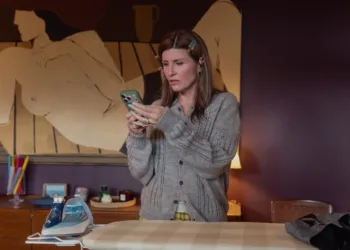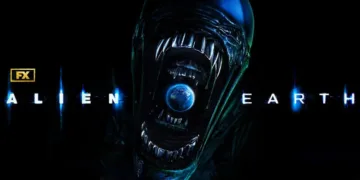






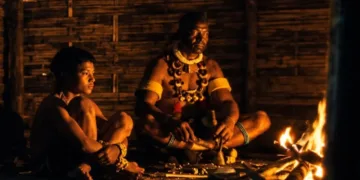



















The opening moments of Alien: Earth are a deliberate act of cinematic archaeology. We are back in the cold, functional corridors of a Weyland-Yutani vessel, the USCSS Maginot, watching a crew emerge from the stillness of cryosleep. This scene is a powerful signifier, a direct line to the 1979 film that codified a certain type of Western industrial dread. Yet, this familiarity is a feint.
The show quickly abandons the void of space for the dense, stratified society of a near-future Earth, where corporations have replaced nations. When the Maginot and its menagerie of horrors crash-land in the Southeast Asian territory of New Siam, the franchise’s core terror is transplanted into a new cultural ecosystem.
This external threat arrives almost simultaneously with an internal one: the corporation Prodigy has perfected “hybrids,” synthetic bodies implanted with the consciousness of terminally ill children. The series immediately establishes its dual concerns—the classic fear of the unknown alien and the modern anxiety of the technologically redefined human. It frames an exploration of monstrosity as something that arrives from the stars and something we build in our own labs.
The Ghosts in the Upgraded Machine
At its heart, Alien: Earth is a meditation on the nature of self, refracted through the Western literary archetype of Peter Pan yet engaged with thoroughly modern, global questions of bioethics. The protagonist, a former cancer patient named Marcy, is reborn into a powerful synthetic body and rechristens herself Wendy.
As played by Sydney Chandler, Wendy is a being of profound contradiction. Chandler’s performance masterfully captures the awkward physicality of a child’s mind piloting an adult form; her movements are filled with a restless, naive energy that stands in sharp contrast to her enhanced capabilities. She leads a group of fellow hybrids, the “Lost Boys,” a diverse cast of young minds played by actors like India’s Adarsh Gourav and Britain’s Jonathan Ajayi.
Their shared experience of being children trapped in manufactured bodies provides a poignant exploration of identity that transcends cultural specifics. The show places these new beings alongside more familiar forms of artificial life. Timothy Olyphant’s Kirsh is an older model of synthetic, a sardonic minder whose weary cynicism acts as a foil to the hybrids’ raw emotion.
His performance balances cold logic with a deep undercurrent of accumulated knowledge, hinting at a past that makes him wary of both his human creators and his new charges. Wendy’s human brother, Hermit (Alex Lawther), provides a relatable baseline of human feeling, his grief and confusion grounding the series’ high-concept questions in palpable emotion.
The show presents a full spectrum of being—from human to cyborg to synth to hybrid—to deeply question where consciousness resides and what moral lines are crossed when mortality becomes a problem to be solved by technology.
Capital and Carnage
The series presents two distinct forms of monstrosity: the biological horror of the alien and the psychological horror of the corporate titan. Samuel Blenkin’s Boy Kavalier is the founder of Prodigy and the story’s primary human antagonist. He is a stunningly repulsive figure, a globalized archetype of the tech mogul whose arrogance has festered into a god complex. He lounges barefoot in his sterile office, quotes J.M. Barrie to justify his actions, and views the world as his personal playset, an embodiment of innovation detached from morality.

Kavalier represents a very modern form of villainy, where capital and ego have erased all ethical lines, making him arguably more terrifying than the creatures he seeks to possess. In contrast stands Morrow (Babou Ceesay), a cyborg security officer from the crashed ship. He is a more traditional physical threat, a man whose fierce, programmed loyalty to his own corporation makes him a relentless and formidable force, a product of a rigid system.
The show’s alien menagerie is equally terrifying. While the classic Xenomorph is a menacing presence, it is joined by new creatures, including a parasitic, single-eyed organism that produces some of the season’s most visceral horror.
The violence is gory and unflinching, honoring the franchise’s body-horror roots. A powerful thematic link is drawn between the captured aliens and the experimental hybrids. Both are treated as assets, specimens to be studied and exploited by Kavalier’s insatiable corporate ambition, suggesting that in this world, all life, whether biological or artificial, is merely raw material for profit.
The Global Aesthetic of Decay
Noah Hawley’s series builds its world with a keen eye for cultural and aesthetic dialogue. The production design by Andy Nicholson contrasts the cold, sleek futurism of Prodigy’s facilities in New Siam with the grimy, analogue decay of the crashed Weyland-Yutani ship.
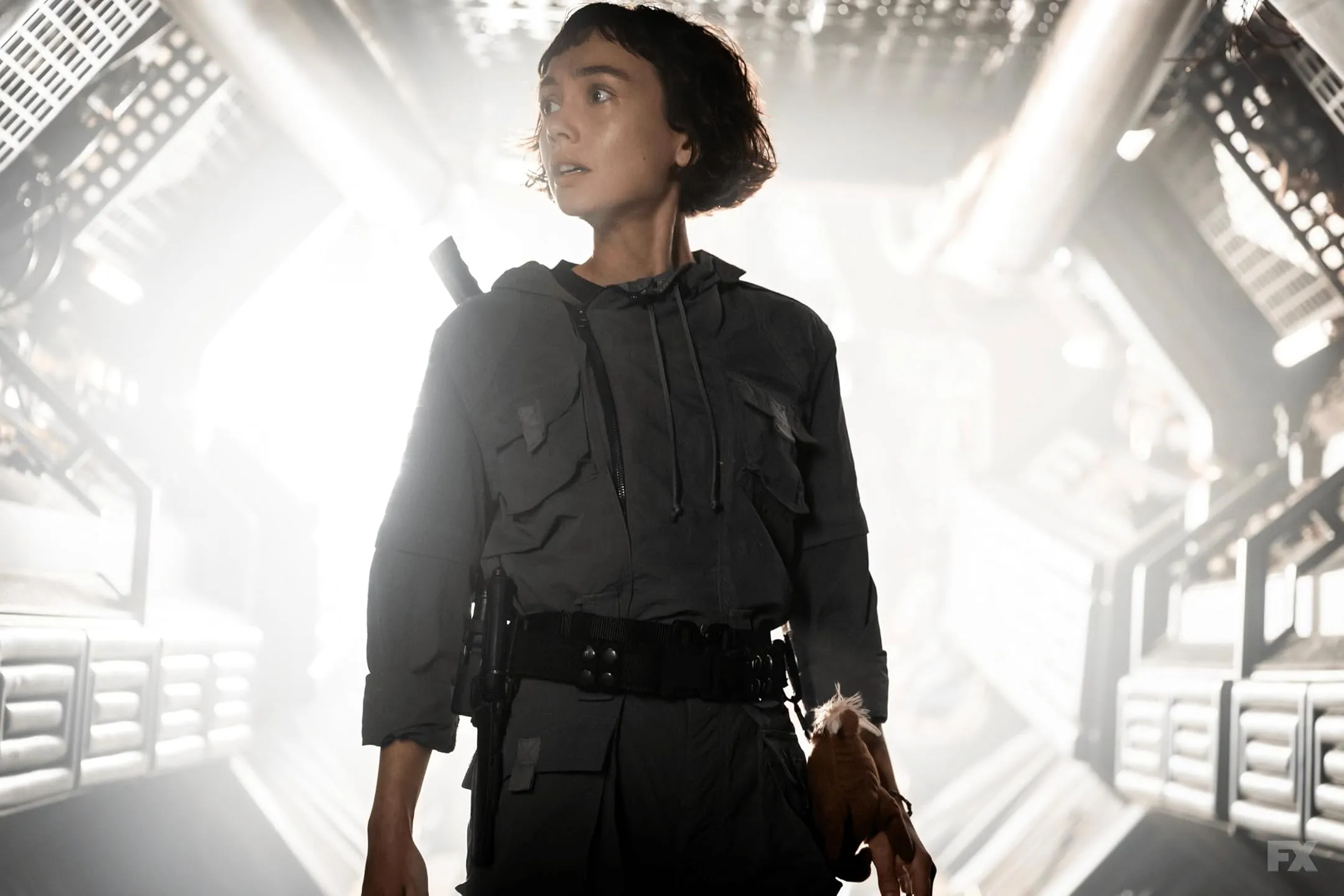
This visual juxtaposition speaks to a world where hyper-modernity is built atop the rusting foundation of the past, where gleaming towers cast long shadows over older ways of life. The setting, realized through production in Bangkok, provides a visual texture that moves beyond the typical Anglo-American sci-fi cityscape, incorporating a different architectural and cultural language into its vision of the future.
The direction reinforces this with a deliberate pace, using slow dissolves and carefully composed, often static, shots to build an atmosphere of eerie tension inside Prodigy, which then shatters during the chaotic, handheld feel of an alien attack.
The show’s sonic identity is similarly layered. Jeff Russo’s score often references the dissonant strings of Jerry Goldsmith’s work on the original film, a clear nod to its cinematic lineage. This is jarringly paired with loud, hard-rock needle drops from bands like Black Sabbath and Tool that punctuate the end of each episode.
This choice feels like a distinctly American directorial signature, an aggressive injection of sardonic energy that serves as a form of authorial commentary on the bleakness of the narrative. The series carefully balances its reverence for the original canon with a clear desire to tell its own story, using the established lore as a launchpad to explore the previously unseen social fabric of Earth itself.
An Ambitious, Imperfect Organism
Alien: Earth successfully merges the franchise’s creature-feature horror with a complex philosophical drama about posthuman identity. Its greatest strength is this ambition, using a foundational piece of American science fiction to interrogate contemporary global anxieties about corporate sovereignty and technological ethics.

This places it in conversation with other modern prestige series that recontextualize established properties for social commentary. The show is not without its flaws. The premiere is dense with exposition, and the initial episodes move at a pace that may test some viewers’ patience. With such a large and varied cast, some supporting characters, particularly the other crew members of the Maginot and certain Prodigy employees, feel more like plot devices than fully realized individuals, their arcs left underdeveloped.
The show’s central metaphor, drawing heavily on Peter Pan, can at times feel blunt. Its repeated vocalization by Kavalier removes much of the potential for subtle interpretation, spelling out its themes a bit too clearly. The final episodes accelerate the plot, and this hurried pacing leaves some narrative threads, especially those concerning the corporate rivalry with Weyland-Yutani, feeling unresolved.
The series is a bold and intellectually stimulating evolution of the Alien universe. It succeeds by understanding that true horror can be found in the monsters we meticulously design in our laboratories, not just in the ones that fall from the sky, a chilling reflection for our own technologically saturated age.
Full Credits
Director: Noah Hawley, Dana Gonzales, Ugla Hauksdóttir
Writers: Noah Hawley, Dan O’Bannon, Ronald Shusett, Bob DeLaurentis, Bobak Esfarjani, Lisa Long, Maria Melnik, Migizi Pensoneau
Producers: Noah Hawley, Ridley Scott, David W. Zucker, Joseph Iberti, Dana Gonzales, Clayton Krueger, Christine Lavaf, Chris Lowenstein, Darin McLeod, Maria Melnik, Migizi Pensoneau, Apinat ‘Obb’ Siricharoenjit
Executive Producers: Noah Hawley, Ridley Scott, David W. Zucker, Joseph Iberti, Dana Gonzales, Clayton Krueger
Cast: Sydney Chandler, Alex Lawther, Timothy Olyphant, Essie Davis, Samuel Blenkin, David Rysdahl, Erana James, Diêm Camille, Kit Young, Babou Ceesay, Adarsh Gourav, Moe Bar-El, Jonathan Ajayi, Sandra Yi Sencindiver, Dean Alexandrou, Andre Flynn, Enzo Cilenti, Lloyd Everitt, Amir Boutrous, Cameron Brown, Ron Smoorenburg, Bear Williams, Niko Tucci, Carlo Natale, Michael Smiley, Richa Moorjani, Karen Aldridge, Jamie Bisping, Max Rinehart, Andy Yu, Tom Moya, Victoria Masoma, Tanapoi Chuksrida
Director of Photography (Cinematographer): David Franco, Dana Gonzales, Colin Watkinson
Composer: Jeff Russo
The Review
Alien: Earth
Alien: Earth is a deeply ambitious and intellectually dense evolution of a classic franchise. It successfully trades the claustrophobia of space for the sprawling horror of corporate dystopia, anchored by superb world-building and compelling performances. While its bold ideas are sometimes hampered by uneven pacing and heavy-handed metaphors, the series remains a chilling, thought-provoking piece of science fiction that proves the deadliest monsters are often the ones we create ourselves.
PROS
- An ambitious premise that blends visceral horror with complex questions about consciousness and corporate power.
- Strong lead performances, especially from Sydney Chandler, Samuel Blenkin, and Timothy Olyphant.
- Stunning production design and world-building that creates a believable near-future Earth.
- Effective new creature designs that add to the franchise's lore without supplanting the original.
CONS
- The narrative pacing is inconsistent, with a slow start and a rushed final act.
- The central Peter Pan metaphor is often too blunt, lacking subtlety.
- Several supporting characters feel underdeveloped due to the large cast and scope.
- The initial episodes are heavy with exposition.