



























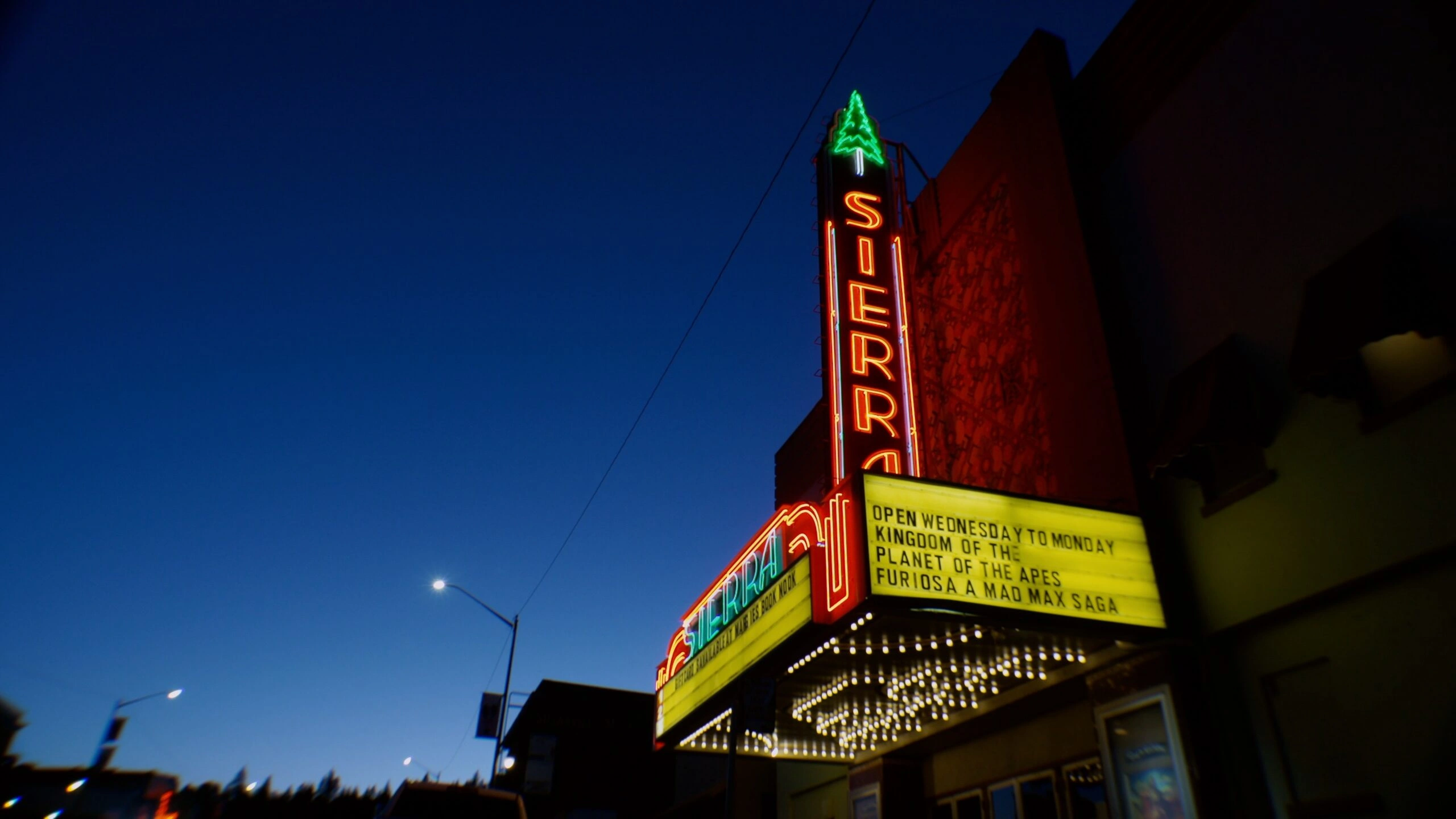

Ten states, 10,825 miles, 123 theaters. Those numbers give Rustin Thompson’s The Last Picture Shows its physical scale, yet the documentary becomes most revealing when it gets down to a single screen and the people trying to keep it illuminated.
Thompson’s 78-minute film travels through the American West documenting independent cinemas, drive-ins, abandoned buildings, and owners whose businesses often make little financial sense. The numbers supplied along the way are brutal. The United States had roughly 22,000 movie theaters in 1929. Fewer than 3,000 remain. Drive-ins have fallen from thousands to around 300.
Statistics can turn cultural decline into an abstraction. Thompson wisely keeps bringing the subject back to people. One owner nicknamed Tiny still works another full-time job while operating his theater. Asked why he bothers, he speaks about supporting the community that supports him. Another couple says their cinema lost roughly $100,000 in each of the previous two years. Their theaters keep opening anyway.
One Screen, One Community
The documentary becomes especially persuasive when Thompson explains what these buildings mean geographically. Ross Melnick, a film historian at UC Santa Barbara, discusses expanding “cinema deserts,” areas where the nearest screen might sit 10, 20, or 50 miles away. Lose a theater in one of these towns and residents lose a gathering place along with a place to watch movies.
The buildings carry that history visibly. The Ruby in Chelan, Washington has operated since 1914. Baker City’s Eltrym opened in 1940, its unusual name coming from “Myrtle” spelled backward in tribute to the original owner’s wife. The O.K. Theatre in Enterprise, Oregon began construction during the era of the 1918 influenza pandemic, then reached its centennial shortly before another pandemic arrived. History has a strange sense of timing.
Thompson also finds younger people participating in this culture. Fourteen-year-old Maverick, named after Top Gun, works a popcorn machine and talks eagerly about seeing movies with an audience. The moment avoids becoming sentimental because Thompson lets the kid work. There is no grand speech staged against a sunset. There is popcorn to make. That practical quality runs throughout the best interviews. These owners understand exactly how precarious their businesses are.
The Shazam Problem
The funniest recurring image in The Last Picture Shows might also be its clearest explanation of why independent exhibition struggles. Thompson repeatedly photographs marquees advertising Shazam! Fury of the Gods. The joke grows every time the title appears.

Owners describe studio booking arrangements that can require a movie to occupy their screen for two weeks. A multiplex can bury a weak performer in one auditorium and use the others for something else. A single-screen cinema cannot. If the film fails to attract the town, the theater spends those weeks showing rows of empty seats.
Thompson makes this piece of industry mechanics unusually easy to understand because he gives us the visual evidence first. We see Shazam appearing from town to town, then hear owners explain why they cannot simply replace it. The edit turns distribution policy into something tangible.
Technology created another expensive hurdle. The shift from film projection to digital equipment in the early 2010s could demand investments approaching $100,000 per projector. Then came COVID closures, with some owners describing shutdowns lasting around 72 weeks. These pressures accumulate inside businesses already operating on thin margins.
Barnyard Cinema in Winthrop, Washington offers a different model. Opened in 2016 after the town had gone decades without a cinema, the venue uses a single screen and leans toward independent and arthouse programming. Its existence suggests that local knowledge still has value, especially when standardized distribution practices treat every town as if it wants the same movie.
Neon Against Empty Highways
Thompson serves as cinematographer, and his strongest images explain why someone might become irrationally attached to these buildings. His camera repeatedly moves between enormous Western spaces and tiny theaters occupying them. Empty highways cut through fields. Main streets sit quiet at dusk. Then a marquee switches on, throwing colored light onto a nearly deserted block. The contrast gives the theaters their emotional scale. They are physically small and culturally enormous.
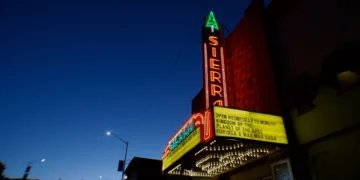
I especially like the nighttime photography because Thompson understands what neon does to an old cinema. During daylight, some of these buildings can look ordinary, tired, or barely functional. At night, names such as the Gem or Eltrym suddenly command the street. You can see why generations remembered them.
The acoustic roots soundtrack pushes those images toward elegy, sometimes too insistently. Around the middle, Thompson returns several times to empty roads, abandoned theaters, still photographs, and melancholy music. The repetition slows a film that runs only 78 minutes. Once an abandoned movie house has communicated absence, the fifth variation has less work left to do.
Clips from Peter Bogdanovich’s The Last Picture Show provide a sharper historical echo. Its dying Royal Theater was already tied to fears about television pulling audiences away from communal moviegoing. Decades later, the technology has changed while the anxiety remains recognizable.
The difference is that Thompson can point to people refusing to accept disappearance as inevitable. The owners of the Sierra have kept their original theater connected to the community through special screenings and events after opening a newer multiplex nearby. Barnyard Cinema appeared where no movie theater had existed for roughly 60 years. Maverick is still making popcorn. And somewhere on a quiet Western street, the marquee is still on.
The Last Picture Shows premiered at the Santa Barbara International Film Festival on February 9, 2026, and expanded to select independent theaters nationwide. The documentary explores the resilience and challenges of historic single-screen movie houses across small-town America.
Full Credits
Title: The Last Picture Shows
Distributor: Foghorn Features
Release date: February 9, 2026 (Santa Barbara International Film Festival)
Running time: 78 minutes
Director: Rustin Thompson
Writers: Rustin Thompson
Producers and Executive Producers: Rustin Thompson
Director of Photography (Cinematographer): Rustin Thompson
Editors: Rustin Thompson
The Review
The Last Picture Shows
Rustin Thompson finds his strongest argument in the people still switching on neon marquees when the economics tell them to stop. The Last Picture Shows turns booking restrictions, costly digital projection, pandemic closures, and the recurring indignity of Shazam! Fury of the Gods into a clear picture of how fragile independent exhibition has become. Thompson occasionally lingers too long on empty highways and abandoned buildings, yet his photography gives those spaces genuine weight. Barnyard Cinema, Maverick at the popcorn machine, and the owners operating at a loss keep the film from becoming a funeral.
PROS
- Beautiful nighttime theater photography
- Memorable independent cinema owners
- Sharp look at studio booking practices
- Strong sense of community and place
- Effective historical perspective
CONS
- Midsection becomes repetitive
- Melancholy montages occasionally feel padded
- Some arguments receive limited examination