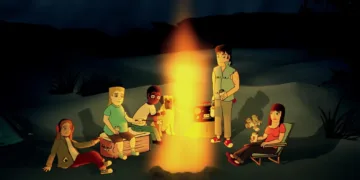





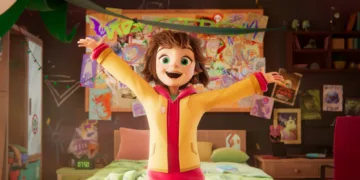

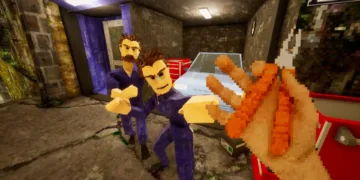
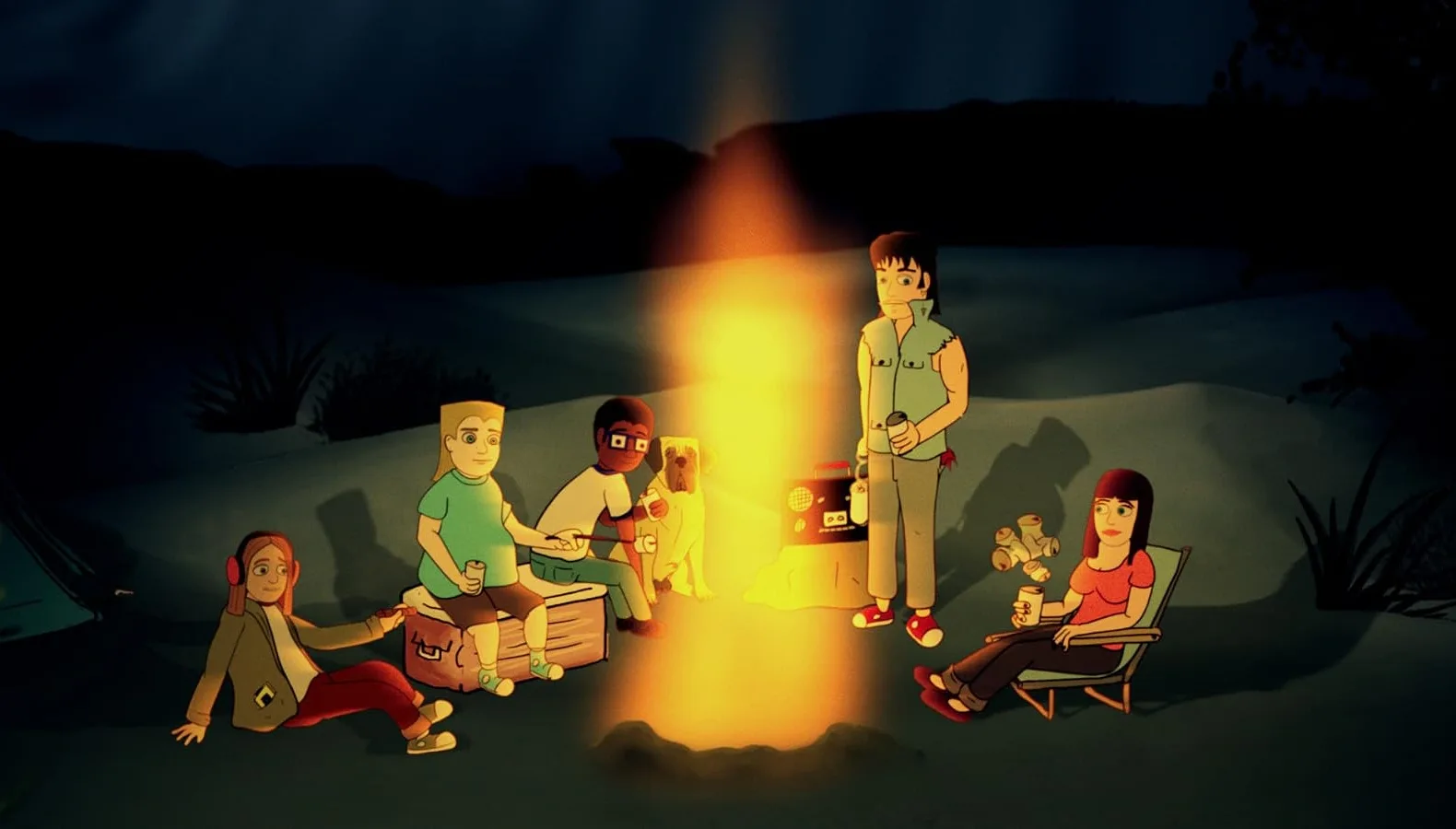

The most revealing thing about The Weird Kidz is how little interest it has in cleaning up childhood for adult consumption. Dug, Fatt, and Mel spend their days inside a Black Bird convenience store playing arcade games, insulting one another, staring at women, and performing the particular stupidity available to children who have been given freedom before judgment. Zach Passero builds his handmade animated horror-comedy around that disorder.
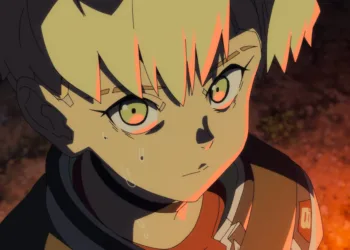
Created over roughly eight years with a tiny crew, the film wears its limited resources openly. Characters move with deliberate crudeness against painted backgrounds, faces are simple, and motion lacks the smoothness expected from studio animation. Yet refinement would work against the world Passero is reconstructing. This is childhood remembered as scribbles in a school notebook: vulgar, energetic, occasionally ugly, and ready to become frightening without warning.
Children Without Supervision
The camping trip initially extends the boys’ ordinary obsessions. Dug’s older brother Wyatt arrives with Mary, and Fatt and Mel immediately turn her into the great mystery of puberty. Their attempts to spy on Wyatt and Mary can become exhausting, particularly when the sexual jokes arrive in clusters, but the childishness is purposeful. These boys understand adulthood through fragments: breasts, beer, condoms, dirty jokes, and the assumption that older teenagers possess some secret knowledge they desperately need.
Wyatt is hardly an ideal guide. He needles Dug constantly, carries himself with the confidence of someone only slightly older, and subjects Mary to a terrible song written in her honor during the drive. The song is funny because the bravado barely conceals sincerity. Passero keeps finding similar cracks in the group’s performance of toughness.
A gas-station stop gives that adolescent comedy a darker frame. The kids pursue beer and condoms while Dug encounters Duana, who recognizes their schemes with the weary ease of an adult who has seen this routine before. Her knowledge of the area’s strange history turns local folklore into something the children cannot dismiss forever.
Grumbles, Mel’s dog, supplies some of the broadest physical comedy, interfering with private moments and fireworks with equal enthusiasm. Yet when Dug disappears, the group’s endless teasing immediately changes register. Fatt and Mel may be ridiculous friends, but they are friends. Their loyalty becomes clearest once joking stops being sufficient protection.
The Monster Beneath the Joke
Dug’s solitary fireworks display provides the film’s hinge. Once the giant ant-like Night Child attacks him and drags him into its nest, the cartoon’s roughness acquires a different power. Bodies can suddenly be damaged with alarming freedom. Limbs disappear. Heads and eyes cease to enjoy the protections ordinarily granted to children in nostalgic adventure stories.
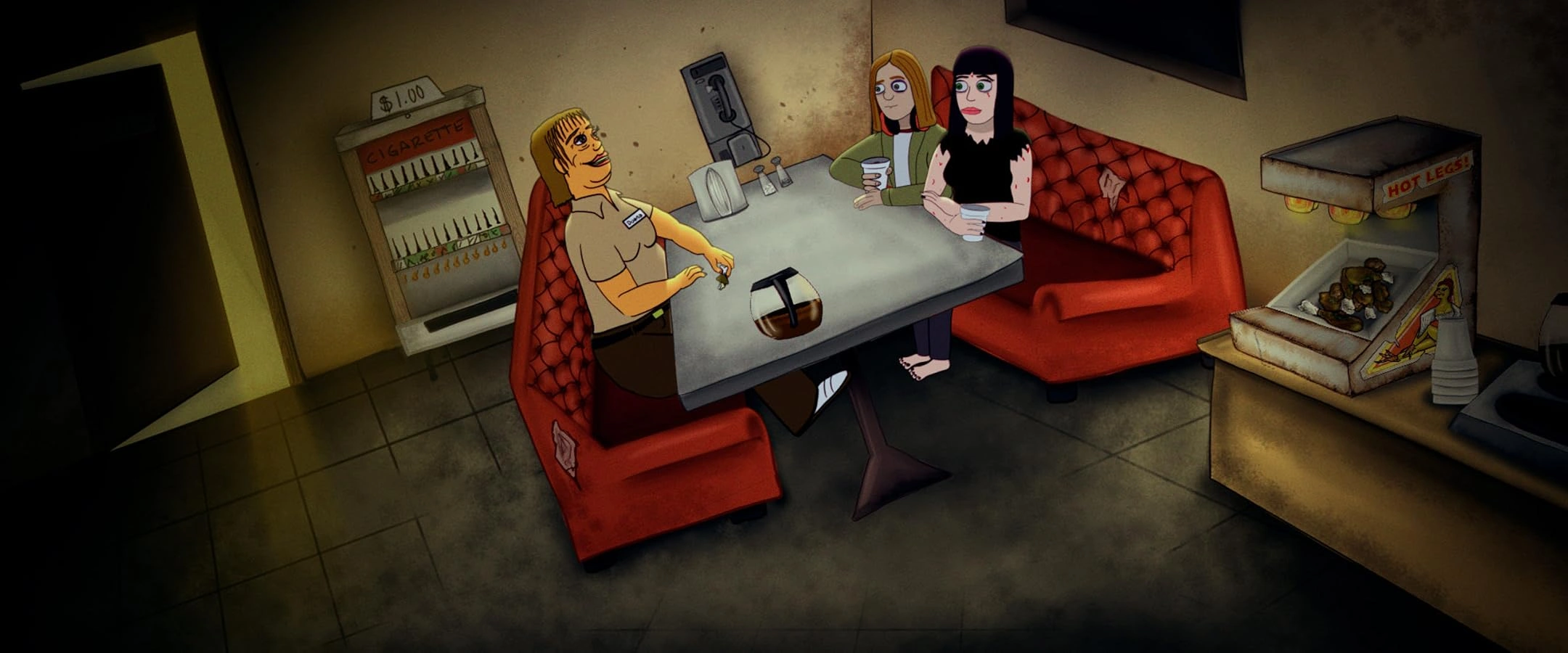
The violence is gleefully excessive, yet Passero refuses to leave the creature inside the convenient moral category of “monster.” Dug discovers a mother feeding her young. Later moments grant the Night Child a sadness that complicates the human instinct to divide the wilderness into innocent children and evil things waiting in darkness. The animal is dangerous. It is also behaving according to needs the film allows the audience to recognize.
That distinction matters because the humans surrounding these children prove far less natural. Fatt, Mel, and Mary search for help and uncover stranger secrets around Jerusalem National Park, including a cult preparing its own ritual. Wyatt and Dug are forced into a survival crisis that makes their earlier sibling hostilities look very small.
The escalation is deliberately unruly: camping comedy becomes giant-insect horror, then local mythology expands into cult madness and increasingly bloody confrontation. The final stretch carries one complication too many, with the cult material competing against a creature story that already has emotional and narrative weight. Yet the excess feels related to Passero’s chosen perspective. Childhood fears rarely arrive with elegant thematic organization. Everything terrifying exists at once.
Latchkey Country
Black Bird belongs to a particular cultural memory of childhood, one shaped by arcade cabinets, convenience stores, stolen alcohol, fireworks, campfire legends, and long stretches during which adults have little idea where their children are. Nostalgia usually turns this freedom into evidence of a healthier age. The Weird Kidz offers a less flattering reading.
Freedom here means exposure. There are no phones waiting to solve Dug’s disappearance, no parents tracking locations, and no reliable adult authority arriving the moment danger becomes real. Duana and the local sheriff occupy the edges of the story, yet the children repeatedly have to construct their own systems of protection.
That makes the friendship among Dug, Fatt, and Mel richer than their crude banter initially suggests. The same boys who spend hours humiliating each other circle together when survival demands it. Dug’s fraught relationship with Wyatt changes under similar pressure, since the hierarchy between older and younger brother becomes meaningless once both can bleed.
Passero’s handmade animation fits that cultural idea perfectly. The film resembles an artifact produced from the obsessions adults once carried out of unsupervised childhood: arcade games, monster movies, dirty jokes, local legends, embarrassing curiosity, and memories of discovering that grown-ups were never as present or competent as children imagined. The drawings may be rough, but the memory behind them is unusually sharp.
The Weird Kidz premiered on October 14, 2022, and has circulated through independent film festivals and special theatrical screenings. The animated horror-comedy follows three pre-teen boys tagging along on a camping trip who encounter a terrifying local monster legend.
Full Credits
Title: The Weird Kidz
Distributor: Independent / Festival Release
Release date: October 14, 2022
Running time: 81 minutes
Director: Zach Passero
Writers: Zach Passero
Producers and Executive Producers: Lucky McKee, Charles Horak, Zach Passero
Cast: Sean Bridgers, Angela Bettis, Ellar Coltrane, Glenn Bolton, Tess Passero
Editors: Zach Passero
The Review
The Weird Kidz
The Weird Kidz turns its crude hand-drawn surfaces into a fitting language for childhood remembered without sentimental polish. Zach Passero’s Black Bird is full of arcade cabinets, sexual curiosity, careless adults, and children expected to survive their own mistakes. The Night Child sharpens that nostalgia into something sadder, especially once the creature stops functioning as a simple threat. The escalating cult material crowds an already busy final stretch, yet the film’s handmade personality survives every detour. Its ugliness, affection, gore, and adolescent stupidity belong together.
PROS
- Distinctive handmade animation
- Strong latchkey-era perspective
- Endearing adolescent friendships
- Surprisingly affecting Night Child
- Gleefully gruesome horror
CONS
- Overloaded final act
- Relentless early sex jokes
- Uneven visual fluidity