










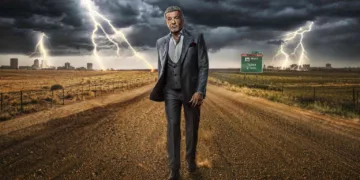



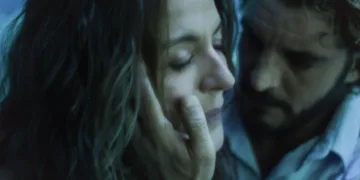
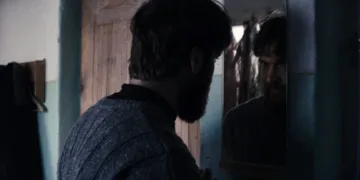











The summer of 1976 serves as a potent cultural signifier in American cinema, a period of sun-bleached dread and societal friction. Brute 1976 attempts to reconstruct this specific moment, opening on a desolate desert highway where the promise of freedom curdles into menace.
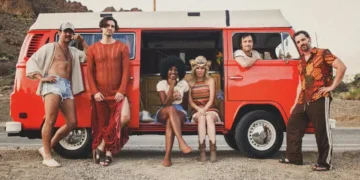
The film introduces Raquel and June, whose journey is cut short by car trouble, leading them into the ghost town of Savage. Their story is a familiar primer for the genre. A second vehicle soon appears, carrying a photographer and models to the same remote locale for a photoshoot.
This setup immediately establishes the film as an old-school slasher, a cinematic dialect spoken fluently in 1970s America. It signals the impending arrival of a cultish family of masked killers and positions its characters as participants in a ritual of survival, one that originated in a very particular national psyche.
The Grammar of Grindhouse
A film like this operates through a shared visual language, a grammar of grit established by American filmmakers half a century ago. Director Marcel Walz, working from an external perspective, meticulously reconstructs this aesthetic, approaching it like a historical document.
The cinematography favors wide, empty desert expanses and uses blown-out lighting to create a harsh, unforgiving atmosphere that bleaches the color from the frame. The visual texture feels deliberately grainy, an affectation designed to mimic the celluloid of the past. Production design is key to this replication; the town of Savage is a museum of decay, filled with rusted vehicles and dilapidated structures that feel authentically dangerous.
This devotion to verisimilitude extends to the period details, from the archetypal hippie van to costumes defined by afros and earth tones, successfully building a world without modern technological safety nets. This studied replication creates an effective time capsule, but it also reveals the challenges of cultural translation.
The iconography of rural American horror—the isolated gas station, the decaying farmhouse—carries a specific weight for a domestic audience, tied to anxieties about the nation’s vast interior. When reproduced by an international filmmaker, these symbols risk becoming purely stylistic, their deeper cultural dread flattened into well-executed tropes.
The process is reminiscent of how Italian directors reinterpreted the American West, creating a new, more operatic form that was distinctly separate from its origin. Walz’s work is less a reinterpretation and more a faithful transcription, one that captures the look of the era but struggles to import its soul.
Archetypes in Amber
Slasher films are built upon a foundation of social archetypes, and Brute 1976 imports its cast directly from the 1970s American youth-culture playbook. We are given the junkie driver, the confident model Roxy, a closeted photographer, and the quintessential blonde sexpot, Sunshine.

These are not deeply explored individuals but cultural shorthand, representations of a youth movement as seen from a great distance of time. They function as chess pieces in a preordained game, preserved in amber for a modern audience. The film’s antagonists, the masked family, are similarly constructed from genre parts. One member, Brutus, wields a chainsaw in a direct nod to Leatherface, but he and his cohorts lack the disturbing specificity of their predecessors.
The terror of the original Sawyer family came from their recognizably human, if grotesque, dysfunction—a dark mirror of the American nuclear family ideal. Here, the killers feel more like anonymous avatars of violence, their masks concealing a void of character instead of a deeper madness. Where the film asserts its own voice is in its depiction of violence.
The practical effects are visceral, with one sequence involving a power drill standing out as a moment of graphic and unforgettable brutality. This specific kill’s surgical nastiness feels more aligned with the body horror of twenty-first-century extreme cinema than the grimy, chaotic violence of 70s grindhouse, suggesting an intersection of different traditions of cinematic cruelty. The other kills, employing standard knives and chainsaws, feel obligatory by comparison, failing to achieve the same shocking impact.
A Narrative Lost in Translation
While the film successfully translates the visual syntax of 70s American horror, its narrative grammar shows signs of difficulty. The plot is a boilerplate slasher structure that offers a predictable sequence of events, a framework that requires thematic weight to feel meaningful.

This is hampered by significant pacing problems; several scenes, particularly a final monologue from the family matriarch, extend far beyond their dramatic utility, draining the film of its accumulated tension. The source of the villains’ ideology, a key component of the original films which often tapped into post-war disillusionment or class rage, is left frustratingly vague here.
Their motives are gestured at through a confusing “end of days” prophecy that feels more like a plot device than a coherent thematic anchor. By stripping the violence of this vital cultural subtext, the film risks reducing its horror to a purely aesthetic exercise. Any attempts to inject social commentary on race feel cursory and disconnected, suggesting a superficial grasp of the complex dynamics of the era.
The final act’s twists come across as unearned narrative mechanics instead of organic developments. Ultimately, Brute 1976 functions as an act of translation where essential meaning has been lost. It captures the surface details—the grit, the clothes, the tools of death—with admirable precision. It fails, however, to translate the underlying anxieties that made the original films so potent, leaving a hollow echo of a more potent scream.
Brute 1976 is a horror film released by Cinephobia Releasing. It premiered at Laemmle Glendale in Los Angeles on August 26, 2025, and opened in select theaters on August 29, with a digital and VOD release scheduled for September 30, 2025. The movie was produced by Neon Noir and pays homage to 1970s grindhouse horror films like The Texas Chain Saw Massacre and The Hills Have Eyes.
Full Credits
Director: Marcel Walz
Writers: Joe Knetter
Producers and Executive Producers: Marcel Walz, Joe Knetter, Sarah French (Producers), Dick Schürmann, Tobias Schürmann (Executive Producers)
Cast: Adriane McLean, Sarah French, Gigi Gustin, Dazelle Yvette, Adam Bucci, Mark Justice, Jed Rowen, Ben Kaplan, Bishop Stevens, Alex Dundas, Robert Felsted Jr., Andreas Robens, Bianca Jade Montalvo
Director of Photography (Cinematographer): Marcus Friedlander
Editors: Samuel Gonzalez Jr., Marcel Walz (uncredited)
The Review
Brute 1976
Brute 1976 is a meticulous reproduction of a bygone era of American horror, capturing the visual grammar of grindhouse cinema with admirable precision. Its commitment to practical gore and period detail is noteworthy. The film falters in its narrative, presenting a hollow story that imitates the actions of its influences without understanding their cultural resonance. The result is a technically proficient but soulless exercise in style, a gory spectacle that looks the part but lacks the thematic weight and genuine dread of the classics it so clearly reveres.
PROS
- The film excels at recreating the sun-bleached, gritty look and feel of 1970s horror through its cinematography and production design.
- Features visceral and well-executed practical effects, including one particularly memorable and brutal kill sequence.
- Successfully establishes a sense of period-specific dread and isolation on a surface level.
CONS
- The protagonists are one-dimensional slasher archetypes with little personality.
- The masked antagonists lack the distinction or terrifying presence of iconic horror villains.
- The plot is a formulaic imitation that fails to offer surprises or thematic depth.
- Many scenes are drawn out, which damages the film's tension and momentum.
- Fails to capture the social and cultural anxieties that made its cinematic influences so powerful.