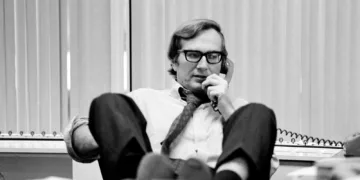















“The son of a bitch is a son of a bitch,” Richard Nixon once snarled about Seymour Hersh. “But he’s usually right, isn’t he?” That grudging admission from a disgraced president captures the essence of a journalistic practice that feels almost like a specific American cultural export: the state-sanctioned adversary.
Laura Poitras and Mark Obenhaus’s documentary Cover-Up uses Hersh’s long career as a map of his nation’s hidden history. The film positions its subject as the deliverer of unwanted news, a figure whose life’s work forms a counter-narrative to the official story of American exceptionalism.
His exposés on the My Lai massacre in Vietnam and the torture at Abu Ghraib were not simply domestic scandals; they were events that fundamentally altered the global perception of American power. The documentary proposes that to understand this cantankerous man from Chicago is to confront the chasm between a nation’s ideals and its actions on the world stage, making it both a biographical portrait and a potent exploration of imperial truths.
The Archaeology of Truth
The film’s visual storytelling consciously avoids sleekness, opting for a texture that reflects the grimy work of excavation. Poitras and Obenhaus build a procedural rhythm from the artifacts of a pre-digital age, complemented by a soundscape of clacking typewriters and whirring archival tape. We see the faint scrawls in Hersh’s yellowed notebooks, the grain of old news footage, and the dust on archival boxes.
These elements are not mere illustrations; they are the substance of the investigation itself, giving the viewer a tactile sense of discovery. The reconstruction of the My Lai story serves as the film’s prime exhibit of this method. It follows Hersh from a vague tip through a cross-country pursuit of sources, a type of shoe-leather reporting that feels like a forgotten craft in an age of instantaneous information.
This physical journey stands in stark contrast to the disembodied nature of modern digital reporting and highlights a different cultural understanding of what constitutes journalistic proof. The editing style is equally direct, mirroring Hersh’s unadorned prose by presenting evidence without excessive commentary. Later, the documentary presents the first-person testimony of the source who provided the Abu Ghraib photographs.
This is a critical moment where the film itself performs a journalistic act, making public a story that institutions sought to control. It visualizes reporting not as a clean summary of events, but as the hard labor of pulling a coherent story from a chaos of whispers and documents.
A Portrait in Friction
The documentary finds its deepest insights when it turns its investigative lens on Hersh himself. He is a difficult subject: prickly, principled, and fiercely guarded about his sources and methods. The film’s most engaging dynamic is the palpable tension between the journalist on screen and the filmmaker questioning him from behind the camera.
Poitras’s probing, off-screen voice is not a passive narrator but an active participant, creating an adversarial relationship that mirrors Hersh’s own interactions with the powerful. This is a fascinating meta-commentary, as Poitras, a documentarian known for her work with whistleblowers, subjects her own protagonist to the scrutiny he applies to others. Truth, the film suggests, is generated through friction, not quiet deference.
This approach prevents the film from becoming simple praise, a common pitfall of American biographical documentaries. Instead, Cover-Up offers a more complex picture by examining Hersh’s professional errors, including his entanglement with forged JFK letters and his misjudgment of Syrian leader Bashar al-Assad.
By acknowledging these failings, the film presents a man whose outsider status is rooted in his very origins as the son of immigrants running a Chicago laundry business, a figure whose fallibility makes his achievements all the more significant. It resists a national tendency toward heroic mythmaking, offering instead a more intellectually honest portrait.
The Dissident’s Work is Never Done
Cover-Up is much more than a history lesson; it is an urgent statement on the contemporary need for fearless journalism. The documentary connects the sins of the past to the obfuscations of the present, showing an octogenarian Hersh still at his desk, receiving calls about atrocities in Gaza.

His move to publishing on Substack is depicted not just as a career choice but as a reflection of a global shift in media consumption, where trust in traditional institutions has eroded. His current platform is a symptom of a fractured information landscape where citizens worldwide seek alternative channels.
The film’s final message transcends its American setting, framing the conflict between reporters and the state as a universal struggle for accountability. The specific details of My Lai or Watergate belong to one country, but the mechanics of state-sponsored deception and the courage required to challenge it are recognizable everywhere.
This documentary serves as a powerful argument that official histories are meticulously constructed and require an equally meticulous deconstruction. It is a warning about the silence that descends when such confrontational voices are absent, leaving the machinery of power to operate without scrutiny and historical memory to be shaped by those who wield it. The work of the dissident, the film makes clear, is never truly finished.
Full Credits
Directors: Laura Poitras, Mark Obenhaus
Producers and Executive Producers: Laura Poitras, Mark Obenhaus, Yoni Golijov, Olivia Streisand
Cast: Seymour Hersh
Director of Photography (Cinematographer): Mia Cioffi Henry
Editors: Laura Poitras, Peter Bowman, Amy Foote
Composer: Maya Shenfeld
The Review
Cover-Up
Cover-Up is a vital and intellectually rigorous documentary that succeeds as both a compelling portrait of a difficult man and a powerful declaration on the necessity of adversarial journalism. Eschewing simple tribute, the film uses Seymour Hersh’s career as a procedural map to explore the mechanics of truth-telling in the face of institutional power. It is an urgent, meticulously crafted work that feels more essential than ever, serving as a potent reminder that a healthy democracy requires relentless, uncomfortable scrutiny.
PROS
- An intellectually honest and nuanced portrait of a complex figure, avoiding simple praise.
- Engaging procedural style that effectively uses archival material to show the hard work of journalism.
- Urgent contemporary relevance, connecting historical events to the current need for independent reporting.
- A balanced perspective that includes its subject's professional missteps, adding to its credibility.
CONS
- The subject, Seymour Hersh, is often abrasive and guarded, which might be off-putting for some viewers.
- Its methodical, dense focus on process may feel slow to audiences expecting a more personal, emotional narrative.
- By prioritizing the professional, the film offers limited insight into Hersh's personal life.