





























A floorboard shatters. Beneath it, there is no foundation, only an endless, impossible void of interlocking rooms and staircases twisting against the laws of physics. One by one, the Demon Slayers fall, swallowed by an architectural nightmare.
This is how the final battle begins in Demon Slayer: Kimetsu no Yaiba Infinity Castle, not with a charge, but with a sudden, disorienting plunge into the enemy’s very heart. The film, the first of a trilogy meant to cover the manga’s closing chapters, picks up immediately after the Hashira Training arc, throwing its heroes into the climactic confrontation they have prepared for.
Separated within Muzan Kibutsuji’s otherworldly fortress, each warrior must now face the highest-ranking demons in a desperate fight for survival. The mission is no longer to hunt, but to endure the labyrinth and somehow defeat an ancient evil on its own ground.
An Architecture of Chaos
Studio Ufotable’s command of animation has become a signature of the series, and its work here approaches a zenith. The integration of 2D character art with 3D generated environments creates a seamless visual field where hand-drawn emotion feels perfectly at home within a world of impossible geometry. The Infinity Castle is the film’s greatest visual achievement, a character in its own right.
It is a surrealist megastructure, an M.C. Escher painting given malevolent life, with rooms that rotate and corridors that fold in on themselves at a demon’s whim. The constant reconfiguration serves a psychological purpose, atomizing the Demon Slayer Corps and ensuring no hero feels safe. This environment is an active participant in the conflict, a perpetually hostile battleground.
Against this dark, oppressive backdrop, the elemental Breathing Techniques provide bursts of brilliant color and form. Giyu’s Water Breathing moves with the grace of Hokusai’s waves, while Zenitsu’s Thunder Breathing crackles with stark, instantaneous flashes of light. These displays illuminate the screen, their vibrant energy a defiant contrast to the shadowy architecture.
The camera work is relentlessly dynamic, executing sweeping, gravity-defying maneuvers that follow the Slayers through the castle’s chaotic spaces. This kinetic cinematography, which pairs wide, disorienting shots of the shifting world with tight, visceral closeups on the combatants, produces an intensely immersive effect.
The Weight of a Soul
Beneath the spectacle, the film finds its footing in potent character moments. The partnership between Tanjiro and the stoic Giyu Tomioka is tested against the demon Akaza. Their fight becomes an exploration of shared responsibility, with Tanjiro’s earnest determination slowly cracking Giyu’s wall of self-imposed isolation.

Elsewhere, Zenitsu Agatsuma confronts his own history in a battle against Kaigaku, a corrupted former peer. Here, Zenitsu is stripped of his usual cowardice, replaced by a quiet, sorrowful resolve. His fight is the climax of his personal arc, a painful reckoning with legacy and the failure of his predecessor. Shinobu Kocho’s graceful, poisoned blade is wielded with a cold fury in her confrontation with the demon Doma.
The conflict is a disturbing portrait of vengeance, her pleasant demeanor a thin mask for a deep, corrosive anger. The film’s emotional apex, however, belongs to the antagonist Akaza. The narrative pauses its forward momentum to explore his human life as Hakuji, revealing a tragic history of love, family, and devastating loss.
This backstory grants him a depth that complicates his villainy, reframing him as a figure trapped by grief. The voice performances are uniformly strong, with Akira Ishida’s portrayal of Akaza capturing the demon’s intensity while conveying the profound vulnerability of the man he once was. Hiro Shimono likewise gives Zenitsu a new gravity, his performance key to the character’s maturation.
A Brutal Ballet
The film is structured as a series of high-intensity battles, each choreographed with a distinct personality. The action is relentless, beginning almost immediately and seldom pausing for breath. Every fight sequence is a creative display of speed and strategy, elevated by meticulous sound design where every sword clang and impact feels substantial.
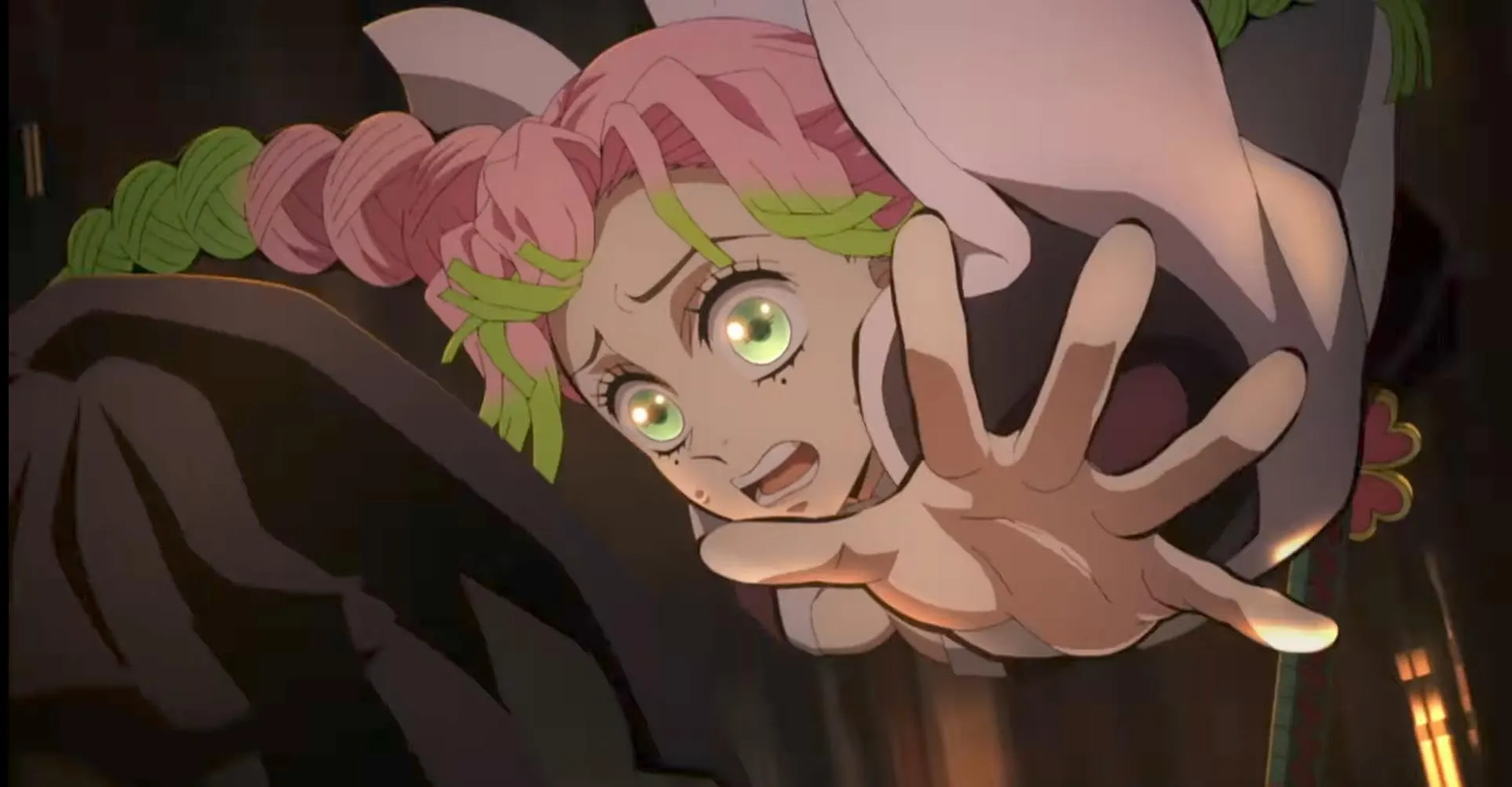
Shinobu’s duel with Doma is a dance of lethal precision, her delicate, insect-like movements hiding a vicious intent. The fight between Zenitsu and Kaigaku is an eruption of raw emotion, a clash of thunderous techniques fueled by the pain of betrayal and a sense of profound duty. The centerpiece is the prolonged confrontation between Tanjiro, Giyu, and Akaza. It is a grueling marathon of endurance, a brutal contest of martial skill and sheer willpower.
The choreography communicates the sheer exhaustion and desperation of the heroes as they face a seemingly insurmountable foe. The score from Yuki Kajiura and Go Shiina is an essential component of this experience.
It combines traditional Japanese instruments, like the sharp strum of a biwa that signals a change in the castle’s layout, with distorted, industrial sounds that mirror the demonic corruption. The music functions as another layer of storytelling, amplifying the tension of a sword clash or softening to underscore a moment of tragic memory.
Fractured Time and Enduring Purpose
As an adaptation, the film is meticulously faithful to its source material, a choice that brings both strengths and weaknesses to the cinematic format. It recreates the manga’s panels with an almost religious accuracy and expands upon the text with small scenes that give characters like the new Ubuyashiki leader, Kiriya, a greater presence.

The film’s 155-minute runtime is dedicated almost entirely to a chain of climactic encounters, a structure that creates some narrative difficulties. The pacing can feel uneven, especially with the constant use of flashbacks. These interruptions are necessary for emotional context, particularly for Akaza’s history, but their placement often breaks the momentum of a fight.
This reliance on looking backward is thematically significant. The story proposes that memory is the ultimate battlefield for both slayers and demons, where past traumas must be confronted to define one’s present identity. This structural choice highlights the story’s primary themes.
Ideas of sacrifice and perseverance are everywhere, as the Slayers push their bodies and spirits past any reasonable breaking point. The narrative questions the line between vengeance and justice through characters like Shinobu, exploring how personal loss can fuel a person’s entire existence. The weight of memory shapes every character, giving their violent conflicts a deeper, more resonant meaning.
Demon Slayer: Kimetsu no Yaiba – The Movie: Infinity Castle is the first part of a trilogy of films based on the popular manga and anime series. It was released in Japan on July 18, 2025, and had its theatrical release in the United States and Canada on September 12, 2025. The film also had an early access screening in select U.S. theaters on September 9 for Crunchyroll Mega and Ultimate Fan subscribers.
Full Credits
Director: Haruo Sotozaki
Writers: Koyoharu Gotouge, Hikaru Kondô
Producers: Akifumi Fujio, Masanori Miyake, Yūma Takahashi
Cast: Natsuki Hanae, Akari Kitō, Yoshitsugu Matsuoka, Hiro Shimono, Takahiro Sakurai, Akira Ishida
Director of Photography (Cinematographer): Yuichi Terao
Editors: Manabu Kamino
Composer: Yuki Kajiura, Go Shiina
The Review
Demon Slayer: Kimetsu No Yaiba The Movie: Infinity Castle
Demon Slayer: Infinity Castle is a stunning cinematic achievement, a relentless barrage of breathtaking animation and masterfully choreographed action. While its narrative momentum is sometimes fractured by a heavy reliance on flashbacks, the profound emotional weight given to its characters, particularly the tragic demon Akaza, makes for a powerful and essential viewing experience. It is a brutal, beautiful start to the series' grand finale.
PROS
- Visually spectacular animation and world design.
- Exceptional, creative, and emotionally charged action sequences.
- Significant character development and powerful voice acting.
- A moving and complex portrayal of the antagonist, Akaza.
- An impactful and dynamic musical score.
CONS
- The narrative pacing can feel uneven due to its structure.
- Frequent flashbacks, while emotionally necessary, can disrupt the flow of the battles.