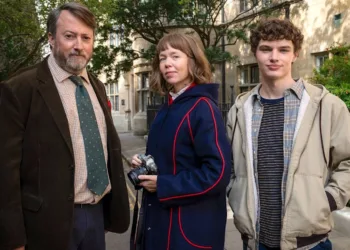





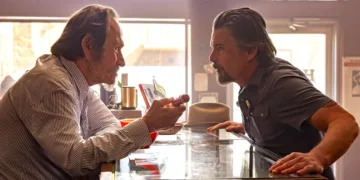





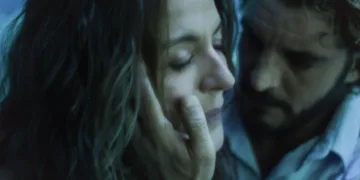













The story begins in Perugia, Italy, a place that became a dateline for a global media frenzy in 2007. A young American exchange student, Amanda Knox, saw her life consumed by the murder of her roommate, Meredith Kercher. Hulu’s The Twisted Tale of Amanda Knox is not a whodunnit.
It arrives in a television landscape saturated with true crime, positioning itself instead as a dramatized corrective. With Knox serving as an executive producer, the series announces its intention to be the definitive account, an attempt to reclaim a narrative famously distorted by tabloids and prosecutors alike.
The show’s primary tension is not the mystery of a crime, but the methodical deconstruction of a conviction. It explores the nightmare of a flawed investigation and a ravenous press through the deeply subjective lens of its protagonist, questioning how a person’s identity can be disassembled and replaced by a monstrous public caricature.
Reassigning the Villain
In this telling of the Knox saga, the actual killer of Meredith Kercher, Rudy Guede, is a footnote. The series deliberately shifts its focus, positioning the Italian criminal justice system and the voracious media as the story’s true antagonists. This is a significant choice, reflecting a broader trend in social-justice narratives where monolithic institutions are seen as the primary source of conflict.
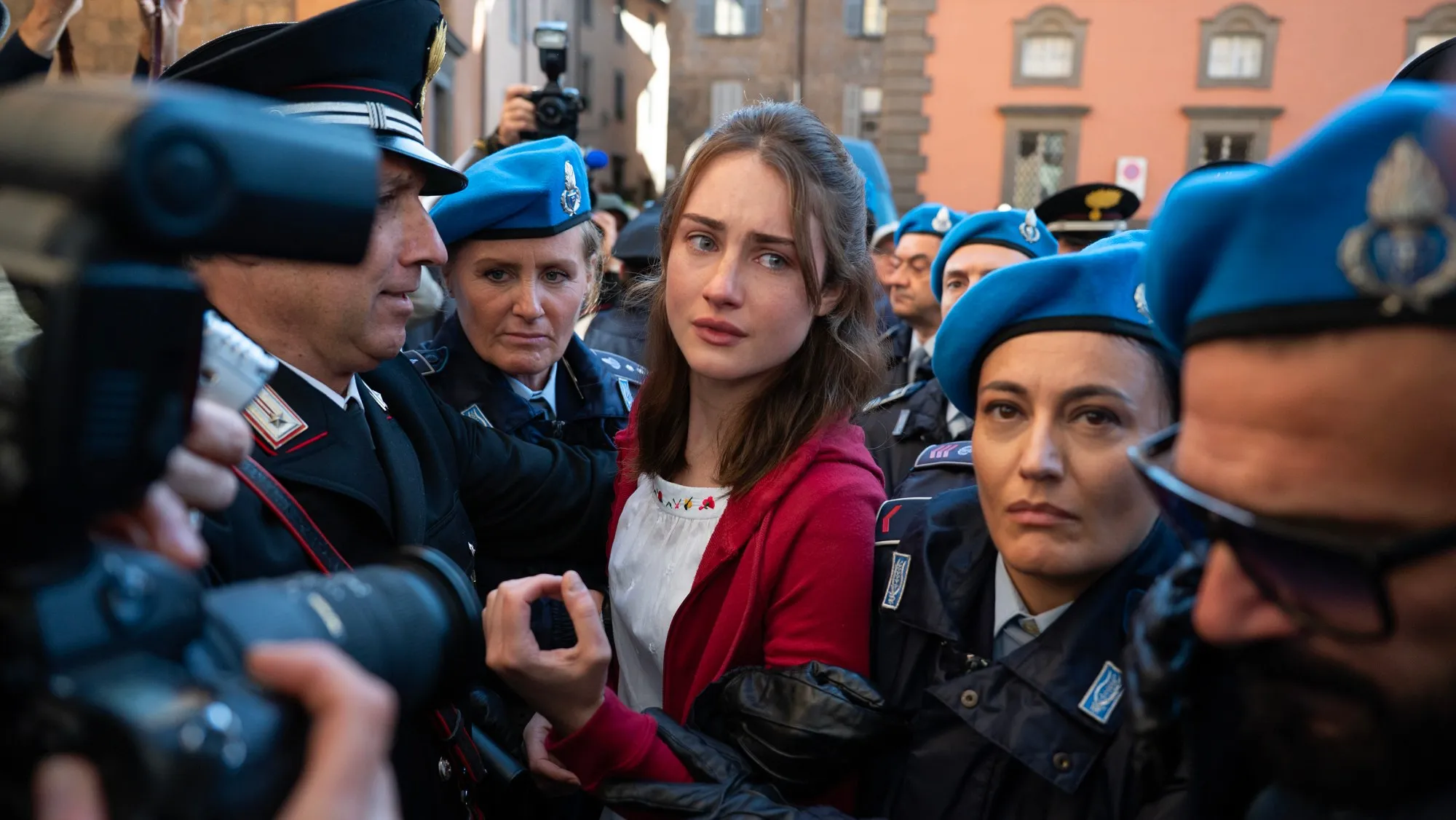
The show portrays the media not just as reporters but as a churning, faceless entity, a visual scrum of flashing bulbs and shouted questions that hounds the Knox family at every turn. The narrative architecture builds its suspense not toward the discovery of Kercher’s body, but toward Knox’s arrest and subsequent interrogation. These events are framed as the real catastrophe, the point where a young woman’s life is seized by forces beyond her control.
The show is less occupied with the forensics of the murder and more with the anatomy of a flawed prosecution. Its central inquiry is why the investigation fixated so intensely on Amanda. The script explores a potent combination of cultural misunderstandings, critical language barriers, and the unchecked ambition of a lead prosecutor.
We see specific instances where Knox’s American demeanor is weaponized against her. An impromptu gymnastics display at the police station is read as bizarre and unfeeling. A t-shirt bearing the slogan “All you need is love” is presented as a mockery of the court. These moments illustrate a deeper friction, the way a person’s behavior, stripped of its cultural context, can be rendered alien and suspicious.
This reframing is most apparent in its mission to dismantle the “Foxy Knoxy” persona. The series meticulously contrasts the hyper-sexualized demon created by tabloids with its portrayal of a confused 20-year-old struggling to comprehend an unimaginable ordeal.
It connects the prosecution’s obsession with her supposed sexual depravity to a long history of misogynistic tropes, suggesting her real crime was failing to perform grief in a way that satisfied a patriarchal system. The series is a study in how a narrative, once set, becomes its own form of evidence.
The Architecture of Empathy
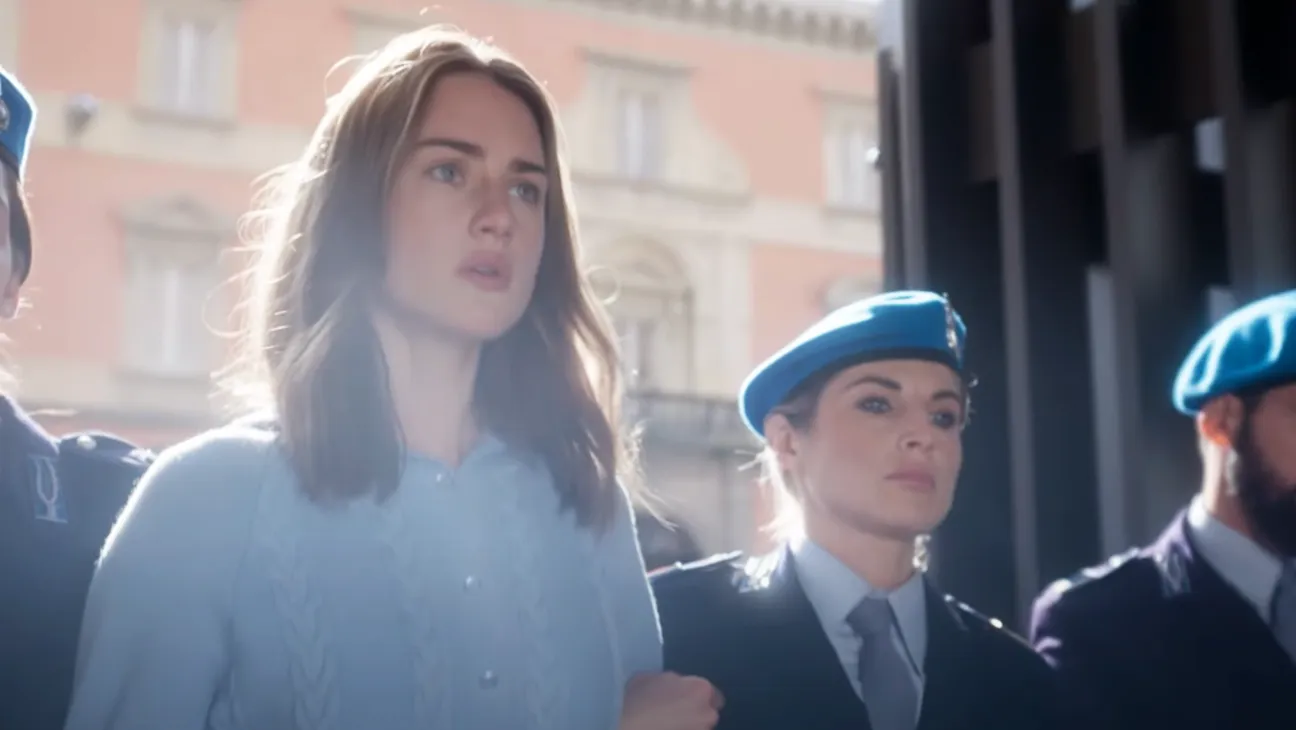
The series grounds its psychological horror in a potent and layered performance from Grace Van Patten. She effectively portrays Amanda’s harrowing evolution, charting a course from the open, buoyant physicality of a carefree student to the hunched, protective posture of a prisoner.
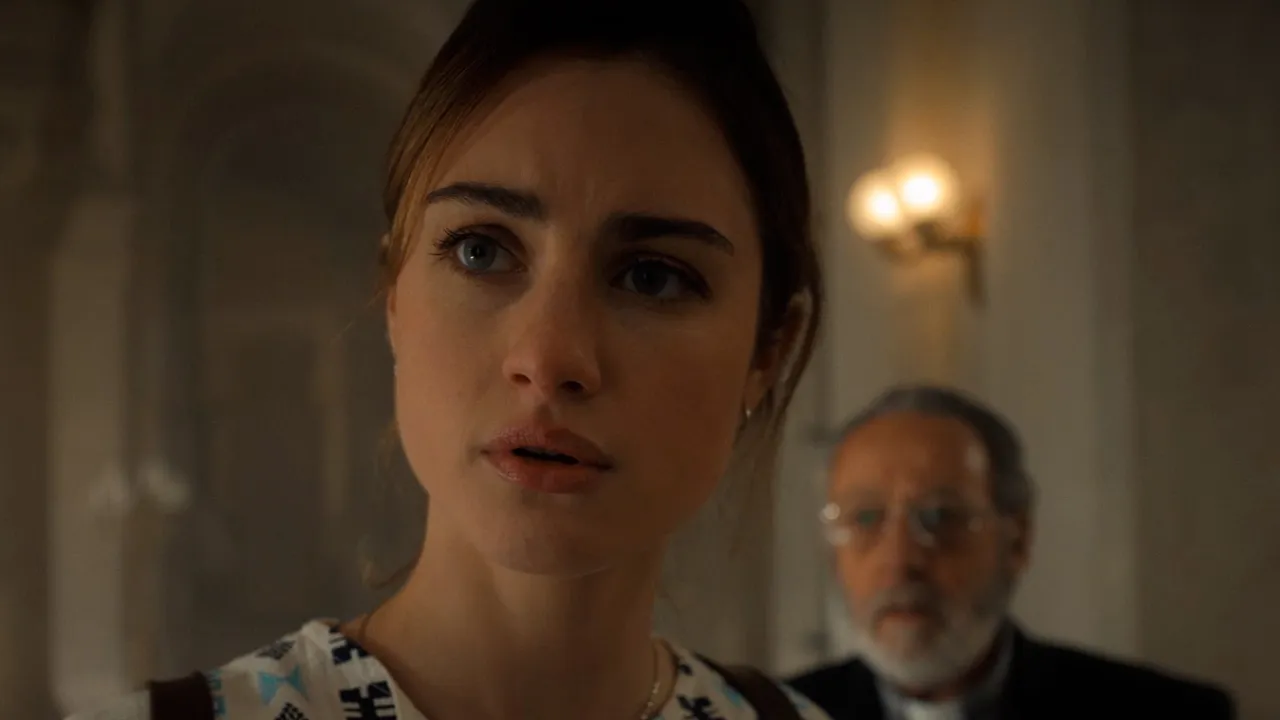
Her performance is a masterclass in conveying trauma through subtlety; the light drains from her eyes over the course of the early episodes, and her voice, initially bright, becomes flat and toneless under the weight of interrogation. Her work in the extended questioning sequences is particularly affecting, conveying a mental and emotional collapse with frightening authenticity as she is deprived of sleep, translation, and legal counsel.
The supporting cast provides a textured backdrop for her ordeal. Francesco Acquaroli plays the lead prosecutor, Giuliano Mignini, not as a cartoon villain but as a man dangerously convinced of his own righteousness, blinded by his narrative theories. Acquaroli allows us to see the certitude in Mignini’s eyes, portraying a man who believes he is the sole protector of the victim’s memory, even as he destroys another young woman’s life.
As Amanda’s mother, Sharon Horgan captures the specific agony of parental helplessness, fighting a battle for her child across an ocean and a language barrier. She conveys a raw, frantic energy in phone calls that feel desperate and achingly real. Giuseppe De Domenico offers a sympathetic portrayal of Raffaele Sollecito, another young person swept into the storm, effectively communicating the white-knight complex that drove him to stand by Amanda.
Director Michael Uppendahl’s work on the second episode is a standout, using suffocating close-ups and distorted audio to immerse the viewer in the claustrophobia of Knox’s interrogation. The camera violates her personal space, mirroring the tactics of her questioners.
Rapid edits and shallow focus heighten her isolation, blurring the world around her into an incoherent threat. This subjective filmmaking, combined with Jeff Russo’s score of persistent dread, constructs a specific emotional reality designed for maximum viewer identification with its protagonist.
The Polyphonic Narrative
A key structural choice that sets the series apart is its use of multiple narrators. While Amanda’s voice guides most of the story, certain episodes shift perspective, handing the voiceover to Raffaele and, most surprisingly, to the prosecutor, Mignini.
This is a technique increasingly common in streaming dramas, which, freed from the constraints of weekly broadcast television, can experiment with more complex narrative forms. It reflects a cultural shift away from a single, authoritative point of view, instead favoring a mosaic of subjective experiences. Hearing Mignini’s internal monologue provides a disquieting insight into his motivations.
He is presented as a complex, tragically human figure driven by a misguided sense of justice, not simple malice. This approach complicates the viewer’s relationship with the show’s antagonist, suggesting that great injustice is often perpetrated by ordinary people convinced they are doing good.
Raffaele’s narration gives him his own agency, preventing him from becoming a simple accessory to Amanda’s story by detailing his own background and psychological state. This narrative device is the show’s primary method for generating deep empathy.
It functions as a direct response to the dehumanizing nature of the original media coverage. By using intimate, first-person narration, the series attempts to restore the humanity that the headlines and courtroom sketches stripped away, forcing the audience to understand the personal stakes for every key player.
The Paradox of the Retelling
For all its stylistic confidence, the series struggles with the weight of its own history. The story is exceptionally well-documented, most notably in a 2016 Netflix documentary that covered the same ground with precision. For viewers already familiar with the case, the show’s midsection can feel like a lengthy and expensive retread, a symptom of a streaming culture where recognizable IP, even a person’s trauma, is often seen as a safer bet than originality.
Its most significant shortcoming, however, is its treatment of Meredith Kercher. The series respectfully depicts her in brief, sun-drenched flashbacks, but she remains a catalyst for Amanda’s story, a spectral presence rather than a fully realized person. There is a deep irony here: the show points out how Kercher was forgotten in the media circus, yet it replicates this very issue by keeping its focus so tightly on Knox. This points to the central paradox of the modern true-crime boom.
The series critiques the sensationalism that surrounded the case while its very existence is predicated on that same public fascination. It wants to have it both ways, pointing a finger at a voyeuristic public while serving up a polished, binge-able product for that same audience. The show fails to interrogate the deeper societal reasons this specific case, involving a young, white, American woman, became a global obsession while countless other tragedies go unnoticed.
Finally, because Knox is a producer, the show presents a definitive, unambiguous version of her innocence. This sanitized perspective smooths over some of the story’s most fraught elements. The racial implications of her coerced, false accusation against Patrick Lumumba, a Black man, are almost entirely sidestepped. For a series so concerned with the mechanics of systemic injustice, this is a profound blind spot, a reminder that even a “reclaimed narrative” can have its own carefully curated omissions.
The Twisted Tale of Amanda Knox is an eight-episode Hulu limited series that premiered on August 20, 2025. The series was released in the U.S. on Hulu, with new episodes airing weekly until October 1, 2025. Internationally, it is available to stream on Disney+.
Full Credits
Director: K.J. Steinberg, Michael Uppendahl, Cate Shortland, Natalie Leite, Quyen Tran
Writers: K.J. Steinberg, Amanda Knox, Sam Rubinek, Nate Burke, Wes Taylor, Mary Laws, Sofya Levitsky-Weitz, Rebeka Barnett
Producers: K.J. Steinberg, Warren Littlefield, Lisa Harrison, Ann Johnson, Graham Littlefield, Monica Lewinsky, Amanda Knox, Chris Robinson, Michael Uppendahl, Benedetta Comito, Carlo Corbellini, Ildikó Kemény, Juli Kerpel, David Minkowski, Margaret Qualley, Rick Singer, Douglas Wilkinson, Shawn Williamson
Cast: Grace Van Patten, Sharon Horgan, John Hoogenakker, Francesco Acquaroli, Giuseppe De Domenico, Roberta Mattei, Rebecca Wisocky, Joe Lanza, Crosby Fitzgerald
Director of Photography (Cinematographer): Colin Watkinson, Simon Hawken, Bella Gonzales
Editors: Lara Johnston
Composer: Jeff Russo
The Review
The Twisted Tale of Amanda Knox
The Twisted Tale of Amanda Knox is a stylistically confident and empathetic retelling, anchored by a potent lead performance. It successfully reframes the saga as a damning story of systemic and media failure. The series is hampered by a sanitized perspective and a narrative that feels too familiar, ironically sidelining the victim at the center of the tragedy it depicts. It is a well-crafted piece of television that cannot escape the contradictions of its own premise.
PROS
- A powerful and layered lead performance from Grace Van Patten.
- Immersive and effective direction that creates a strong sense of psychological distress.
- Successfully reframes the story to critique the justice system and media sensationalism.
- Nuanced portrayals of supporting characters that avoid simple hero/villain dynamics.
CONS
- The narrative feels redundant for anyone familiar with the 2016 documentary.
- The victim, Meredith Kercher, is marginalized within Amanda Knox's story.
- It critiques the public's fascination with the case while simultaneously relying on it.
- The perspective feels inherently biased and sanitized due to Knox’s role as an executive producer.