














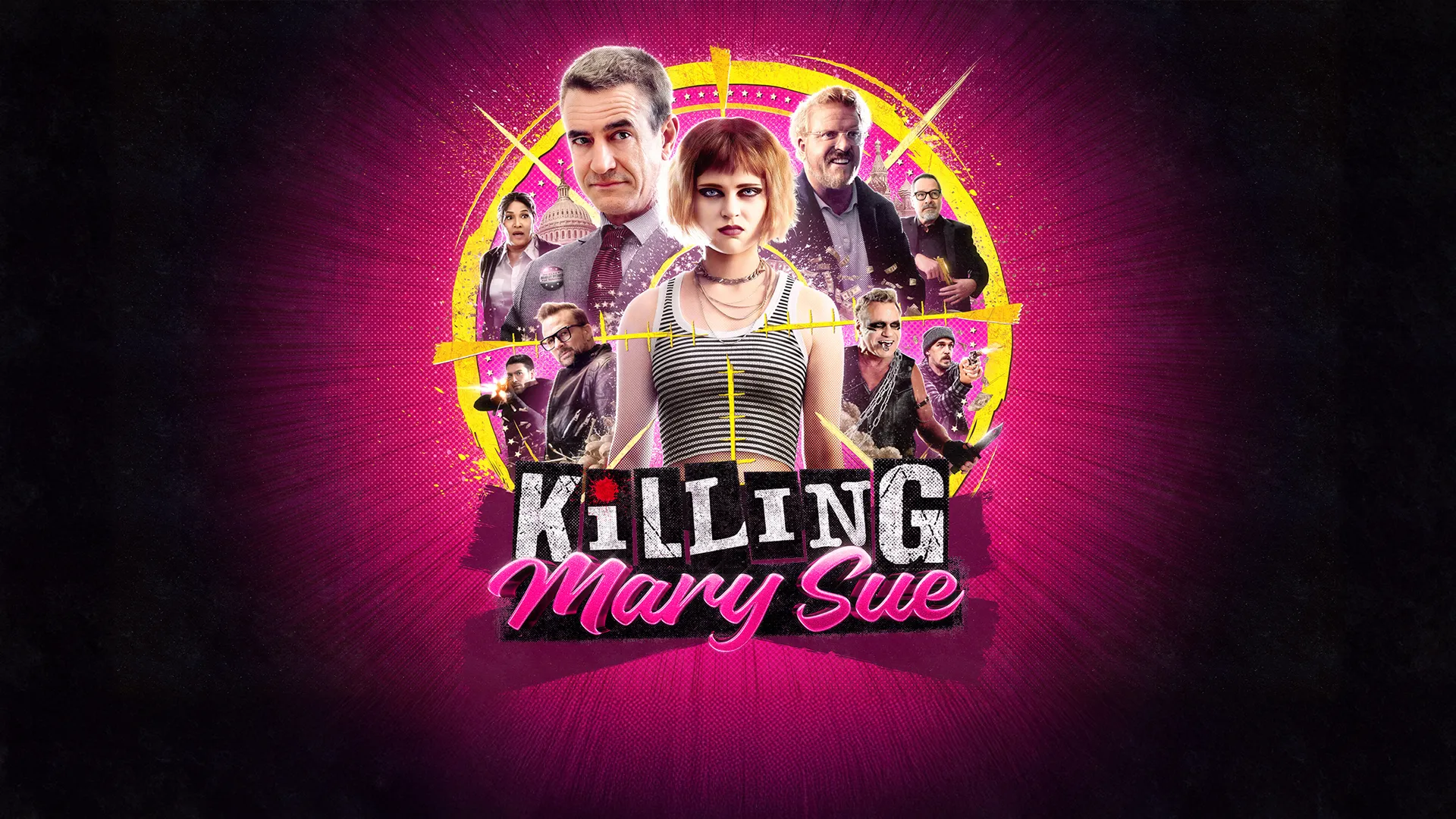

In the contemporary political arena, where optics are currency and family members can be liabilities, what is the logical endpoint of cynical damage control? Killing Mary Sue posits a darkly absurd answer: contract killing.
The film sets its stage with a premise that feels both outrageously farcical and uncomfortably close to the bone of modern power dynamics. U.S. Senator Bradley Weiner (Dermot Mulroney) is a man whose career is threatened not by policy failure but by his stepdaughter, Mary Sue (Sierra McCormick), a whirlwind of scandal and self-destruction.
The film’s title announces its thematic project. A “Mary Sue” is a creature of fan-fiction lore, an author’s idealized avatar gifted with unearned competence. By naming its protagonist so directly, the film attempts a self-aware deconstruction of this very trope.
Mary Sue is the problem child whose drug use and international incidents are tanking the Senator’s poll numbers. His solution, cooked up with his campaign manager Wes (Jake Busey), is to have her permanently removed from the equation. This sets into motion a plan for a clean, simple assassination that, of course, immediately descends into bloody, chaotic failure.
The Post-Traumatic Protagonist
At the center of the film is a paradox in human form. Mary Sue is presented as a collision of two archetypes: the traumatized victim and the invincible action hero. Her backstory is one of genuine pathos, having witnessed the violent death of her father as a child. This event has left her a hollowed-out figure, seeking oblivion in substance abuse.
Yet, when assassins descend upon her, she reveals a preternatural talent for combat, a proficiency the script attributes to a life spent playing video games. This is a very 21st-century form of apotheosis, where virtual skill becomes manifest reality, a commentary on a generation whose expertise is often cultivated in simulated spaces, detached from physical consequence until violence makes it brutally real.
Sierra McCormick navigates this duality with a compelling, snarky nihilism that masks a raw nerve of vulnerability. Her performance suggests a person who has weaponized her own apathy as a shield. Against her, Dermot Mulroney’s Senator Weiner is a creature of pure surface, a gesticulating cartoon of corrupt ambition whose panic is his only authentic trait. He represents the complete decay of political ideology into frantic, performative self-preservation.
The assassins sent to dispatch Mary Sue are treated less as characters and more as functions. They are quirky, disposable obstacles in a video-game-like progression of threats, from a killer who she mistakes for a stripper to a family of commandos emerging from COVID-19 quarantine.
They exist to be overcome. This world of exaggerated performance creates a space where a character like Mary Sue can logically exist, but it constructs a deliberate barrier to any real emotional access. We observe her, but we are not invited to feel with her, a cold distance that perhaps mirrors the alienation of online existence itself.
The Whiplash of Intent
The film’s attempts at comedy are, to be blunt, juvenile. The humor relies on the kind of playground wordplay found in the surnames of Senator Weiner and his opponent, Anita Koch, a brand of wit that mistakes crudeness for sharpness. It feels like a film trying to speak the language of internet memes without understanding the grammar.

A recurring gag involving a Russian oligarch and a banana farm is repeated with diminishing returns, a testament to a script that prioritizes noise over substance. The action sequences exist in a similar state of contradiction. The physical stunt work is often coherent and grounded, yet it is consistently undermined by cheap digital effects.
Muzzle flashes and blood spatter have the weightless, artificial quality of a browser-based game, pulling the viewer out of any visceral reality the choreography might have built. This schism is a metaphor for the film itself: the solid bones of a B-movie are buried under layers of cheap digital noise in an aspiration for a slickness it cannot achieve.
This technical dissonance is a symptom of the film’s larger, more critical failure: its tonal schizophrenia. For much of its runtime, the movie operates as a bloody farce. Then, it slams on the brakes. The chaos pauses for an extended, jarring attempt at psychological depth, asking the audience to suddenly engage with the grim reality of Mary Sue’s depression and addictions.
This reflects a profound failure of nerve, an insecurity with the chosen genre. It suggests a misguided belief, common in modern storytelling, that a narrative must be validated by overt trauma, that suffering is a shortcut to depth. A film that has spent an hour treating violence as a punchline cannot suddenly demand sincere emotional investment in a character’s trauma. The shift is not just awkward; it is a fundamental miscalculation that breaks the film’s own established contract with its viewer.
A Parody of its Own Parody
The aesthetic of Killing Mary Sue is a self-conscious throwback to the low-budget, direct-to-video schlock of a bygone era. It aims for a certain kind of cult appeal, where its rough edges and absurdities are the point. Yet where the most memorable schlock possesses a strange, singular vision or an undeniable earnestness, this film feels calculated.

Its messiness is not born of authentic creative chaos but of a cynical checklist of “edgy” elements. Its primary intellectual mission is to deconstruct the Mary Sue trope, but its execution is too frantic and unfocused to provide any meaningful critique. A successful deconstruction requires a deep understanding of the subject. The film fails to grasp why the trope is a narrative problem—because it circumvents stakes and earned character development.
By creating a literal Mary Sue and having her effortlessly dispatch all threats, the film doesn’t analyze the archetype; it just enacts it lazily. It becomes a prime example of the very thing it purports to examine. The script’s lack of focus is apparent in its constant introduction of new subplots, from KGB spies to entanglements with the Russian mob.
This narrative bloat is a symptom of a fear of simplicity, a cultural pressure for every minor story to have a complex, interconnected universe. The ambition to say something about character archetypes and political corruption is clear, but it is buried under layers of poor execution and tonal confusion. The film mistakes frantic energy for wit, leaving an unpleasant and unsatisfying experience. It is a work of fiction that ultimately says nothing at all.
“Killing Mary Sue” is an action film released by Samuel Goldwyn Films on digital platforms on June 13, 2025. It was filmed just before the 2023 SAG-AFTRA strikes and was made under a tight production schedule.
Full Credits
Director: James Sunshine
Writers: James Sunshine
Producers: Larry Layfield, Jonathan Sachar, Patrick Durham, Dave Lugo
Executive Producers: Rosy Sultana, Abdul Bhuiyan
Cast: Sierra McCormick, Dermot Mulroney, Sean Patrick Flanery, Jason Mewes, Martin Kove, Kym Whitley, Jake Busey, French Stewart, Jesse Kove, Katie Killacky, Rita Rehn, Andy Prosky
Director of Photography (Cinematographer): John Sawyer
Editors: James Sunshine
Composer: Tasos Eliopoulos
The Review
Killing Mary Sue
Killing Mary Sue attempts a clever deconstruction of a well-known character trope but collapses under the weight of its own chaotic execution. Its ambitious premise is squandered on a tonally schizophrenic script that veers recklessly between bloody farce and unearned melodrama. While Sierra McCormick commits to the paradoxical lead role, the film is too messy, its humor too juvenile, and its satire too unfocused to land any of its intended punches. It is a film that, in trying to critique a lazy narrative device, becomes a lazy narrative itself.
PROS
- An ambitious premise that attempts to satirize the "Mary Sue" character archetype.
- Sierra McCormick's committed lead performance effectively captures her character's contradictory nature.
- Features some moments of coherent, well-executed physical stunt work.
CONS
- The central satire fails completely, with the film becoming a textbook example of the trope it critiques.
- Suffers from severe tonal whiplash, shifting jarringly between broad comedy and serious drama.
- A weak script filled with juvenile humor and underdeveloped subplots.
- Poor technical execution, particularly the cheap-looking digital blood and muzzle flashes.
- An unfocused narrative that feels chaotic and messy.