
























![Kingdom Hearts Collection [I-III] Review](https://gazettely.com/wp-content/uploads/2026/10/Kingdom-Hearts-Collection-I-III-1-360x180.webp "Kingdom Hearts Collection [I-III] Review: KHII Holds Steady as Newer Entries Fluctuate 37")





In the freezing Chicago air of January 2019, a story broke that seemed to confirm the nation’s deepest anxieties. Jussie Smollett, an actor on the successful show Empire, reported a vicious hate crime. The details were ugly and specific: racist and homophobic slurs, a chemical substance thrown on him, and a noose looped around his neck.
The attackers allegedly invoked “Maga country,” rooting the assault in the era’s venomous political climate. The public reaction was immediate and immense. Celebrities, politicians, and countless citizens voiced their support for Smollett, viewing the attack as a raw symptom of a society grappling with hatred. This wave of sympathy, however, was short-lived.
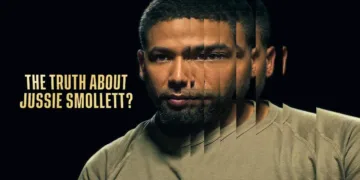
The narrative took a sharp, disorienting turn as the Chicago Police Department shifted its focus, and the man who was the victim suddenly became the primary suspect in orchestrating the event. The documentary The Truth About Jussie Smollett? positions itself at this fracture point, aiming to re-examine a case where the facts themselves became part of the story.
Constructing a Suspect
The documentary first builds the official police narrative with the patient, methodical structure of a television procedural. The pacing is deliberate as we follow the Chicago Police Department’s investigation, with each new piece of information presented as a clue leading toward an inevitable conclusion.
The film highlights the small, odd details that first sowed seeds of doubt, such as Smollett returning to his apartment with his Subway sandwich apparently unscathed. His initial reluctance to provide his phone records is framed as a critical piece of withheld evidence, arousing suspicion in both the investigators and the viewer.
Then-Superintendent Eddie Johnson is presented as the story’s authoritative guide, a seemingly trustworthy narrator who calmly lays out the department’s reasoning in direct-to-camera interviews. The cinematic turning point arrives with the introduction of Bola and Ola Osundairo, two brothers connected to Smollett through the show Empire.
The film treats their discovery, found by tracing rideshare data, as a major breakthrough. Their on-camera testimony forms the spine of the case against Smollett, as they claim the actor paid them $3,500 to stage the attack to boost his public profile. The evidence is laid out for the audience piece by piece: a personal check, security footage of the brothers purchasing supplies. The editing here is clinical, building a seemingly airtight case that leaves little room for ambiguity.
Unraveling the Official Story
Just as the audience settles into this version of events, the film’s structure inverts itself. The pacing accelerates, and the narrative begins to actively dismantle the case it just built. Jussie Smollett is given the floor to present his unwavering defense. In intimate interview settings, he expresses a deep sense of anger and betrayal, providing alternative explanations for the evidence against him.

The check, he insists, was payment for personal training, not a hoax. The documentary then pulls its focus outward to critique the investigators. It reframes the Chicago Police Department by presenting its documented history of misconduct, using archival footage and news clips to create a backstory of institutional corruption.
This context suggests the department’s handling of the Smollett case might not be impartial. The film’s most effective narrative device is withholding a key piece of information about its own guide. Late in the runtime, we learn that Superintendent Johnson was fired for dishonesty, a revelation that acts as a powerful rug-pull, forcing the audience to question the credibility of the entire investigation he led.
The film then introduces its most contentious piece of evidence: grainy security footage of two figures near the crime scene. By showing different parties interpreting the same blurry figures differently, the film turns the footage into a mirror, forcing viewers to confront their own biases in the search for truth.
A Cast of Unreliable Narrators
The documentary’s emotional core lies in its presentation of every key party as a potentially unreliable narrator. Jussie Smollett’s performance is central to this. He communicates his story with palpable emotion, yet his defense rests almost entirely on his personal conviction without offering new, concrete evidence.

This creates a fascinating tension for the viewer: do you trust the raw emotion of his testimony, or does the lack of proof make his appeals feel hollow? The Osundairo brothers are portrayed with a similar complexity. Their on-screen interviews are often awkward and stilted, leaving one to question if they are simply men unaccustomed to the camera or rehearsing a story.
The late reveal that they are pursuing a tell-all book deal functions as a powerful character moment, introducing a clear financial motive that complicates their entire testimony. Finally, the Chicago Police Department is itself framed as a collective character with a history of shaping narratives to fit its goals.
The film uses the department’s past controversies to establish it as an institution with its own agenda. This characterization makes their confident assertions in the Smollett case feel less like objective fact and more like one side of a carefully constructed story, one that served their interest in closing a high-profile case quickly.
The Truth in the Title
This film uses the familiar mechanics of the true-crime genre but steers them toward an unfamiliar destination. The aesthetic is slick and modern, with dramatic reenactments and atmospheric cityscapes designed to create a sense of suspense and importance.

However, where most true-crime narratives work toward a definitive conclusion, this one actively subverts that expectation. Its structure, which carefully builds a case only to meticulously deconstruct it, is engineered to create a state of sustained ambiguity. The pacing is key to this effect; it lingers on moments of doubt and rushes through potential certainties, ensuring the viewer never feels completely settled on one version of events.
The experience is intentionally disorienting. The documentary denies the audience the satisfaction of a clear verdict, instead leaving them with the frustrating feeling of unresolved questions. It suggests that in a story this saturated by media, public opinion, and institutional agendas, a simple truth may be impossible to find.
The question mark in the title is not just punctuation; it is the film’s final statement. It transforms the documentary from a simple investigation into a commentary on our own desire for narrative closure in a world that rarely provides it.
The Truth About Jussie Smollett? is a documentary film that examines the 2019 incident involving actor Jussie Smollett’s reported hate crime in Chicago. It delves into the investigation, media response, legal proceedings, and political consequences. The film includes Smollett’s first extensive on-camera interview since 2019, along with interviews from individuals involved in the case, such as police, journalists, lawyers, and the Osundairo brothers. It premiered globally on Netflix on August 22, 2025. The documentary presents various perspectives, allowing audiences to draw their own conclusions.
Full Credits
Director: Gagan Rehill
Producers and Executive Producers: Tom Sheahan, Tim Wardle
Cast: Jussie Smollett, Abimbola Osundairo, Olabinjo Osundairo, Eddie Johnson, Melissa Staples, Josie Duffy Rice, Rafer Weigel, Gloria Rodriguez, Tina Glandian, Chelli Stanley
Editors: Kevin Austin
Composer: Rob Manning
The Review
The Truth About Jussie Smollett?
This documentary is not a search for answers but an exploration of doubt. It skillfully constructs and deconstructs narratives, forcing the audience to confront their own biases instead of providing a simple verdict. While its refusal to offer closure will frustrate some, it succeeds as a sharp commentary on how truth is shaped, sold, and ultimately lost in the modern media landscape. It is a thought-provoking, if unsettling, viewing experience.
PROS
- Effectively uses its structure to create intentional ambiguity.
- Functions as a sharp critique of police and media narratives.
- Engaging presentation of all key figures as unreliable narrators.
- Slick, fast-paced filmmaking keeps the complex story accessible.
CONS
- Offers no clear resolution, which will be unsatisfying for many viewers.
- Its central thesis about unknowable truth may feel like an evasion.
- Relies heavily on existing evidence without uncovering significant new information.







