




























Chicago Fire enters its fourteenth season at a crossroads, grappling with challenges both manufactured and real. The long-running NBC drama has built its reputation on the interpersonal bonds of Firehouse 51, a workplace family that faces danger together and celebrates survival over drinks at Molly’s. Season 14 tests that formula severely.
The premiere arrives with multiple cast members already gone, others preparing to exit, and a new character designed to shake things up. Meanwhile, the show layers a timely narrative about municipal budget cuts affecting first responders, creating a dual crisis that mirrors production realities.
Familiar faces like Stella Kidd, Kelly Severide, Violet Mikami, Mouch, and Herrmann remain, joined by newcomer Sal Vasquez. The season promises to explore how institutions and relationships withstand pressure, but the early episodes suggest the show itself may be the entity most under strain.
When Family Becomes a Revolving Door
The season opens by acknowledging what viewers already knew from casting announcements: Sam Carver, Jack Damon, and Darren Ritter are leaving. What’s striking is how little ceremony accompanies these exits. Carver disappears entirely between seasons, referenced briefly as having transferred out of state. No farewell scene, no final moment at the firehouse, just an absence where a character once stood. For a show built on the language of family, the treatment feels coldly transactional. Damon gets even less: a single line explaining his transfer.
Ritter receives slightly better treatment, though “better” remains relative. The setup involves his ex-boyfriend Dwayne getting shot in New York, prompting Ritter to rush to his side. It’s a workable exit strategy on paper, but the execution undermines the concept. The relationship with Dwayne never received enough development to carry this weight. The sudden revival of this connection, combined with his immediate departure, reads less like organic character movement and closer to convenient plotting.
Violet’s reaction to her friends leaving touches on something real. Her frustration speaks to a larger problem the show faces: how do you maintain emotional stakes when the roster constantly shifts? Mouch voices this concern directly, joking that maybe if he doesn’t get attached to new firefighters, they’ll actually stick around. It’s a meta moment that accidentally highlights the show’s structural problem. Chicago Fire has always cycled cast members, but Season 14’s rapid turnover feels different.
The production realities driving these changes are no secret. Budget cuts and renegotiated contracts mean fewer guaranteed episodes for cast members. The show attempts to address this through its own narrative about municipal budget constraints. When Engine gets taken out of service, that’s also code for certain actors not appearing. The transparency is almost refreshing, except it also draws attention to the machinery behind the storytelling.
The Stellaride Roller Coaster Nobody Asked For
The Season 13 finale ended with Stella telling Kelly she was pregnant. It was a significant reveal for characters who had been building toward parenthood for seasons. The journey had included a failed adoption attempt and numerous conversations about readiness. The pregnancy announcement felt earned. Then the Season 14 premiere opens with Stella learning she’s already lost the pregnancy.

The whiplash is intentional. What the writers created feels manipulative. The problem isn’t the miscarriage itself. That’s a reality many people face, and exploring it through characters we care about could have generated powerful storytelling. The problem is the structure. Why end a season with news designed to make audiences cheer, then immediately reverse it? The show compounds the issue by moving past the loss with remarkable speed. Stella gets approximately one scene to process her grief before the narrative pivots to fostering.
A social worker named Terry arrives asking if Stella and Kelly would consider taking in Isaiah, a fourteen-year-old boy whose family is experiencing hardship. The timing is staggering. Two people who just lost a pregnancy, who are facing mandatory overtime due to budget cuts, are now being asked to care for a teenager. Terry frames it as Isaiah’s last chance, adding emotional manipulation to an already questionable premise.
To the show’s credit, it does explore how Stella and Kelly approach the decision differently. Kelly embraces the opportunity quickly, taking advice from Joe Cruz about bonding through gaming. He spends an evening playing video games with Isaiah, and the boy visibly relaxes around him. Stella struggles more, which makes psychological sense. Isaiah already has a mother. She’s navigating the complex dynamic of being an additional adult authority in a teenager’s life who may not want that role.
The fostering storyline also falls into a familiar pattern for Chicago Fire. This isn’t the first time the show has explored foster care or adoption. The repetition drains the storyline of fresh energy. There are moments that work. Stella and Kelly communicate with genuine maturity, discussing concerns without talking over each other. Their partnership remains one of the show’s most consistent assets. But those moments feel like oases in a storyline that seems designed to delay rather than develop.
The show also fails to give adequate space to the pregnancy loss itself. We get brief acknowledgment, Kelly reassuring Stella they’re in this together, and then the plot moves forward. For a show that usually excels at letting characters sit with difficult emotions, the efficiency here feels wrong.
The Problem With New Firefighters Named Sal
Sal Vasquez arrives at Firehouse 51 under circumstances designed to signal “pay attention.” Chief Dom Pascal is pressured by CFD brass to place Vasquez at 51, described as the firefighter’s last chance in the department. From his first scene, Vasquez establishes himself as the archetypal rogue: overconfident, dismissive of authority, prone to risky decisions. When 51 responds to a call that turns into a shootout, Vasquez handles himself with combat training that suggests his police academy background wasn’t just educational.
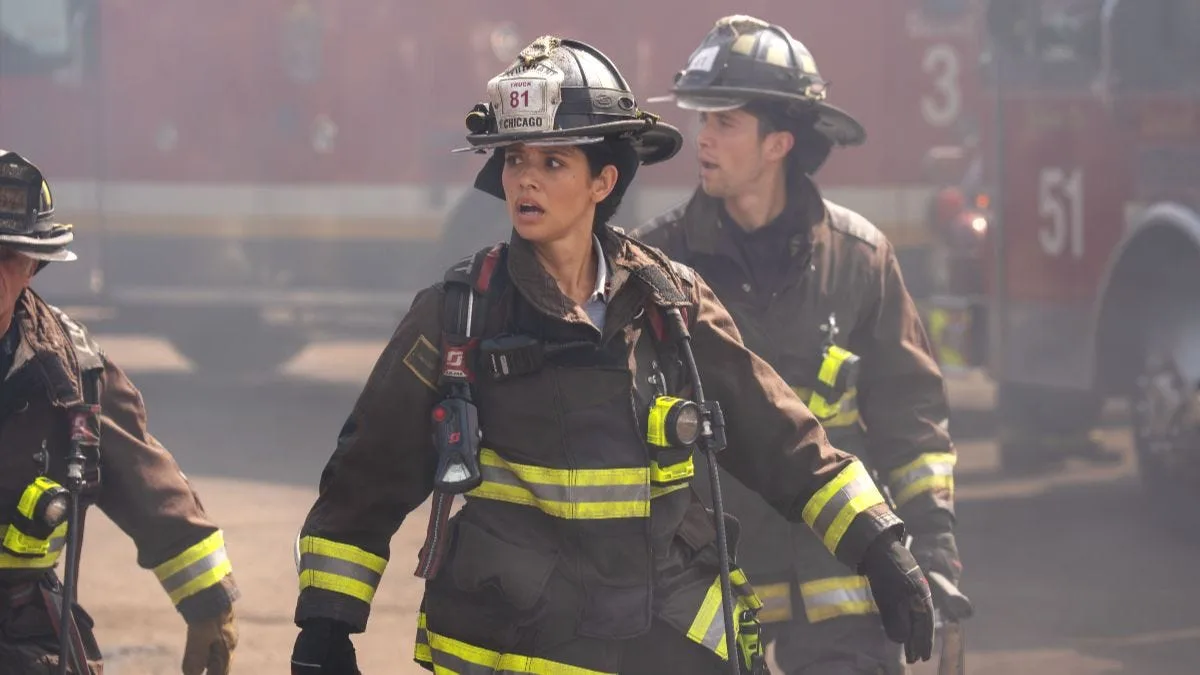
Brandon Larracuente brings natural charisma to the role. The problem isn’t his performance. The problem is the character blueprint he’s been handed, which Chicago Fire has used repeatedly. The mysterious new firefighter with a troubled past, defensive attitude, and hidden skills is a template the show has deployed for Carver, for Damon, for others before them. Even the revelation of his backstory (father imprisoned for evidence tampering) feels like Mad Libs using previous characters’ story beats.
This creates what might be called the investment problem. After watching Carver develop into a genuinely interesting character only to vanish without farewell, why should viewers emotionally commit to Vasquez? The show has trained its audience not to get attached. The protective distance viewers maintain isn’t apathy; it’s pattern recognition.
Stella gets assigned the role of managing Vasquez, which means the show positions her as both foster parent to Isaiah and surrogate parent to a grown man acting like a teenager. After Mouch offers advice about learning from the people you mentor, Stella shifts her approach slightly. She recognizes that Vasquez possesses skills and techniques from other firehouses. The moment hints at a more interesting dynamic, where mentorship flows both directions. But it gets overshadowed by Vasquez’s continued inability to follow basic orders.
The comparison to Pascal is instructive. Pascal also arrived as a new character meant to fill a significant role. But Pascal offered something different from his predecessor rather than attempting to recreate him. Vasquez doesn’t yet offer that differentiation. He’s a type rather than a character, and types wear thin quickly.
The Politics of Austerity and Storytelling Under Constraint
The season’s recurring crisis involves municipal budget cuts affecting Chicago’s emergency services. The statistics cited are grim: 49% of 911 calls supposedly go unanswered due to dispatcher shortages. An early storyline involves a paramedic falling asleep at the wheel after exhaustion, causing an ambulance crash. Violet recognizes the driver as Murphy, a friend from the academy, and tries to convince her to report the circumstances. Murphy refuses, fearing for her job.

The budget crisis serves multiple functions. Narratively, it creates obstacles and raises stakes. Practically, it provides cover for production realities. Thematically, it positions Chicago Fire as engaging with real-world issues about underfunded public services. The timing makes the fictional budget constraints feel uncomfortably plausible.
The show introduces Annabeth Gish as Annette Davis, the new mayor’s chief of staff. She meets with Pascal repeatedly to discuss the budget crisis, conversations that go nowhere productive. The subplot also gestures toward a potential romance. Davis asks Pascal out, which he declines despite having recently removed his wedding ring. His continued claim to be married, despite his wife’s death, speaks to unresolved grief.
Pascal’s evolution this season is one of the more successful elements. Season 14 moves past questions about whether he can be trusted. Pascal is now clearly established as a capable, committed leader. When he tells Severide that he’ll be responsible for multiple firehouses due to staffing shortages, it’s presented as recognition of Kelly’s capabilities. The budget storyline also creates space for Violet to shine independently. Her advocacy for Murphy demonstrates initiative and problem-solving without being tied to romantic storylines.
The structural problems emerge in the tonal inconsistencies. The show tells us that firefighters are stretched thin, constantly exhausted. Then it shows us lengthy scenes of characters relaxing at home, playing video games, having drinks at Molly’s. The disconnect between the stated crisis and the depicted reality creates whiplash. Chicago Fire has always balanced high-stakes emergencies with firehouse camaraderie. That balance feels shakier this season.
The Herrmann and Mouch subplot exemplifies this tonal confusion. After Herrmann stepped down from his lieutenant position, he decides he should keep the lieutenant’s office anyway. His suggestion that they “time-share” it doesn’t play as comedic; it makes him look selfish. The subplot does reveal that Herrmann is facing financial difficulties, which leads to Mouch offering to give up his ownership stake in Molly’s. It’s a generous gesture that also feels slightly absurd, though it gestures toward Herrmann potentially retiring to run Molly’s full-time.
Season 14’s early episodes reveal a show caught between competing pressures. The creative desire to tell stories about resilience and community. The production reality of reduced resources and cast availability. The need to maintain Chicago Fire’s essential identity while acknowledging that everything is changing. Sometimes these pressures produce interesting friction. Sometimes they just produce friction. The season hasn’t yet found stable ground, leaving viewers to wonder whether the doors being kicked down lead anywhere worth following.
Chicago Fire is an American procedural drama television series that premiered on October 10, 2012, on NBC. The series is currently in its fourteenth season, which premiered on Wednesday, October 1, 2025, on NBC. New episodes air on Wednesdays at 9 p.m. ET/PT on NBC and are available to stream the following day on the NBCUniversal streaming service, Peacock. The fourteenth season is expected to feature new plot developments, including a storyline involving potential CFD layoffs, as well as the aftermath of the Season 13 finale cliffhangers, which included a baby revelation for Stella and Severide and a major personnel change for Herrmann and Mouch.
Full Credits
Director: Reza Tabrizi, Joe Chappelle, Sanford Bookstaver, Matt Earl Beesley, Eric Laneuville
Writers: Michael Brandt, Derek Haas, Andrea Newman, Michael A. O’Shea, Michael Gilvary, Jill Weinberger
Producers and Executive Producers: Dick Wolf, Peter Jankowski, Derek Haas, Michael Brandt, Andrea Newman, Arthur W. Forney, Matt Olmstead, Danielle Gelber
Cast: Taylor Kinney, Christian Stolte, Joe Minoso, Randy Flagler, David Eigenberg, Eamonn Walker, Jesse Spencer, Kara Killmer, Miranda Rae Mayo, Anthony Ferraris
Director of Photography (Cinematographer): Lisa Wiegand, Jayson Crothers, William R. Nielsen Jr., Marc Ritzema, Anthony J. Lullo
Editors: Megan D’Arco, Micky Blythe, Oscar Rene Lozoya II, Adam Stilestein, Etienne Des Lauriers
Composer: Atli Örvarsson
The Review
Chicago Fire Season 14
Chicago Fire Season 14 stumbles under the weight of too many departures and recycled storylines. The Stellaride pregnancy reversal feels manipulative, Vasquez follows a tired template, and the budget crisis creates tonal whiplash between stated exhaustion and depicted leisure. Strong performances and Pascal's evolution can't compensate for a show that's lost its narrative footing. The revolving door of cast changes undermines the family dynamic that once defined the series. What emerges is a season that feels less like purposeful storytelling and more like damage control.
PROS
- Strong chemistry between Stella and Kelly remains intact
- Pascal's character development shows genuine growth
- Violet gets meaningful storylines independent of romance
- Timely exploration of underfunded emergency services
CONS
- Manipulative pregnancy storyline that's quickly abandoned
- Excessive cast turnover undermines emotional investment
- Vasquez follows an exhausted "rogue firefighter" template
- Repetitive foster/adoption storylines lack fresh perspective
- Tonal inconsistencies between crisis messaging and leisurely scenes