



















![Kingdom Hearts Collection [I-III] Review](https://gazettely.com/wp-content/uploads/2026/10/Kingdom-Hearts-Collection-I-III-1-360x180.webp "Kingdom Hearts Collection [I-III] Review: KHII Holds Steady as Newer Entries Fluctuate 37")



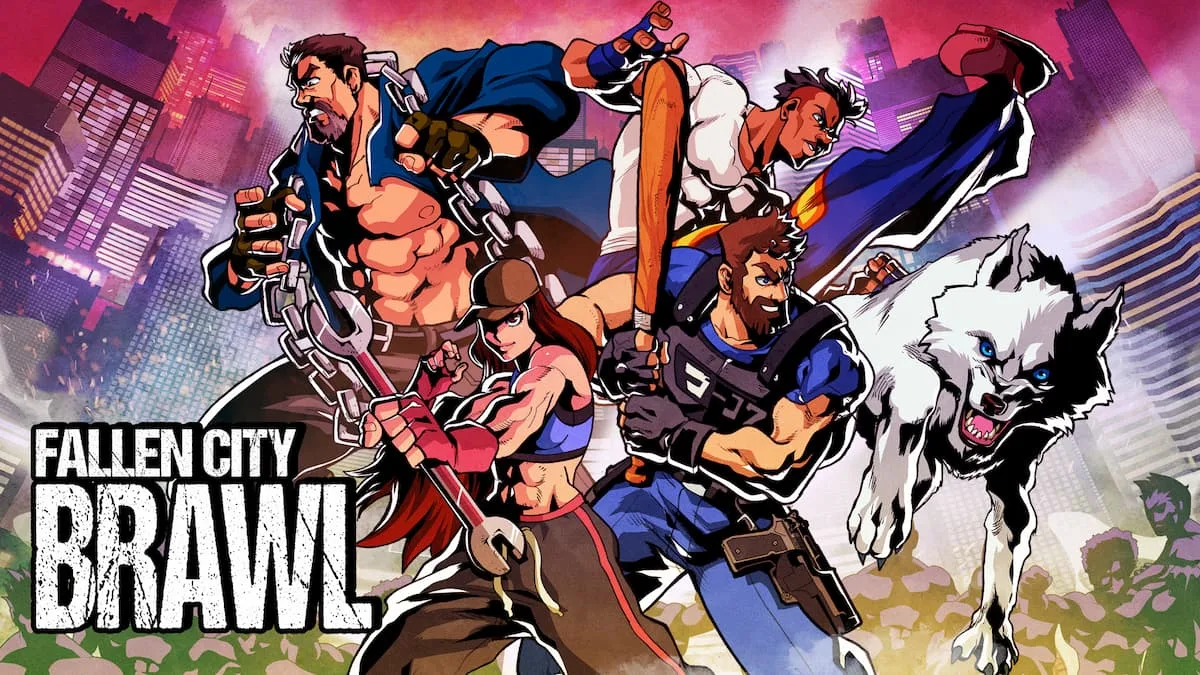

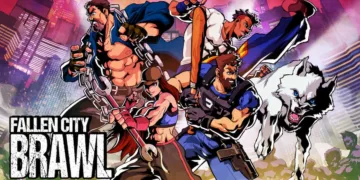
There is a specific feeling that comes from old arcade brawlers, a sense of immediate, uncomplicated purpose. Fallen City Brawl reaches for that feeling with both hands. It places you in the worn-out sneakers of a street-level hero and points you toward a clear objective.
The metropolis of Fallen City has been seized by a criminal syndicate, and its leader, a man named Ignition Gear, rules the streets. The narrative setup is as clean and direct as a side-scrolling path from left to right.
Four strangers, each with their own reason to fight, have come together to dismantle this operation one punch at a time. The game wants to transport you back to an era of straightforward action, where the story was just enough to get the fists flying.
Four Fighters, One Playbook
Your choice of character offers the first, and perhaps most significant, strategic decision. The roster includes four classic archetypes, each providing a different texture to the experience of cleaning up the streets. Sgt. Clay is the group’s foundation, an ex-SWAT officer framed for a crime he didn’t commit.
His design suggests reliability. With balanced speed and power, he serves as the perfect entry point, the Ryu or Axel of this world. His signature weapon, a shotgun, is less a firearm and more a percussive instrument of crowd control. Each blast sends a satisfying wave of force across the screen, shoving enemies back and giving you precious breathing room.
Playing as Clay feels stable and powerful; he is the anchor in a chaotic fight, the character you choose to learn the game’s fundamentals before experimenting with more specialized styles. His straightforward nature is both a strength and a weakness, offering consistency at the potential cost of long-term excitement.
Ricco, a special forces operative whose unit was wiped out by Ignition Gear, offers a completely different rhythm. He is all about speed and aggression. His attacks are a flurry of quick jabs and kicks, demanding you stay close to your enemies and overwhelm them with sheer volume. His pistol functions differently from Clay’s shotgun. It doesn’t create space; it controls it, peppering foes from a distance to interrupt their attacks or finish off weakened targets.
Playing as Ricco introduces a feeling of frantic energy. You are constantly moving, darting in and out of enemy range, managing the flow of combat through constant pressure. This makes him a high-risk, high-reward character, as his lower power per hit means you must stay in the thick of the fight longer, exposed to more potential damage.
Natasha, the mechanic searching for her sister, brings a more technical approach. She is a combo-focused fighter, designed to juggle enemies in the air. Her playstyle evokes a sense of fluid, rhythmic control, turning a street brawl into a violent dance. Her signature weapon, a cartoonishly large wrench, is thrown like a boomerang, adding a satisfying ranged option with a unique arc and impact.
Her motivation is the most personal of the group, and her fighting style reflects that focused intensity. Keeping an enemy suspended in the air with a continuous stream of attacks creates a feeling of desperate, singular purpose, a mechanical reflection of her narrative goal.
Finally, there is Iron Jackson, the hulking juggernaut betrayed by his former gang. He is the classic heavy hitter, a character whose slow, deliberate movements must be carefully considered. Every punch feels like it could shatter concrete. His use of heavy chains and Molotov cocktails adds a strategic layer unavailable to the other characters.
A well-placed Molotov can create a wall of fire, cutting off enemy paths and dealing damage over time. This transforms the play space, forcing you to think about positioning. Playing as Jackson is an exercise in patience and timing, rewarding methodical players who can anticipate enemy movements. His power is immense, though it is unfortunately undercut by reports of a game-breaking bug tied to his Chaos super move, a technical flaw that can shatter the power fantasy in an instant.
The combat system these characters inhabit is functional, built upon a single-button combo string, jump kicks, and ground attacks. The inclusion of a parry suggests a deeper defensive layer, a way to turn an enemy’s aggression into an opening. In practice, the simple enemy patterns rarely push you to master it. The game’s most original mechanic is its Gem system.
Pummeling enemies and smashing scenery releases gems that fill a special meter. This meter fuels two powerful attacks: a standard “RIOT Super” for emergencies, and the more elaborate “CHAOS Super.” This second option is a cinematic flourish, calling in backup from mercenaries who roar onto the screen in sports cars or on motorcycles, unleashing a hail of bullets. It is a moment of spectacle that briefly elevates the simple combat.
A Sprint Through the Streets
The journey to reclaim Fallen City is a short one, a full-throttle sprint that concludes before it has a chance to build any real momentum. The game’s structure, a mere seven stages, can be completed in about an hour. This rapid pacing works against any narrative ambition. The fight to save a city feels less like an epic struggle and more like a single afternoon’s violent errand.
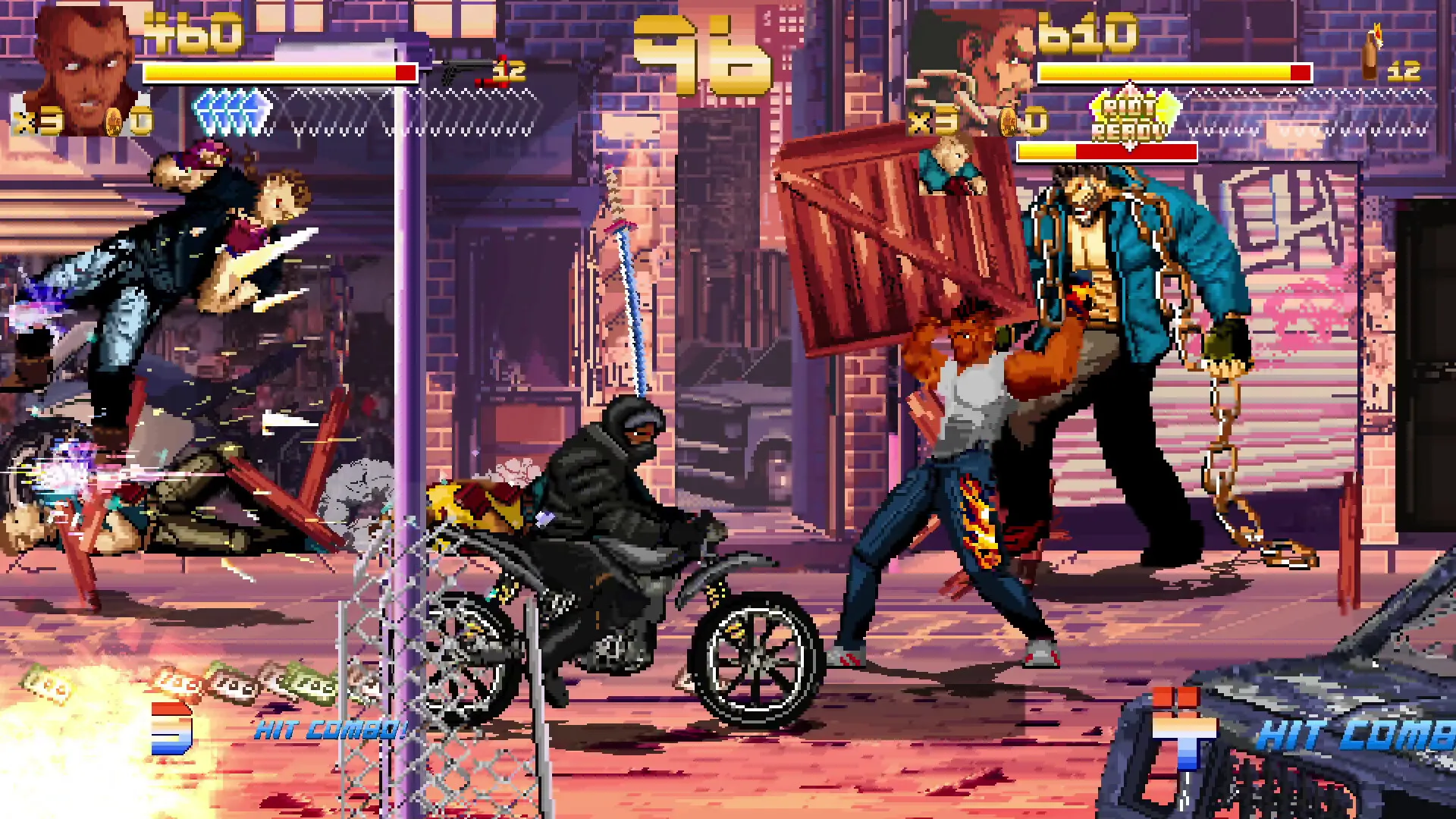
There is no time to develop a connection to the city or its heroes. The stages themselves are a tour of genre tropes: a graffiti-marked subway, an industrial beach, a dimly lit gym. They function as simple backdrops for the action but do little to establish a sense of place. Fallen City never feels like a real, breathing world with a history or a soul. It is a collection of interchangeable sets, lacking the memorable details that made the worlds of Final Fight or Streets of Rage feel iconic and lived-in.
This lack of environmental storytelling might be forgivable if the action itself sustained a high level of tension and excitement. The standard enemies, a generic assortment of thugs and goons, are little more than punching bags, easily dispatched and quickly forgotten.
The responsibility for creating memorable, climactic moments falls to the game’s bosses, the six Lieutenants who serve Ignition Gear. It is here that the game’s design stumbles most severely. A boss fight in a beat ’em up should be a test of skill, a final exam on the mechanics you have learned. It is a dramatic peak, the culmination of a level’s rising action. Fallen City Brawl’s boss encounters are the opposite of this.
The core issue is a catastrophic flaw in their design: they can be stun-locked with ease. A player can corner a boss and pummel them with a continuous combo, preventing them from ever fighting back. The fight can be over in seconds. The game’s clumsy attempt to counteract this involves giving bosses absurdly high damage values.
A single punch from a Lieutenant can cleave off more than half your health bar. This does not create difficulty; it creates frustration. The encounters become a thoughtless race to land the first hit. There is no strategy, no pattern recognition, no satisfying back-and-forth. The dramatic tension evaporates, replaced by a cheap, gimmicky exchange that feels arbitrary.
This design failure reaches its nadir with the final confrontation. The antagonist, Ignition Gear, the man whose tyranny is the entire reason for the game’s events, is just as susceptible to this flawed design. His fight is so underwhelming, so devoid of ceremony or challenge, that many players defeat him without even realizing he is the final boss.
The game simply ends. This is a critical narrative failure. The story does not conclude; it just stops. It robs the player of any sense of victory or closure, making the entire preceding hour feel pointless. A great brawler leaves you feeling like a hero. Fallen City Brawl leaves you feeling like you have simply run out of things to hit.
A Symphony with Silent Punches
The game’s presentation is a mosaic of conflicting quality, with moments of competence placed right next to baffling technical shortcomings. Visually, it aims for a chunky, satisfying arcade aesthetic. The large character sprites have a certain appeal, and many of the attack animations are fluid and impactful. You can feel the power in Iron Jackson’s swing or see the speed in Ricco’s kicks.

This cohesion is frequently shattered by a bizarre lack of consistency in the art style. Character sprites often appear to be of completely different scales, as if a G.I. Joe action figure were brawling with a He-Man collectible. The effect is jarring, constantly breaking any sense of a unified world. The environmental art suffers as well.
Certain stages are so cluttered with garish, poorly rendered pixel art that they become visually “noisy,” making it difficult to track your character or read incoming enemy attacks. The final stage, meant to be a dramatic rain-slicked street, is instead a muddy, indistinct wash of pixels that could be an aquarium or an industrial freezer.
The audio is where this inconsistency becomes most apparent, creating a profound sensory disconnect. The soundtrack, from veteran composer Daniel Lindholm, is absolutely spectacular. It is a pitch-perfect collection of high-energy rock and synth tracks that captures the spirit of the genre.
The music provides the emotional core of the experience, telling you when to feel heroic, tense, and triumphant. It does all the heavy lifting for the game’s atmosphere. This makes the state of the sound effects all the more disappointing. They are not merely bad; they are often entirely absent.
Executing a powerful super move might happen in complete silence, turning a moment of on-screen spectacle into a weightless, unsatisfying light show. Motorcycles, a common vehicle for enemy arrivals, glide across the screen without a whisper of an engine. In one stage, massive flaming beams fall from the ceiling, a clear environmental threat that should fill the soundscape with crashing and splintering.
Instead, they land as quietly as feathers. This lack of audio feedback is deeply damaging. Sound effects in an action game are crucial for confirming impacts and giving weight to your actions. Without them, punches feel like they are hitting nothing. The entire kinetic chain of action and reaction is broken, leaving the player in a strange, hollow void where the excellent music is the only thing providing any energy.
Ultimately, this lack of polish contributes to the game’s fleeting nature. There is very little to hold onto once the credits roll. In an era where modern classics like TMNT: Shredder’s Revenge pack their games with unlockable characters, alternate modes, challenges, and galleries, Fallen City Brawl offers almost nothing. There are no secrets to find, no extra content to earn.
The only reason to play again is to experience the short campaign with a different character or to try the game’s second difficulty setting. The presence of two-player local co-op is a welcome feature, yet it only allows you to share a shallow experience. The game feels less like a complete, passion-filled revival and more like a rough first draft.
The Review
Fallen City Brawl
Fallen City Brawl channels the spirit of arcade classics with a spectacular soundtrack and a functional combat foundation. This potential crumbles under the weight of broken boss encounters, absent sound effects, and inconsistent art. What could have been a worthy tribute is instead a hollow, hour-long sprint that feels unfinished. It has the right look but lacks the impact and soul of its inspirations, offering a fleeting glimpse of fun that disappears far too quickly.
PROS
- An outstanding, high-energy soundtrack.
- Four distinct playable characters with unique weapons.
- Successfully captures the visual aesthetic of a classic arcade brawler.
CONS
- Boss fights are anticlimactic and poorly designed.
- Many crucial sound effects are completely missing.
- Extremely short with almost no replay value.
- Inconsistent visuals and technical glitches.