
























![Kingdom Hearts Collection [I-III] Review](https://gazettely.com/wp-content/uploads/2026/10/Kingdom-Hearts-Collection-I-III-1-360x180.webp "Kingdom Hearts Collection [I-III] Review: KHII Holds Steady as Newer Entries Fluctuate 37")



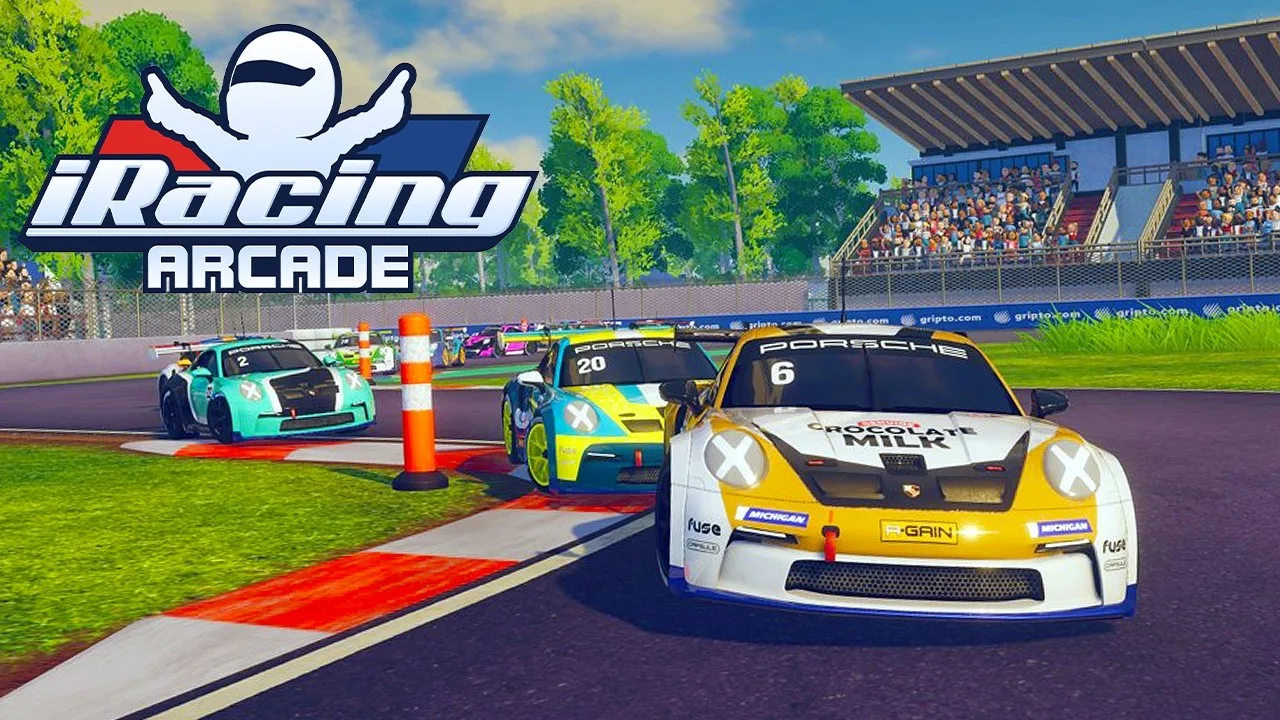

The name “iRacing Arcade” carries an immediate tension. iRacing has spent decades cultivating a reputation as the most demanding racing simulator available, a platform where serious competitors invest in elaborate setups and study telemetry like engineers. Arcade sits at the other end of the spectrum entirely. Developed by Original Fire Games, the studio behind Circuit Superstars and Karting Superstars, this is a casual, controller-friendly racer dressed in a colorful, cartoonish aesthetic. Cars are miniaturized, tracks are bright and saturated, and the whole thing radiates an approachable warmth that sits about as far from iRacing’s sterile realism as possible.
Priced at $24.99/€24.50 and currently available on PC via Steam, with console versions planned for summer 2026, iRacing Arcade brings real-world licensed tracks and car classes into that cheerful arcade package. The question worth spending time on is whether the combination actually works. Can the iRacing name carry genuine credibility into a space this casual, and does Original Fire Games deliver a racing game that earns its own place on its own merits?
Real Tracks, Real Cars, Real Limitations
The track list is one of iRacing Arcade’s stronger selling points on paper. Fourteen licensed real-world circuits are available, including Imola, Bahrain, Motorland Aragon, Tsukuba, Miami, Lime Rock, and Paul Ricard, alongside two fictional tracks returning from OFG’s previous games. The circuits are accurately modeled and genuinely fun to drive, with small touches of care throughout. Imola features Brazilian flags and flowers in the fencing near the Tamburello chicane, a quiet tribute to Ayrton Senna that mirrors the real-world memorial at the circuit.
The weakness is variety. None of the tracks offer alternative layouts, leaving players with a single configuration per venue. Environments also tend to look similar across circuits, with consistent lighting conditions that reduce any sense of traveling to different corners of the world. Over a full career, back-to-back races on the same track in different series compounds that feeling.
The car roster is where the content feels thinnest. Eight cars span tin tops, open-wheel, and prototype classes, starting with the Fiat 500 and progressing through Formula Junior, GT cars, Formula 4, Formula GP, GTP, and LMP2. Only two are fully licensed real-world vehicles: the Fiat 500 and the Porsche 911 GT3 Cup. The absence of oval racing and rallycross disciplines is a curious gap, given that both exist within iRacing’s own catalogue and OFG’s earlier work.
Presentation is polished. The visual style refines OFG’s trademark miniaturized aesthetic with more detailed car models and a shift to third-person camera view. Sound is functional rather than memorable, though the Formula GP’s V10 engine note rather than a modern hybrid tone is a pleasing choice. The game runs exceptionally well on PC, handling lower-spec hardware like the MSI Claw without issue, and performs well on Steam Deck too. A few UI omissions linger throughout: no speedometer, no tachometer, and no rear-view mirror.
Floaty by Design
The driving model in iRacing Arcade is genuinely forgiving. Cars carry high grip, steering is crisp and responsive, and breaking traction is something that rarely happens accidentally. The automatic gearbox and locked third-person camera remove any mechanical complexity from the player’s plate, with no setup adjustments available. What remains is pure racing: throttle, brake, and steering, with the racing line doing more work than either of the first two.
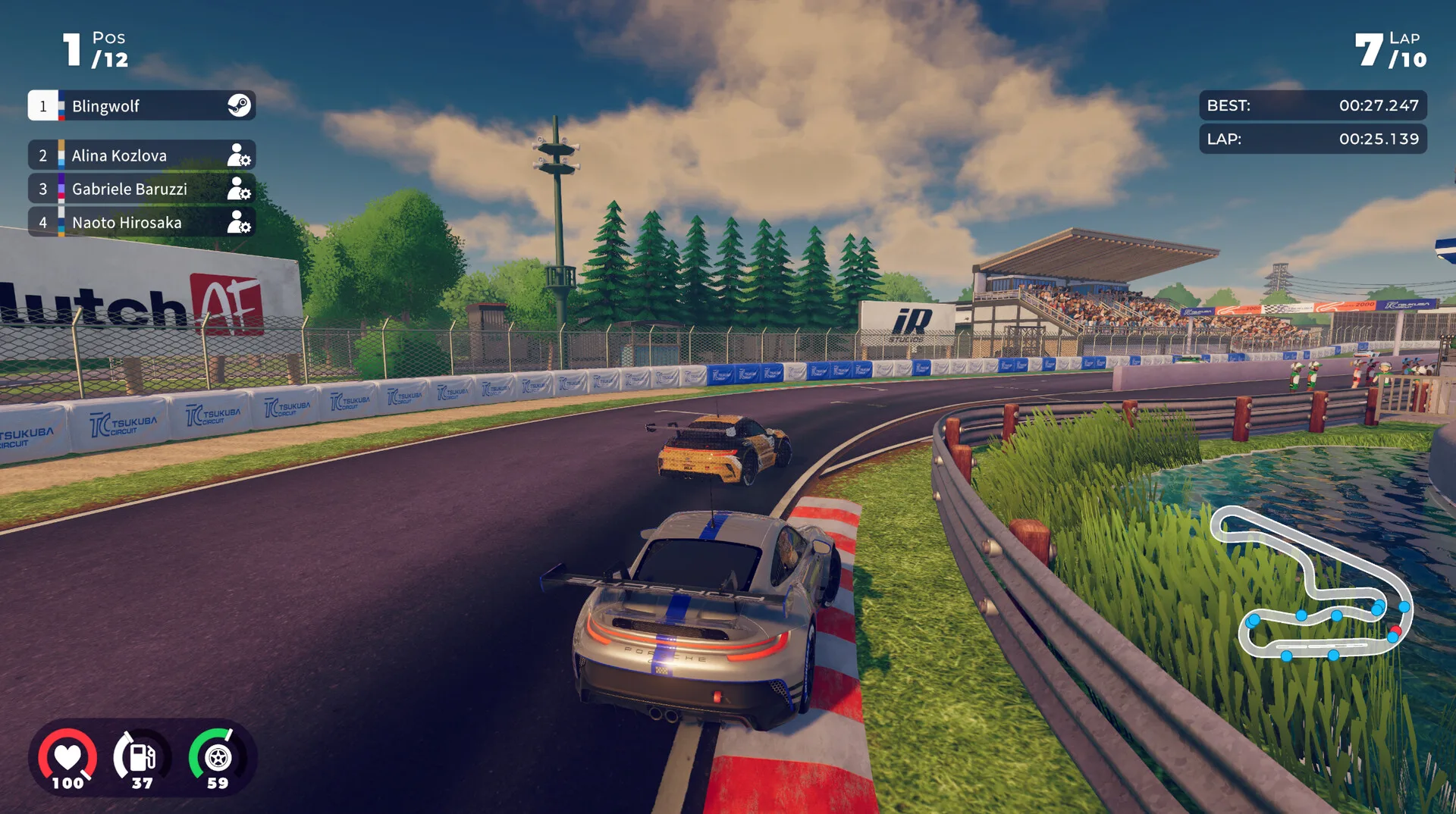
That approach holds up well at lower car classes. The Fiat 500 handles in a way that feels satisfying, letting players learn the tracks and build a feel for the physics without anything fighting them. Slipstreaming works meaningfully too, providing a real speed boost when running closely behind another car, with a subtle airflow visual effect to mark it. Tire wear gradually reduces grip, and hitting curbs produces small handling disturbances. These are light echoes of real racing behavior, layered in without making the game feel heavy.
The problem surfaces with faster cars. Small steering inputs produce snappy, exaggerated responses that make the higher-class vehicles significantly less enjoyable to drive on a controller. The Fiat 500 and mid-tier cars feel right. The Formula GP and prototype classes feel like they are pushing back against the player.
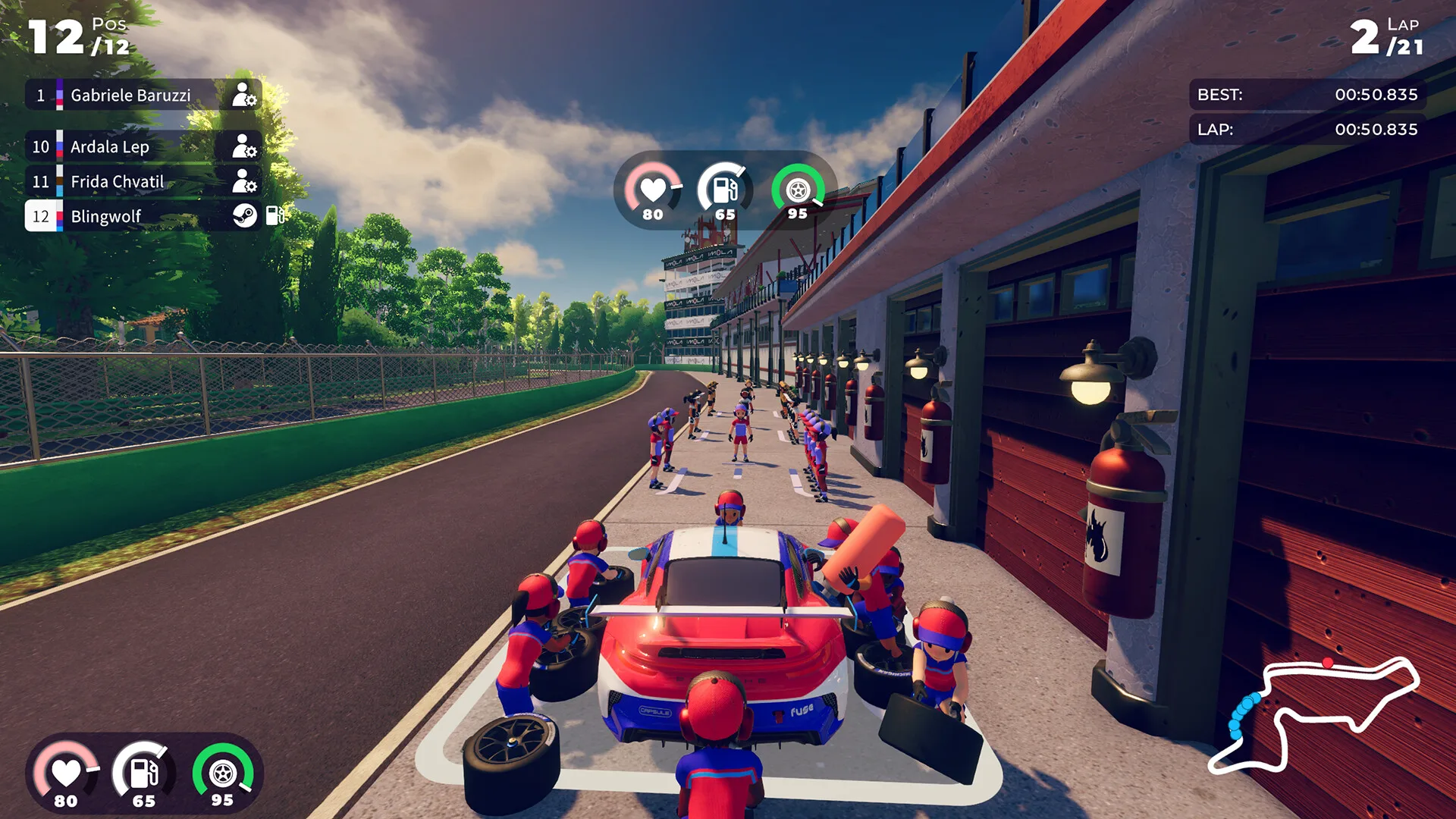
Race structure evolves through the career. Early events run three to five laps and focus purely on racing. Longer endurance races are introduced gradually, adding fuel and tire management and requiring pit stops. The pit mechanic itself is straightforward: drive into a highlighted stall and the animated crew handles everything. Tire changes are quick; refueling takes longer, and leaving early risks running short on fuel. The game auto-calculates the correct fuel load for the remaining distance, which removes meaningful decision-making from the stop itself.
AI pit strategy is predictable. Opponents almost always wait until the final possible lap before pitting, and once you recognize the pattern, it becomes easy to exploit. The penalty system is similarly loose. Vehicle contact does not trigger penalties unless driving is almost cartoonishly reckless, and there are no incident points. Car health degrades gradually through contact, slowing the car as it drops, and that consequence does most of the work of keeping players from driving like bumper cars.
Building a Team, One Race at a Time
iRacing Arcade opens its career with a license test at Lime Rock Park, run in the Fiat 500. For anyone with prior racing game experience, it functions as a brief introduction to the controls. The license concept then disappears entirely, which feels like an early signal that some of the game’s structural ideas do not fully follow through on their potential.
The career spans eight racing series, from the Fiat Pilot Challenge through Formula Junior, the Porsche GT3 series, and eventually the Sportscar Championship. Each season runs 13 weeks, with players able to enter multiple series per week. The structure is clear and easy to read, with each week asking players to manage their campus before heading to the track.
The campus system is the career’s most distinctive feature. Players develop a plot of land by constructing buildings: a Team HQ to hire AI drivers to race in your place, a Garage for livery customization and car storage, plus R&D, Chassis, and Engine Shops that each generate passive race boosts. These boosts, ranging from extra horsepower to improved fuel efficiency or added health points, are drawn randomly from each building’s pool. Only two can be equipped per car per week, which introduces light strategic thinking around which events to prioritize. Buildings level up at XP and cash thresholds, can be demolished to make room, and the campus accepts decorative touches like roads, trees, and trophy monuments.
The economy runs on XP and coins earned through race results, both scaled by difficulty. All cosmetic content, including liveries, driver suits, and helmet designs, is purchased with in-game currency. There are no microtransactions, which is worth stating plainly given how often games at this price point reach for them.
The career loop generates a genuine pull. Races are short enough that sitting down for one always risks turning into five. The valid criticism is that the experience does not evolve structurally as the series advance. Cars get faster and competition sharpens, but the rhythm of each week stays the same from start to finish.
Company on Track, and Online
iRacing Arcade’s AI behaves like arcade AI should at its best: competitive, physical, and willing to throw an elbow. Door-to-door contact is frequent and expected, and at lower difficulty settings the opposition provides a fair challenge for newcomers without being overwhelming. The mid-range difficulties are the sweet spot for casual players, aggressive enough to keep races engaging without becoming a frustration exercise.
At higher difficulty settings, that balance breaks down. Opponents dive-bomb corners, run into the back of the player’s car, and push wide on corner exit with little apparent consequence. The deeper issue is that AI cars seem largely immune to the health bar system that governs the player’s vehicle. Driving into a competitor can chip away at your own health while theirs remains unaffected. The AI also pits in a near-identical pattern across every race, always holding out until the last possible lap. Once recognized, this becomes easy to exploit rather than interesting to strategize around.
Online multiplayer supports up to 12 players per session, but there are no public lobbies or automatic matchmaking. Joining a race requires a lobby code, which significantly limits spontaneous play. Custom lobbies can be filled with AI opponents, making the feature viable for small groups at least. There is no local multiplayer option. Time trial leaderboards offer some competitive outlet, though they are a solo activity. One genuinely positive note: the game requires no subscription, a direct contrast to the main iRacing platform, meaning the full online experience is available with a single purchase.
Who Is This For?
At $24.99/€24.50, iRacing Arcade asks a fair price for what it delivers. The career mode has enough pull to justify the cost for players who connect with its loop, and the campus building system gives it an identity that most arcade racers lack.
The audience this suits best is fairly specific: newcomers to racing games who want accessible competition on real-world tracks, and casual players looking for something low-stakes to pick up without much commitment. Sim racers and experienced players will likely exhaust the content quickly. Eight cars, 14 tracks, and eight series have a ceiling, and they reach it faster than the game might like.
There is a quiet logic to the iRacing branding here. Players who grow comfortable with real circuits and car classes in this format may find themselves curious about the fuller simulator. Console versions arriving in summer 2026 should extend the game’s reach to exactly the audience it is designed for.
iRacing Arcade is a high-energy, third-person racing game that blends approachable arcade mechanics with the authentic pedigree of the iRacing simulation brand. Developed in collaboration between iRacing Studios and Original Fire Games (the creators of Circuit Superstars), the title features a charming, stylized art style with “pocket-sized” versions of officially licensed real-world cars and tracks. Players can engage in a robust career mode that involves building a motorsport empire from a backyard garage to a world-class facility, managing drivers, and upgrading equipment. Released on March 3, 2026, the game is currently available on PC via Steam, with planned releases for PlayStation 5 and Xbox Series X|S scheduled for later in 2026.
Full Credits
Director (Creative/Game Director): Dave Kaemmer, Carolina Mastretta, Alberto Mastretta
Writers (Lead Writer/Narrative Designer): Chris Leone
Producers/Studio Leadership (Producers, Executive Producers, and Key Studio Heads): Tony Gardner (President), John Henry (Co-Founder), David Kaemmer (CEO/Technical Director), Tyler Hudson
Lead Voice Cast: Jason Donovan (Spotter), various announcer and pit crew voice-overs
Art Director/Lead Artist: Alberto Mastretta, Carlos Mastretta
Key Engineering/Technical Leads: David Kaemmer, Eric Hudec, Christian Folkers, Thorsten Folkers
Composer/Sound Director: Gregory Hill (Sound Director), Original Fire Games Audio Team
Developer, Publisher: iRacing Studios, Original Fire Games, iRacing
Release Date: March 3, 2026 (PC)
The Review
iRacing Arcade
iRacing Arcade is a cheerful, well-made arcade racer that knows its audience. Original Fire Games delivers polished presentation, a genuinely engaging career loop, and accessible racing on real-world circuits. The campus building system gives the game a personality most arcade racers never develop. What holds it back is content volume, a snappy handling model that falters with faster cars, and AI that turns unpleasant at higher difficulties. For newcomers and casual players, it earns its price. For anyone expecting depth matching the iRacing name, it falls short.
PROS
- Accessible, fun driving model for slower car classes
- Career mode campus system is genuinely engaging
- Real-world licensed tracks modeled with care
- Excellent PC optimization across hardware
- No subscription required for online play
CONS
- Only eight cars, with faster classes feeling twitchy on controller
- Fourteen tracks with no alternative layouts grows repetitive
- AI becomes unfair and damage-asymmetric at higher difficulties
- No public lobbies or matchmaking for online play
- No oval or rallycross disciplines despite iRacing's catalogue







