



























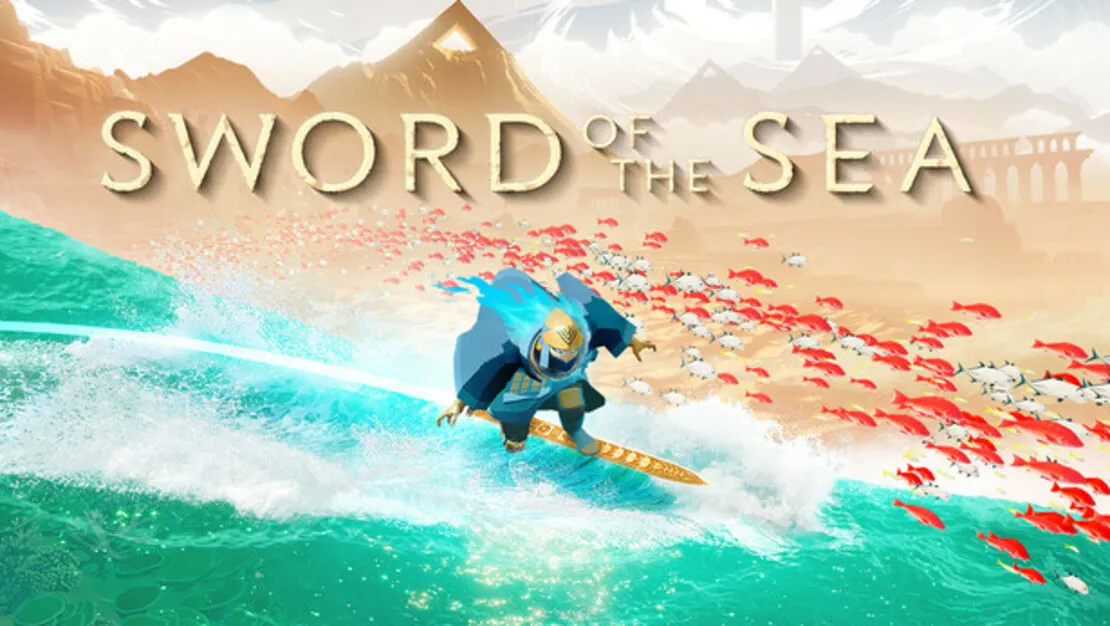

It begins with a single drop of water. In a dark, still chamber, the liquid strikes a forgotten statue, and a being of myth stirs. You are the Wraith, a silent protagonist awakened into a world bleached by sun and time. Before you lies a vast, arid kingdom of sand-choked ruins and sprawling deserts. Your only tool, and your only hope, is the hoversword.
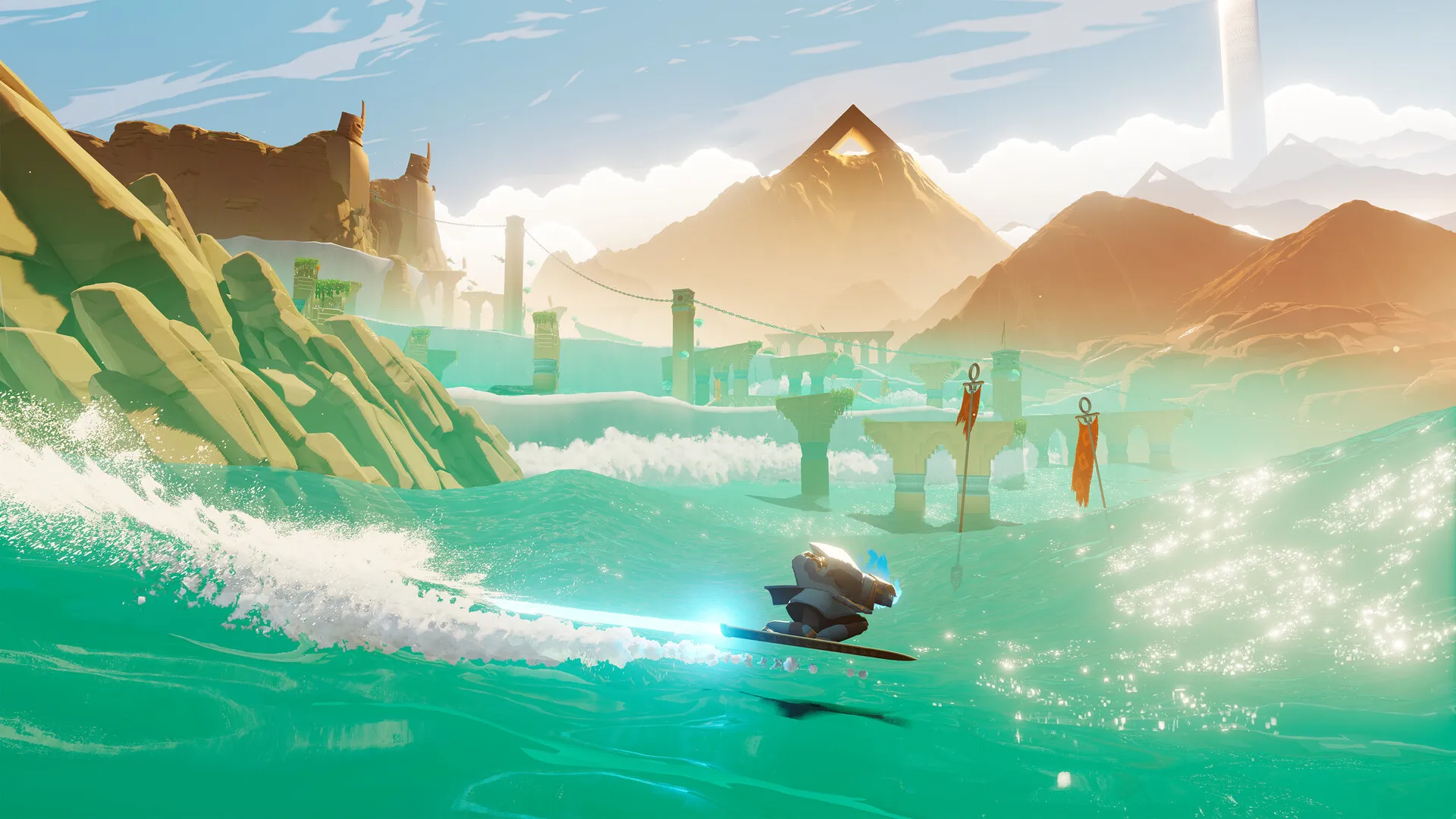
This blade is your constant companion, a multi-purpose marvel that acts as a surfboard on waves, a skateboard in ancient temples, and a snowboard on frozen peaks. Your purpose is simple yet immense: to ride across this desolate landscape and restore its lost ocean. The world is an expansive, quiet mystery, filled with the ghosts of what once was. Your passage through it promises to bring life back to the dust.
Kinetic Poetry
The core of Sword of the Sea is its movement. Riding the hoversword is a fluid, almost dreamlike experience built on the principle of uninterrupted flow. The game wants you to feel graceful and powerful. This design philosophy stands in stark contrast to many games centered on board sports.
Think of the Tony Hawk’s Pro Skater series, where the primary joy comes from mastering a complex system through trial, error, and countless bails. The thrill in those games is born from punishing precision and the eventual conquest of a difficult challenge. Sword of the Sea is not interested in that kind of mastery. Here, failure is almost entirely absent.
There is no face-planting into concrete or tumbling down a mountainside to break your combo. The mechanics are exceptionally forgiving. You glide effortlessly over minor obstacles, and the system subtly guides your landings, ensuring your rhythm remains unbroken. Small ledges seem to have a slight magnetic pull, and jump pads in the form of ethereal jellyfish will gently drift toward you if your trajectory is slightly off.
This focus on maintaining momentum creates a meditative state for the player. The joy is not in the destination, or even in the perfection of a specific trick, but in the simple, continuous act of motion. This feels like a direct evolution of the ideas in Giant Squid’s previous game, The Pathless, where speed was maintained by rhythmically shooting targets.
That system, while creative, still tethered the player to a set of specific points. Sword of the Sea severs that tether, granting a purer sense of freedom. The world itself is a massive, organic skatepark. Every rolling dune is a ramp, every crumbling aqueduct a rail to grind, and every valley a natural half-pipe. This design encourages you to build and maintain speed, turning simple travel into a hypnotic act of performance.
The experience is heightened with a DualSense controller, where the haptic feedback and integrated speaker communicate the texture of every surface. You feel the soft grit of sand giving way under your board, the deep thrum of gliding over a vast body of water, and the sharp, percussive clatter of skating over ancient tiles. This detailed sensory feedback grounds you completely in the physical act of motion, making the traversal a rich and tactile experience.
Painting with Water
The gameplay loop is a satisfying cycle of action and spectacular reaction, and it is here that the game’s narrative truly unfolds. In each large region, your goal is to find and reactivate dormant mechanisms, ancient relics of a forgotten civilization. The process of reaching them forms the basis of the exploration, but the result of your actions is where the storytelling happens.
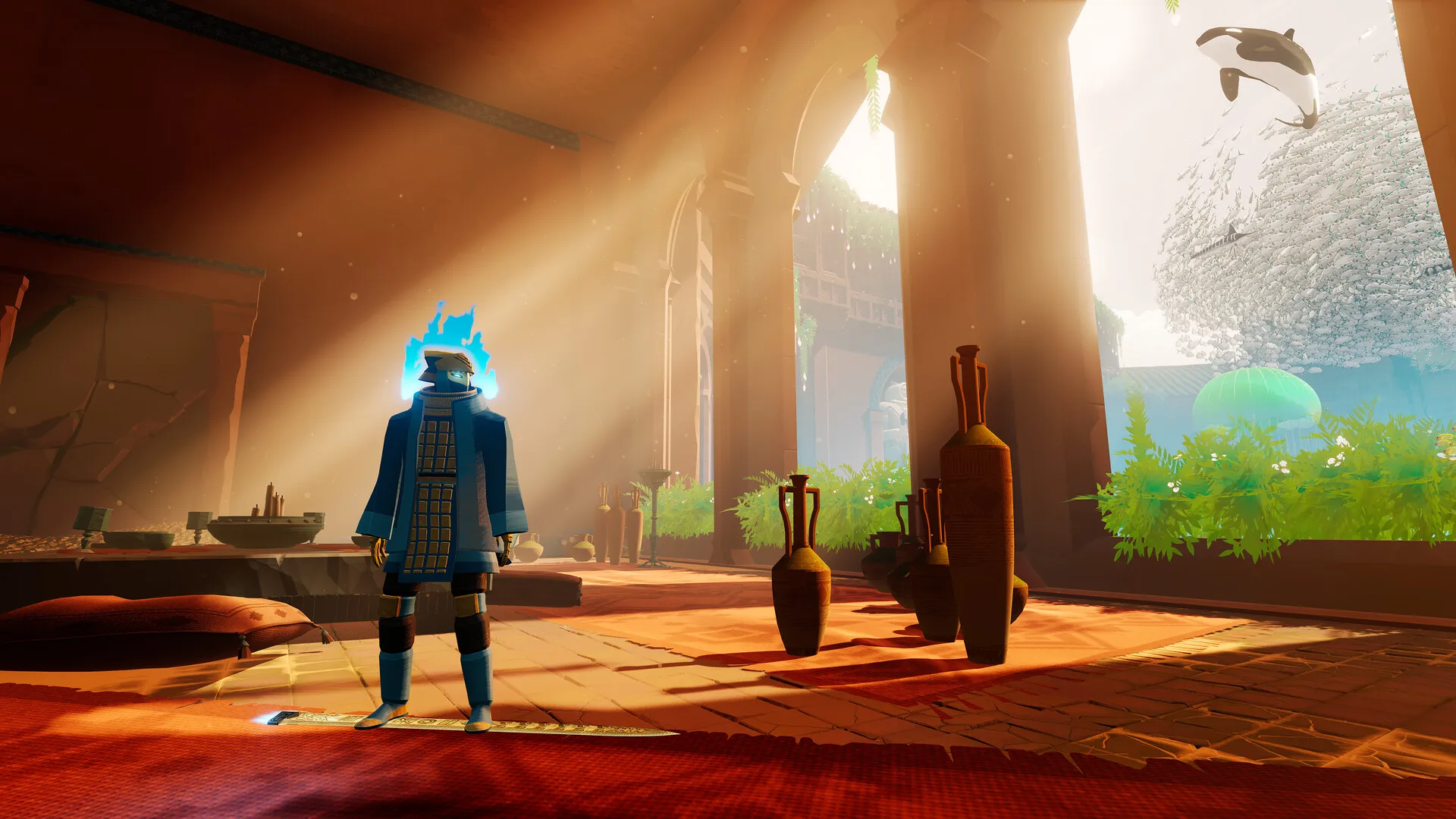
Activating these points unleashes a torrent of life-giving water that transforms the environment before your eyes. A sun-baked canyon can become a teeming river, and a vast desert can reveal the lost ocean floor resting just beneath the sand. This transformation is the game’s central reward and its primary method of narrative progression. You are not told a story about a world being healed; you are the direct agent of that healing, and you witness the consequences in real time. The narrative arc of each level is this visible, tangible shift from desolation to life.
The pacing of these moments is deliberate. The game often presents you with a massive, dormant landscape, instilling a sense of purpose. The subsequent search for the trigger points feels like a quiet pilgrimage. When the water finally rushes in, the sequence is treated as a cinematic and emotional climax.
The visual payoff is immense, as schools of manta rays and colossal whale sharks appear to swim through the air, and the barren ground sprouts otherworldly flora. This change is also mechanically significant. The new waterways create different traversal routes and open up previously inaccessible areas, inviting you to re-explore the level with a fresh perspective.
The puzzles that gate this progress are intentionally simple, often requiring you to find three switches or activate a series of runes. This design choice wisely keeps the focus on movement and spectacle. Complex environmental puzzles would force the player to stop and analyze, breaking the state of flow that is so central to the experience.
The puzzles here function as signposts, not roadblocks, gently guiding you through the world without ever arresting your momentum. Exploration is rewarded not just with a collectible, but with the profound satisfaction of seeing the direct, beautiful result of your presence.
An Unspoken Symphony
The game tells its story not with words, but with a masterful command of color, scale, and sound. The visual presentation is magnificent, employing a striking art style that feels both grand and intimate. The camera frequently pulls back to frame the tiny player against immense, awe-inspiring backdrops, creating a sense of scale that evokes the classic wide-screen epics of cinema.
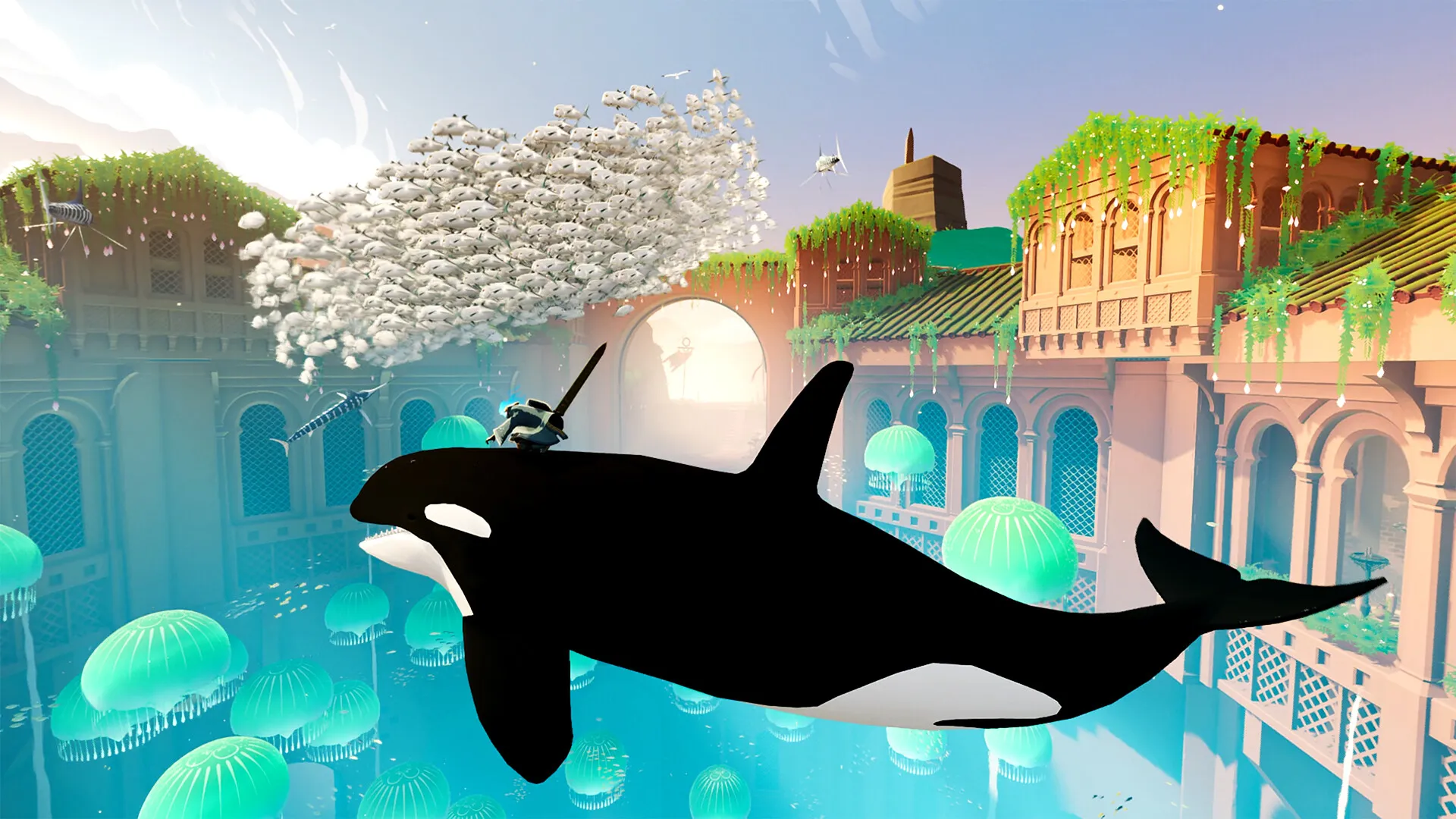
The art direction uses a powerful color theory to communicate the state of the world. Desolate areas are often rendered in muted, monochromatic palettes of brown and grey, conveying a sense of age and decay. Upon their restoration, these same areas explode with saturated blues, greens, and golds, a visual language that speaks directly of hope and renewal. The world feels like a living painting, one that you are actively helping to complete.
This visual splendor is elevated by Austin Wintory’s masterful score. The music here is not mere background ambiance; it is a reactive, dynamic system that functions as the game’s emotional core. It swells and recedes based on your speed, your location, and key story beats. During quiet exploration, it is understated and atmospheric. As you build speed and crest a massive dune, the orchestra rises to meet your exhilaration.
In the climactic moments of transformation, the music becomes a powerful, soaring anthem. It provides the awe, melancholy, and triumph that the silent protagonist cannot express. The world’s history is pieced together through environmental clues, like murals on crumbling walls and ancient stelae that hint at a great conflict and a subsequent drought. These elements, combined with the immaculate sound effects that convey your speed and impact, create a powerful and immersive sensory experience that speaks a universal language of loss and rebirth.
The Gentle Tide
Other game systems are present but are carefully implemented to serve the core experience. A trick system allows for expressive flips and spins, but it remains shallow by design. Players can purchase new moves from a mysterious vendor, but the game never demands complex combos or high scores outside of a few optional, timed challenges in dedicated skate-park zones.
This makes the trick system an accessible layer of flair, available for those who want to engage with it without becoming a barrier for those who simply want to enjoy the ride. The game is also quite short, lasting only three to five hours. This brevity works in its favor. It ensures that the simple puzzle design never feels tedious and that the spectacle of the world’s transformation remains potent from beginning to end. It is a concentrated shot of wonder, a perfectly paced experience that respects the player’s time and never risks diluting its own impact.
A few sequences where you control giant sea creatures do, however, disrupt the game’s otherwise impeccable flow. These moments feel heavy and imprecise, a stark contrast to the hoversword’s elegance. While they succeed in creating a sense of drama and scale from a narrative standpoint, the mechanical execution feels clunky and undermines the physical joy that defines the rest of the game.
It’s a rare instance where the gameplay is misaligned with the intended emotional response. These are minor stumbles in an otherwise graceful performance. A New Game Plus mode is available for those who wish to revisit the world, adding on-screen displays for speed and trick scores.
This is a smart addition that provides tools for a more mechanics-focused replay without compromising the purity of the first playthrough. The game succeeds because it understands its own purpose. It is not a test of skill or a complex narrative epic. It is a sensory experience, a piece of interactive art designed to evoke feelings of freedom, awe, and serenity.
The Review
Sword of the Sea
Sword of the Sea is a breathtaking piece of interactive art. It trades mechanical depth for a sublime sense of flow, creating an unforgettable and meditative experience. Its power lies in its spectacular visuals, a masterful score, and a traversal system that feels like kinetic poetry. While its puzzles are simplistic and a few moments falter, the game's short, focused journey is a cascade of awe-inspiring beauty. It is a testament to how gameplay can evoke pure, unadulterated joy.
PROS
- Exceptionally fluid and forgiving traversal system.
- Stunning art direction and world transformation.
- A powerful, dynamic score by Austin Wintory.
- Creates a profound sense of meditative flow.
CONS
- Puzzles are overly simple and repetitive.
- Sequences controlling giant creatures feel clunky.
- The trick system is underdeveloped.