
























![Kingdom Hearts Collection [I-III] Review](https://gazettely.com/wp-content/uploads/2026/10/Kingdom-Hearts-Collection-I-III-1-360x180.webp "Kingdom Hearts Collection [I-III] Review: KHII Holds Steady as Newer Entries Fluctuate 37")




There is a curious trend in modern television, a kind of creative alchemy that attempts to spin single-serving comedy sketches into multi-season narrative gold. For every roaring success that becomes a cultural touchstone, there are countless others that demonstrate the difficulty of stretching a ninety-second joke into six hours of television.
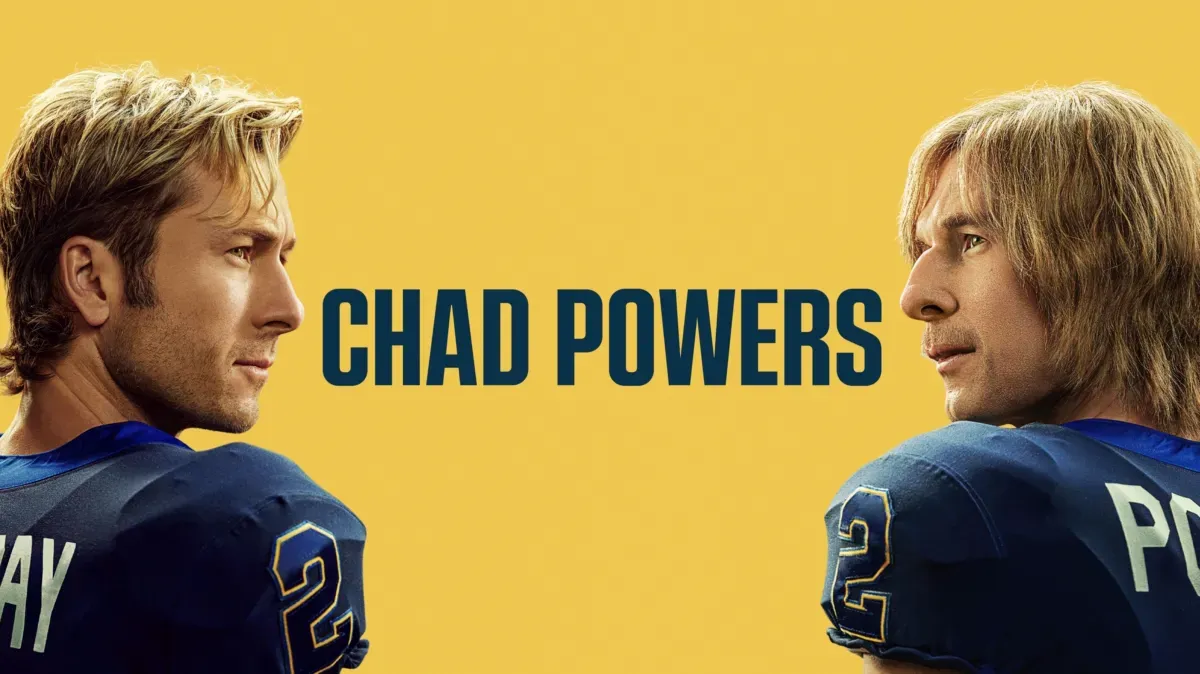
Into this crowded field walks Chad Powers, a series with a premise so profoundly absurd it feels less like a pitch and more like a dare. Based on an old ESPN+ stunt featuring Eli Manning, the show asks a simple, baffling question: What if a disgraced college quarterback, eight years past his prime, tried to sneak back into the sport using a bad wig and a face full of latex? The man is Russ Holliday, a once-great player whose career imploded in a spectacular fumble during the national championship.
His on-field failure was matched only by his off-field arrogance, cementing his status as a football pariah. Now, hearing of open tryouts at a small Georgia university, he concocts a plan born of pure desperation. He will become Chad Powers, a mild-mannered, homeschooled walk-on with a mysterious past and a golden arm. It is a ridiculous, high-wire act of a concept, one that teeters constantly between inspired lunacy and outright collapse.
The Man in the Latex Mask
The entire flimsy architecture of Chad Powers rests on the shoulders of Glen Powell, who delivers a masterful dual performance that is the show’s primary reason for being. His Russ Holliday is a magnificent creation of modern douchebaggery. Powell refuses to sand down the character’s edges, presenting him as a crypto-touting, conspiracy-spouting man-child who navigates the world with an unearned swagger.
He is the kind of guy who gets turned down by the “hawk tuah girl” and somehow believes it is her loss. The show makes no apologies for his deeply unlikeable nature, forcing the audience to grapple with a protagonist who offers few reasons to be cheered. It is a testament to Powell’s inherent charisma that Russ remains watchable, a compelling train wreck you cannot look away from.
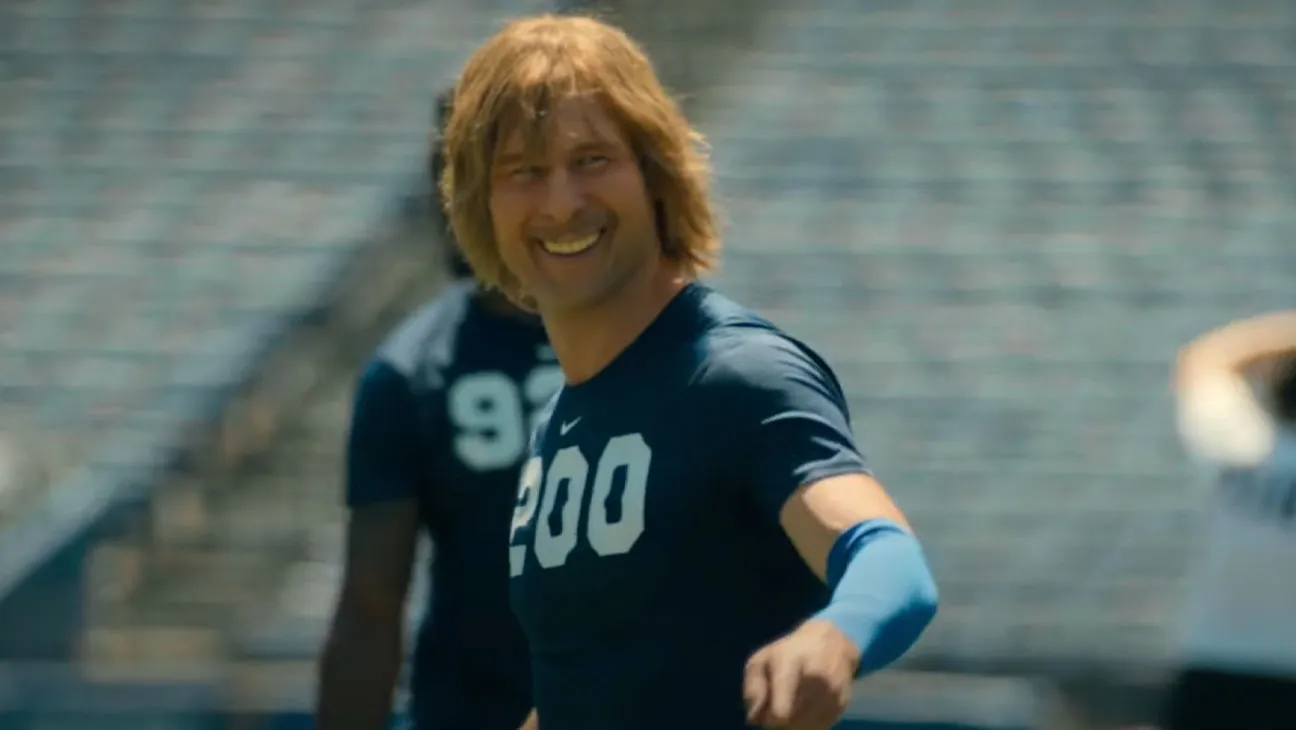
Then, with the application of some unconvincing prosthetics, he transforms. Chad Powers is Russ’s polar opposite, a vessel of aw-shucks humility and wide-eyed sincerity. Powell adopts a reedy, high-pitched accent that sounds like a nervous teenager doing a Foghorn Leghorn impression. His physicality shifts completely; the confident strut of Russ is replaced by Chad’s awkward, slightly hunched posture, as if he is trying to shrink into himself.
Director Tony Yacenda often frames him from low angles on the field, making him look like an unlikely titan, while in conversation he seems small and lost. This role feels like a spiritual successor to Powell’s chameleonic work in Hit Man, another story about identity play, but here the comedy is broader and the stakes are somehow both lower and more personally humiliating.
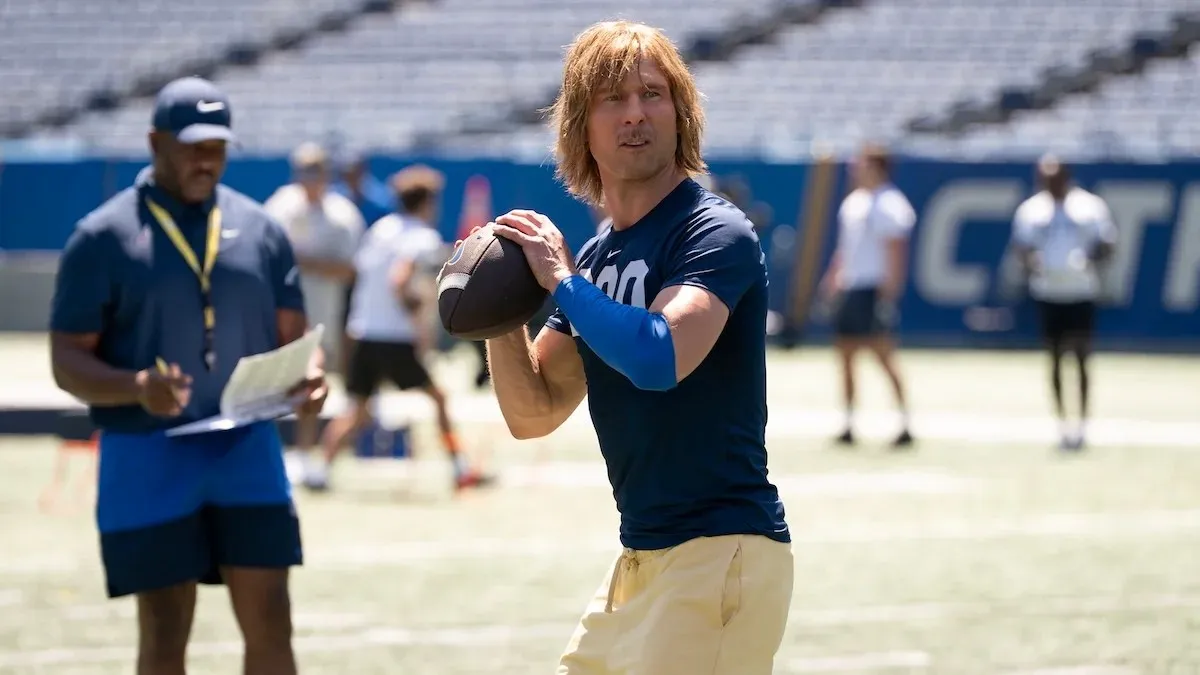
His convincing athleticism during the football sequences, a product of his own high-school playing days, provides a crucial dose of authenticity. Without Powell’s complete commitment to both the odious Russ and the lovable Chad, the show’s central conceit would simply evaporate.
A Game of Laughs and Groans
As a comedy, Chad Powers is a study in inconsistency, its playbook filled with both brilliant calls and baffling fumbles. The show is at its funniest when it leans into the sheer logistical nightmare of Russ’s deception. The tension is palpable in scenes where Chad’s prosthetic nose threatens to melt off in the Georgia heat or when a celebratory dunk in a swimming pool becomes a moment of sheer panic.
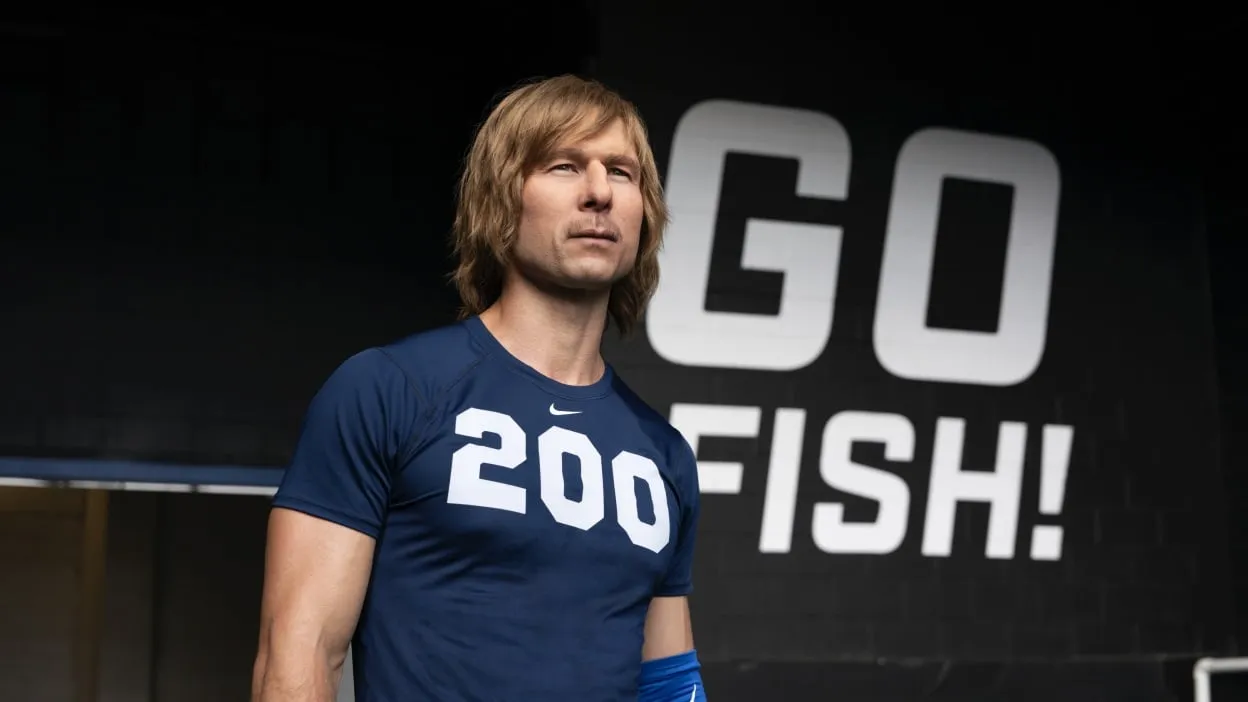
The humor is sharpened by crisp editing that cuts between Chad’s awkward improvisation and the suspicious faces of his coaches. The lies themselves become a source of escalating absurdity. Chad’s backstory is a masterpiece of on-the-fly invention, a confusing narrative involving feral wolves, a town with no internet, and a medical condition called “pee-hole disorder” that conveniently prevents him from using the communal showers. These moments, where Russ is forced to build his fake identity in real time, are comedic highlights.
However, the show struggles to maintain a consistent tone. It attempts to be a heartwarming sports story and a foul-mouthed, R-rated comedy simultaneously, and the two sensibilities often clash. The visual language is typically bright and sunny, befitting a hopeful underdog tale, which makes the sudden detours into vulgarity feel jarring rather than subversive.
This tonal whiplash creates an uneven viewing experience. For every clever line, there is a joke that feels painfully out of date. The script repeatedly goes to the well of making fun of Chad’s perceived lack of intelligence, with characters nicknaming him after films like Radio and Slingblade. This brand of humor was already tired in the early 2000s, and in 2025 it feels lazy. The show’s occasional use of ableist slurs for a punchline is a particularly sour note, a lazy shortcut in a show filled with otherwise clever talent.
More Than a One-Man Team?
While Powell is the sun around which this entire system orbits, the supporting cast provides some necessary gravity. The show’s most effective relationship is the reluctant partnership between Chad and Danny (Frankie A. Rodriguez), the team’s mascot and Russ’s self-appointed sidekick. Rodriguez has a sharp, cynical wit that pairs perfectly with Powell’s earnest goofiness, and he often serves as the audience surrogate, voicing the utter insanity of the situation.
The script never bothers to give Danny a convincing reason to risk everything for Russ’s scheme, but the actors’ chemistry is strong enough to make you forget. Perry Mattfeld brings a quiet strength to Ricky, the head coach’s daughter and a brilliant offensive mind fighting for respect. Her professional struggle mirrors Russ’s personal one, creating a compelling, if underdeveloped, thematic link between them.
The veteran presence of Steve Zahn as Coach Jake Hudson is a consistent delight. Zahn is a master of non-verbal communication, and his weary, perplexed reactions to Chad’s existence are a reliable source of comedy. He grounds the show in a recognizable reality, even as everything around him spirals into nonsense. As Russ’s father, Toby Huss is tragically underused. Their few scenes together are crackling with the unspoken history of a strained relationship, hinting at a deeper, more dramatic show that Chad Powers rarely has time to be.
The wider ensemble of players and coaches are sketched in as familiar archetypes: the pious quarterback, the grizzled assistant, the booster-club president. They serve their narrative functions but rarely feel like people with lives beyond the football field, reinforcing the sense that this is Russ Holliday’s world and everyone else is just living in it.
Changing the Play at the Last Second
For five of its six episodes, Chad Powers runs a familiar route, adhering closely to the conventions of the sports movie genre. It dutifully checks off the boxes: the training montages scored to upbeat music, the initial hostility from teammates melting into grudging respect, the slow-burn romance with the coach’s daughter.
It is a well-worn formula, a comfortable narrative structure that has powered underdog stories from Rudy to The Mighty Ducks. The show executes these tropes with competence and charm, delivering a version of a story we have all seen before, but with enough comedic absurdity to keep it fresh. The pacing is steady, building towards what seems like an inevitable and heartwarming climax where our hero learns his lesson and wins the big game.
Then, in its final quarter, the show calls an audible. The season finale eschews the expected triumphant resolution for something far more prickly and cynical. It is a jarring tonal shift that avoids easy answers and leaves its protagonist in a morally complicated place. This abrupt turn forces a re-evaluation of everything that came before.
Was the conventional sports story simply a Trojan horse for a darker, more satirical commentary on the emptiness of redemption narratives in a corporate-driven sport? Or was it merely a clumsy, if bold, cliffhanger designed to ensure a second season? The ending hangs in the air, a Hail Mary pass into ambiguity. Does the show’s final, cynical play retroactively make the entire season a more intelligent piece of satire, or does it simply feel like a trick?
The television series Chad Powers is a sports comedy that follows Russ Holliday (Glen Powell), a disgraced college quarterback who attempts to restart his football career by disguising himself as the talented, affable walk-on, Chad Powers. The series is based on a viral sketch featuring Eli Manning. The show premieres on September 30, 2025. You can watch it streaming exclusively on Hulu in the U.S. and through Hulu on Disney+.
Full Credits
Director: Tony Yacenda
Writers: Glen Powell, Michael Waldron, Paloma Lamb, Jamie Lee, Ben Dougan, Jordan Mendoza, Luvh Rakhe, Gaelyn Golde
Producers and Executive Producers: Glen Powell, Michael Waldron, Eli Manning, Peyton Manning, Jamie Horowitz, Ben Brown, Luvh Rakhe, Adam Fasullo, Tony Yacenda
Cast: Glen Powell, Steve Zahn, Toby Huss, Perry Mattfeld, Wynn Everett, Frankie A. Rodriguez, Clayne Crawford, Colton Ryan, Keese Wilson, Xavier Mills
Director of Photography (Cinematographer): N/A
Editors: Patrick Tuck
Composer: Natalie Holt
The Review
Chad Powers
Chad Powers is a show held together by the sheer force of its star's charisma. Glen Powell's fantastic dual performance as a loathsome jock and his simple-minded alter ego is a comedic masterclass that makes the absurd premise work. However, his efforts are often undercut by a wildly inconsistent tone and a script that resorts to dated, mean-spirited humor. While its subversive finale hints at a smarter show, the journey there is a clumsy mix of brilliant plays and unforced errors. It's a flawed comedy that's more of a fixer-upper than a championship contender.
PROS
- Glen Powell’s committed and captivating dual performance.
- An absurdly funny central premise with great moments of physical and improvisational comedy.
- Strong supporting turns from a talented cast, particularly Steve Zahn and Frankie A. Rodriguez.
- A surprising and thought-provoking finale that subverts genre expectations.
CONS
- A jarringly inconsistent tone that veers between sweet sports story and crude comedy.
- Use of dated and sometimes offensive humor that misses the mark.
- Underdeveloped supporting characters and subplots that feel secondary.
- Heavy reliance on familiar sports-movie clichés for most of the season.







