



























History rarely announces its turning points with a trumpet blast. More often, it is a low hum, a change in the pressure of the air. Annemarie Jacir’s Palestine 36 places us directly inside that hum. The year is 1936, the place is Palestine under the British Mandate, and the atmosphere is thick with a volatile, precipitous energy. This is not a story with a hero; it is a sprawling, ambitious account of a society at a critical juncture, facing the systematic erosion of its existence and beginning to formulate a response.
The film functions as a kind of historical seismograph, meticulously recording the tremors of land seizure, political betrayal, and nascent rebellion that would soon erupt into a full-blown earthquake. It is a work of immense gravity, a cinematic document that looks to a specific past to ask agonizing questions about the present.
The View from Everywhere
Instead of a single protagonist’s path, the film offers a complex social cartography, mapping a nation through its disparate parts. We experience this world primarily through the travels of Yousef (Karim Daoud Anaya), a young farmer whose quiet demeanor conceals a roiling internal conflict.

He is the narrative filament connecting two irreconcilable realities, torn between a filial duty to the soil of his village, Al Basma, and the modern allure of Jerusalem. His transformation from a hopeful youth to a hardened rebel is the film’s central emotional throughline.
In the village, life is elemental. It is a world of farmers and ancient olive groves, of families like the widow Rabab’s (Yafa Bakri) who measure their history by the generations buried in the land now being signed away by distant men in suits. In the city, Yousef enters the perfumed air of the Palestinian elite.
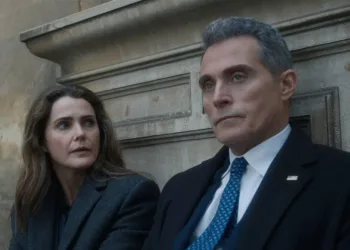
His employer, the influential journalist Amir (Dhafer L’Abidine), represents a particular kind of establishment naivete, the belief that civilized men can reason their way out of a mugging. His wife, the firebrand Khuloud (Yasmine Al Massri), writes blistering anti-colonial essays (under a male pseudonym, a delicious irony the film doesn’t belabor) yet remains insulated by her class.
Jacir masterfully exposes this chasm, most pointedly in a scene where Amir asks Yousef to explain the rural experience to his wealthy friends, only for the farmer to be immediately silenced. The condescension is suffocating; it crystallizes the internal fractures that weaken the Palestinian position from within. Adding another vector to this social geometry is Khalid (Saleh Bakri), a laborer whose radicalization is swift and absolute, born not of theory but of a foreman’s boot and the raw injustice of unequal pay.
Anatomy of a Fire
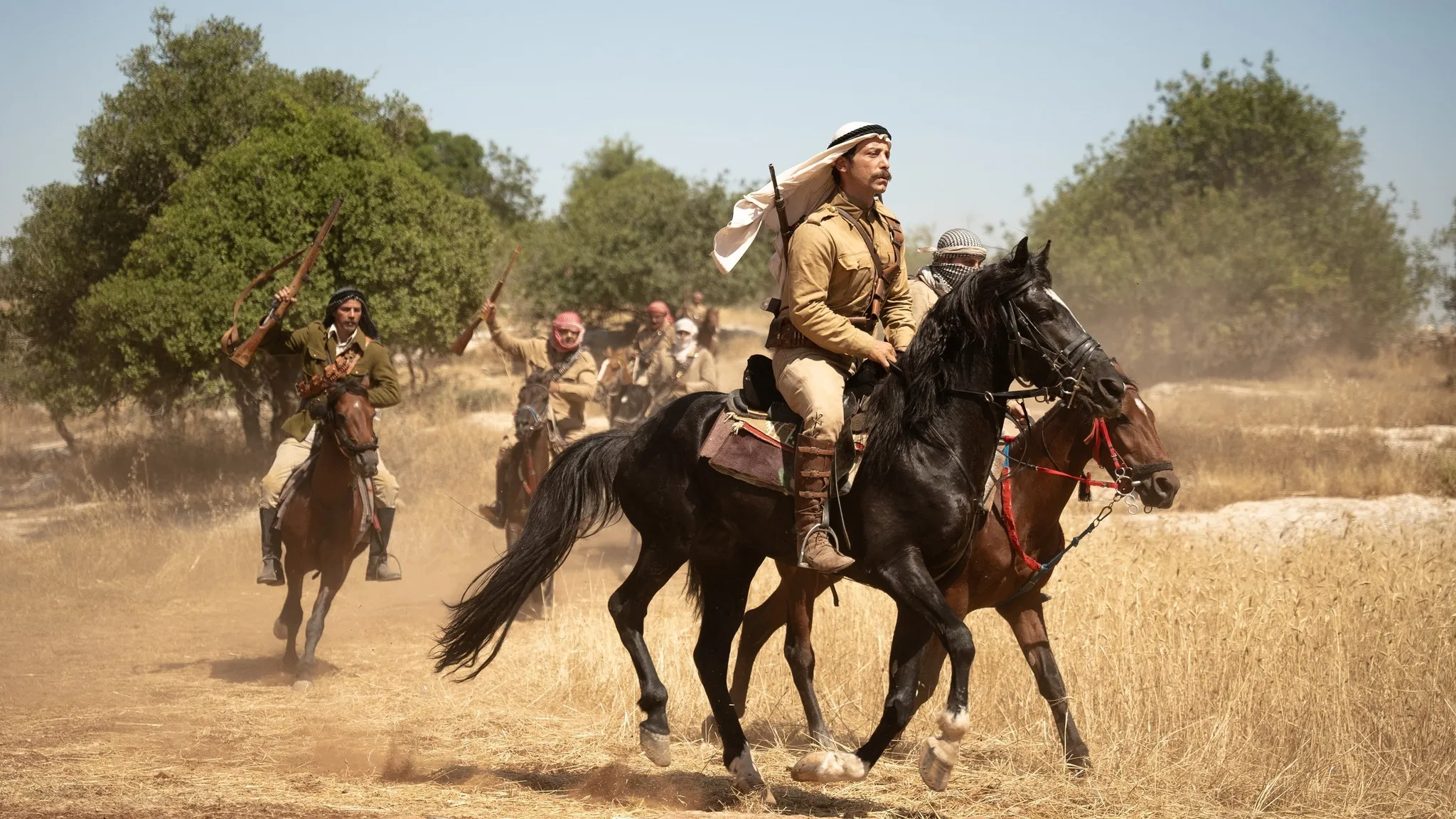
The film is a forensic study of how resistance is born. It does not erupt fully formed but evolves with the grim logic of a terminal diagnosis. It begins with the general strike, a monumental act of collective will, before moving to petitions and finally to the calculus of armed struggle.
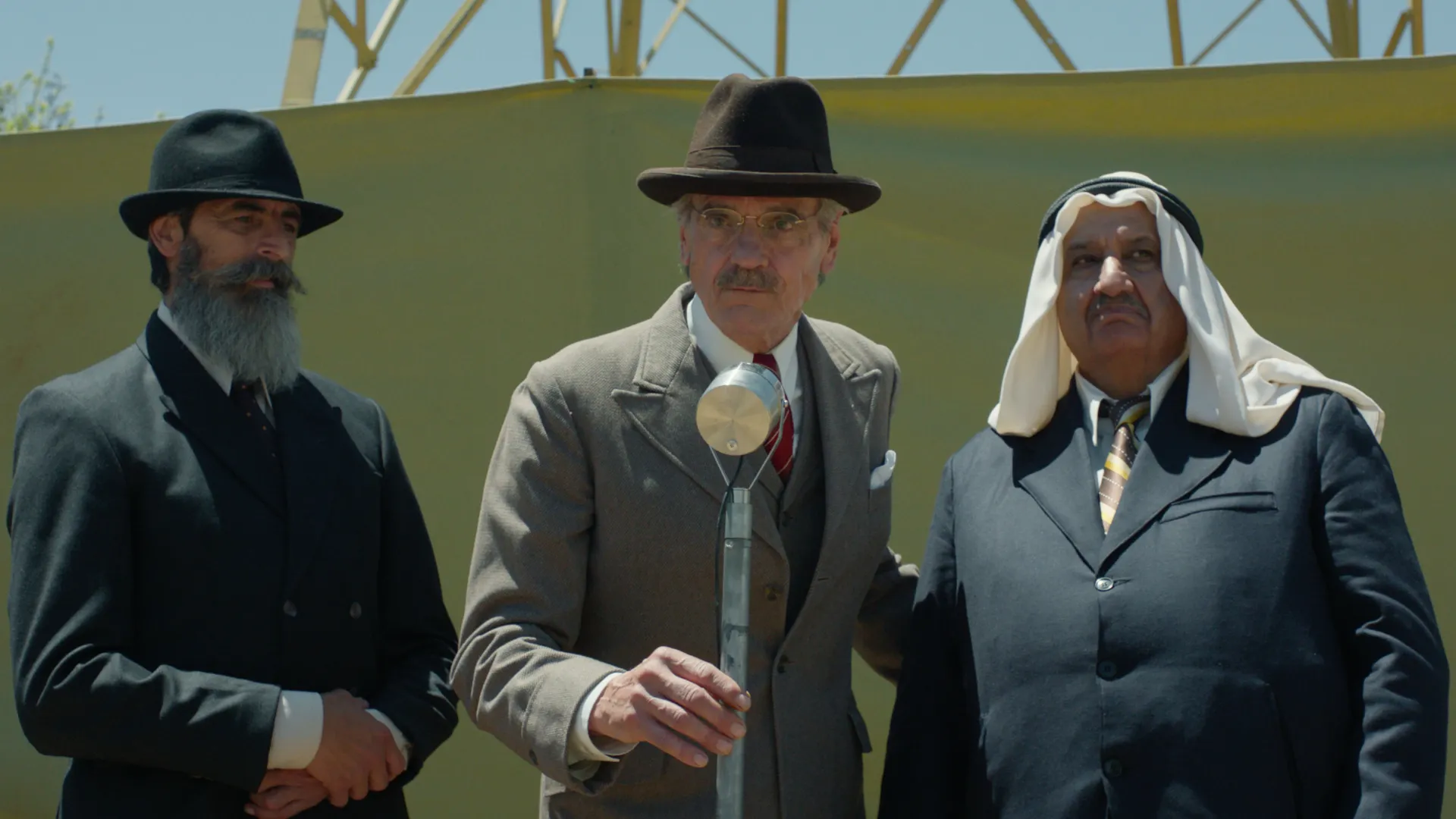
Jacir presents this progression not as a choice but as a reaction, an immune response to the spreading infection of colonial policy. The British are portrayed not as a monolith but as a differentiated machine of empire. There is the arch manipulator in Jeremy Irons’ High Commissioner, who cloaks imperial ambition in the language of paternalistic concern. There is the embodiment of pure, thuggish force in Captain Wingate (Robert Aramayo).
Most interestingly, there is the sympathetic bureaucrat Thomas Hopkins (Billy Howle), who represents the fallacy of the “good colonizer.” His efforts to chart borders and secure rights are genuine, yet his ultimate frustration and departure are not a personal tragedy. They are a political failure, an abdication of responsibility that is its own form of violence.
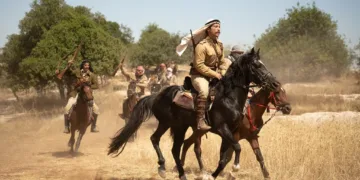
The film’s style mirrors its fractured subject. Jacir stitches authentic archival footage directly into the narrative, a technique of historical grafting that blurs the line between recreation and reality. The plot is a mosaic, a structure that denies easy catharsis but builds a powerful sense of collective fate.
The film is intensely physical; violence is a matter of split lips and constrained bodies, while affection is a fleeting touch, an embrace that feels both precious and doomed. The sight of British officers enjoying a picnic overlooking the village they are helping to dismantle captures the surreal banality of their power.
The Unquiet Past
The cast operates with the seamless chemistry of a true ensemble. As Yousef, Karim Daoud Anaya provides a quiet, observant center, his face registering the slow curdling of hope into hardened resolve. Saleh Bakri gives Khalid a towering gravitas, while Yasmine Al Massri perfectly captures Khuloud’s conflicted intelligence.
While most roles are rendered with nuance, the depiction of Captain Wingate veers perilously close to caricature; he’s a sneering sadist missing only a waxed mustache to complete the picture. This is a minor flaw in a work of exceptional craftsmanship.
The visual world of Palestine 36 is sumptuous, with Hélène Louvart’s cinematography capturing the sweep of the landscape and the intricate details of Hamada Atallah’s period costumes. The texture of an embroidered dress or the light on a terraced hill feels as important as the dialogue.
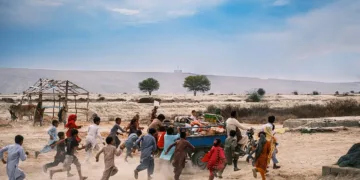
The film’s real power lies in its translation of abstract historical forces into tangible human experience. History here is not a chapter in a textbook; it is the taste of dust, the weight of a rifle, the fear in a child’s eyes.
By excavating the events of 1936 with such precision and empathy, the film offers not an answer, but a lens. It is a work of historical reclamation, challenging the simplified narratives that have long dominated the discourse. It makes the past feel profoundly, uncomfortably present, showing us that the old fires are still burning right beneath our feet.
Palestine 36 is a historical drama that premiered at the Toronto International Film Festival on September 5, 2025. The film is set during the 1936 Arab revolt against British rule and follows a variety of characters navigating the turmoil of the time. The movie is being distributed by Curzon Film in the United Kingdom, MAD Distribution in the Middle East, and Watermelon Pictures in North America.
Full Credits
Director: Annemarie Jacir
Writers: Annemarie Jacir
Producers: Ossama Bawardi, Cat Villiers, Azzam Fakhreddin, Hani Farsi, Nils Åstrand, Olivier Barbier, Nathanaël Karmitz, Katrin Pors, Hamza Ali
Cast: Hiam Abbass, Kamel El Basha, Yasmine Al Massri, Jalal Altawil, Robert Aramayo, Saleh Bakri, Yafa Bakri, Karim Daoud Anaya, Billy Howle, Dhafer L’Abidine, Liam Cunningham, Jeremy Irons
Director of Photography (Cinematographer): Hélène Louvart, Sarah Blum, Tim Fleming
Editors: Tania Reddin
Composer: Ben Frost
The Review
Palestine 36
Annemarie Jacir's Palestine 36 is a work of immense historical and cinematic importance. It is a demanding, sprawling epic that meticulously diagrams the origins of a modern tragedy, trading simple catharsis for profound, unsettling understanding. While a one-dimensional villain slightly mars its otherwise complex social portrait, the film succeeds as a powerful, necessary act of historical reclamation. It is essential viewing for anyone who believes the past is never truly past; it is a film that does not just depict history, it breathes it.
PROS
- A masterful ensemble performance that gives weight to a wide range of social perspectives.
- Intelligent and nuanced exploration of the internal class divides within Palestinian society.
- Stunning cinematography and detailed production design that create a deeply immersive world.
- Effective integration of archival footage that grounds the narrative in historical fact.
- An ambitious and unflinching approach to a complex, politically charged history.
CONS
- The primary British antagonist is written as a one-dimensional, theatrical villain.
- Its complex, mosaic-like structure may be challenging for viewers unfamiliar with the historical context.