














Some films ask you to watch; Silent Friend asks you to listen. Its central story is told from the perspective of time itself, anchored by a magnificent ginkgo tree standing sentinel in a German botanical garden. This is a work of quiet observation, one that reminds me of long afternoons spent in a city park, noticing the small dramas of the world unfolding when you finally sit still.
The movie explores the deep connections between people and the flora that surrounds them on a university campus. It treats scientific inquiry with a poetic sensibility, less concerned with answers and more with the beauty of the questions. This is not a conventional drama. It is a sensory experience that encourages the audience to slow down and consider a reality operating at the pace of nature. It gently introduces the idea that communication exists in many forms, far beyond the limits of human language.
Three Timelines, One Root
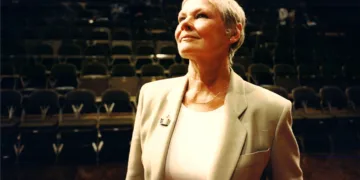
The film’s narrative is composed of three distinct timelines, all unfolding at Germany’s University of Marburg. Director Ildikó Enyedi weaves these stories together, cutting between them freely, with the ginkgo tree serving as the silent, constant witness to a century of change. In 1908, we meet Grete (Luna Wedler), a brilliant young woman seeking to become the university’s first female science student.
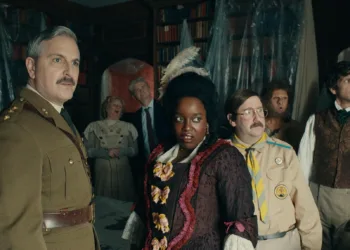
Her trial is an interview with a panel of old male professors who seem determined to humiliate her. They turn questions about the Linnaean system of plant classification into leering inquiries about her morals, using the sexuality of plants as a proxy to attack her character. Undeterred, Grete finds her purpose through botanical photography, a craft she learns to pay her rent, discovering universal structures of life in the precise images she creates.
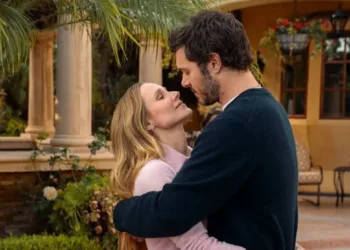
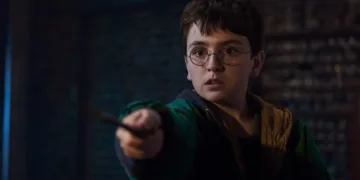
She carves out a space for herself in a world built by men. A switch in time takes us to 1972, where Hannes (Enzo Brumm), a shy farm boy studying literature, feels adrift in the city. He is mocked by privileged students for being insufficiently revolutionary, finding solace in books. His world changes when he meets Gundula (Marlene Burow), a self-assured botany student.
When she leaves for a trip, she entrusts him with her geranium. Tending to the small flower becomes a profound act for Hannes, a way to understand care and forge a connection to the person he yearns for. Finally, in 2020, Tony (Tony Leung), a neuroscientist from Hong Kong, is isolated on the campus during the COVID lockdown.
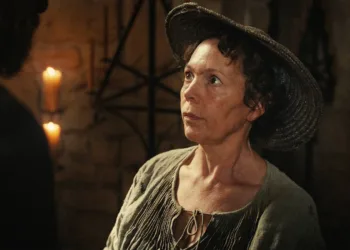
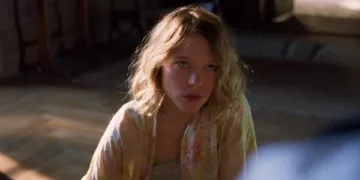
His work studying the brainwaves of pre-verbal infants is halted, so he turns his equipment on the ginkgo, attempting to measure its hidden life with remote guidance from a French botanist (Léa Seydoux). His only human contact is the campus’s grumpy caretaker, a man who is initially suspicious of this quiet visitor.
A Cinema of Textures
Silent Friend is a masterclass in using cinematic form to convey meaning. It is a film that you feel as much as you watch, and much of that comes from its carefully differentiated visual styles. Each era is given a distinct texture that feels completely intentional.

Grete’s world of 1908 is captured in crisp, formal 35mm black-and-white. Its cold precision mirrors the rigid social structures and scientific objectivism of her time. For Hannes’s 1970s story, the filmmakers switch to a grainy and saturated 16mm color stock. This choice gives his world a hazy, warm quality, perfect for a story of first love that feels like a fading photograph.
Tony’s contemporary isolation is shown in a sharp, clean digital format, emphasizing the starkness of modern architecture. Cinematographer Gergely Pálos consistently decenters the human perspective. His camera lingers on germinating seeds in luscious macro shots and finds unusual angles on the ginkgo.
The branches of the tree often frame the actors, subtly suggesting they are enveloped by, or even secondary to, the natural world. This approach makes the tree feel less like a backdrop and more like the film’s true protagonist. Colorful graphics representing electrochemical signals give a tangible form to the movie’s abstract scientific concepts, visualizing the invisible world Tony is trying to access.
An Unfinished Conversation
At its center, Silent Friend poses large questions about existence. How do we define consciousness when our own experience is so limited? The film suggests our human-centric view is a small part of a much larger picture, allowing for the possibility of connection between any living things. Each organism, it seems to say, has its own unique perception of the world.

The ginkgo tree itself becomes a powerful symbol of endurance, a being that operates on a different scale of time, quietly observing fleeting generations of human activity. This is a film that trusts its audience. It avoids simple resolutions, a choice that feels confident and refreshing in an era of spoon-fed narratives. Grete’s professional future, Hannes’s romance, and Tony’s experiments are all left open-ended. The movie finds its purpose in the persistence of curiosity, not in the comfort of answers. This thoughtful approach is grounded by its cast.
Tony Leung gives a masterful performance, communicating a universe of loneliness and grace with profound stillness. The way he watches a person walk by a window becomes a complete story. Luna Wedler makes Grete a formidable and intelligent presence, her wit a sharp defense against condescension. The supporting actors, including the wonderfully expressive caretaker, provide moments of humor that keep the film from becoming too staid. The performances make the film’s heady concepts feel deeply human.
“Silent Friend” premiered at the 82nd Venice International Film Festival on September 5, 2025. Following its festival debut, it is scheduled for screenings at other film festivals, including the Toronto International Film Festival and the BFI London Film Festival. A wider theatrical or streaming release has not yet been announced.
Full Credits
Director: Ildikó Enyedi
Writers: Ildikó Enyedi
Producers and Executive Producers: Reinhard Brundig, Mónika Mécs, Nicolas Elghozi, Meng Xie, Morgane Olivier
Cast: Tony Leung Chiu-wai, Léa Seydoux, Luna Wedler, Enzo Brumm, Sylvester Groth, Martin Wuttke, Johannes Hegemann, Rainer Bock, Marlene Burow, Yun Huang
Director of Photography (Cinematographer): Gergely Pálos
Editors: Károly Szalai
Composer: Gábor Keresztes, Kristóf Kelemen
The Review
Silent Friend
Silent Friend is a deeply thoughtful and visually stunning film that rewards patience. It forgoes traditional narrative for a meditative exploration of time, connection, and perception. While its deliberate pace may not suit everyone, the film's intellectual ambition, exquisite cinematography, and a beautifully understated performance from Tony Leung make it a profound cinematic experience. It is a work that lingers, gently altering the way you see the world long after the credits roll.
PROS
- An original and ambitious narrative structure spanning three different time periods.
- Exquisite cinematography, with each era defined by a distinct and meaningful visual style.
- Powerful and understated lead performances, particularly from Tony Leung.
- A deep and intelligent exploration of humanity's relationship with nature and time.
CONS
- The slow, meditative pace may feel inert to viewers accustomed to faster narratives.
- A lack of conventional plot resolution could be unsatisfying for some.
- The long runtime requires a significant investment of attention.
- Its focus on ideas might feel emotionally distant at times.