





















The story begins with a familiar incantation: “Once upon a time.” These words from director Clement Virgo do not promise comfort. Instead, they open a dark fable, a world suffused with a strange, hypnotic dread. From the first frame, we are placed in a land that feels unstuck from history, a place both beautiful and deeply menacing. Into this world walks Cécile, a young woman who has fled the Congo with her mother.
Their sanctuary is a vast, isolated estate owned by Florence, a wealthy humanitarian whose charitable acts seem to mask a disquieting agenda. Played with a captivating poise by Mallori Johnson, Cécile carries herself with a profound confidence and grace that immediately sets her apart.
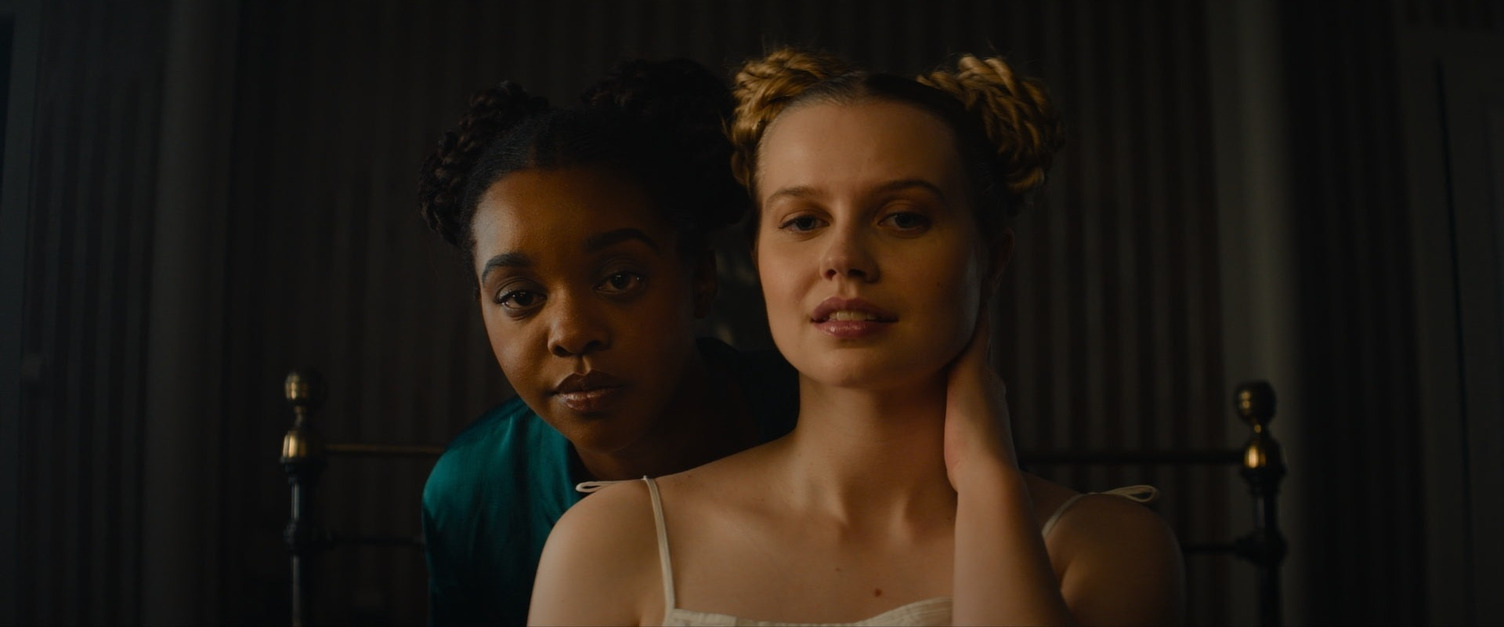
Their arrival is observed by Florence’s sheltered daughter, Fanny (Angourie Rice), who watches the newcomers with a quiet, unnerving intensity. From their first meeting, a potent dynamic is set in motion, one of fascination and danger that will drive the film through its landscape of gothic melodrama and psychological horror. The pristine surfaces of this world, from its manicured lawns to its polite customs, barely conceal a deep and unsettling rot. Virgo has crafted a disquieting vision where safety is an illusion and every kindness feels like a prelude to a threat.
The Gilded Trap of Nowhere
The film’s setting is a masterful act of disorientation. It is a land of no specific time or place, a reality constructed from the echoes of history’s darkest chapters. Vintage cars share the road with armed police searching for migrants, while posters warning of traitors suggest a modern surveillance state. The estate itself, with its white owners and Black workers toiling the land, evokes the Antebellum South or Apartheid-era hierarchies.
This deliberate temporal and geographic ambiguity makes the narrative feel both ancient and immediate, a cautionary tale for any era. The production design paints the central mansion as a beautiful prison. Its opulent interiors, filled with antique furniture and lavish dressings, feel cold and sterile, suggesting a life lived under glass.
Cinematography drenches scenes in deep, saturated hues of red and blue or stark shadows, turning paradise into a site of claustrophobia. The camera often lingers, creating a sense of being watched that mirrors Fanny’s obsessive gaze. This feeling is amplified by the costume design. Cécile’s regal African finery, rich with color and texture, stands in sharp contrast to the pale, doll-like dresses Fanny wears.
The clothing is a visual representation of the cultural and personal forces at play, one signifying a deep connection to identity and the other a hollow, manufactured innocence. By placing his story in this unmoored reality, Virgo ensures the viewer never finds their footing, heightening the psychological tension with every frame.
A Study in Consumption
The film’s psychological weight rests on the tangled connection between its two young women. Fanny’s initial admiration for Cécile soon curdles into a form of obsessive consumption. She does not want to befriend Cécile; she wants to become her. The transformation is methodical. First, Fanny asks for her hair to be styled in the same way.
Soon she is borrowing Cécile’s clothes and attempting to mimic her confident walk and worldly demeanor. This dynamic is a form of erasure, where Fanny’s privilege allows her to treat another person’s identity as a costume. The obsession intensifies when Cécile begins a romance with a groundskeeper named Rufus, a relationship that awakens a possessive jealousy in Fanny.
Mallori Johnson gives Cécile a grounded authenticity, her watchfulness a quiet defense against the strange world she has entered. She communicates immense strength through stillness and subtle expression. Angourie Rice is her disquieting opposite, portraying Fanny with a chilling blend of naive charm and latent menace.
Her performance captures the emptiness of a girl raised in privilege who sees another person as an object to be possessed. Their on-screen chemistry is palpable, a fragile bond that is also a conduit for danger. Their interactions are the engine of the film’s suspense, a slow, methodical study of appropriation and the predatory nature of innocence.
Echoes in a Fever Dream
Through this allegorical framework, Steal Away examines the brutal mechanics of exploitation and the fraught nature of bodily autonomy. It is a potent meditation on how inherited power corrupts, and how histories of oppression bleed into the present. The film explores these ideas without scolding or didacticism, letting the unsettling atmosphere and character dynamics carry the thematic weight.
The narrative logic follows that of a dream, with a structure that sometimes frays at the edges and stylistic choices that startle. Some plot revelations feel abrupt, and the editing can be jarring, choices that reflect the disoriented state of the characters.
Yet the film’s ambition is undeniable. The strange tonal shifts and visual eccentricities contribute to its singular quality. Virgo creates a potent and slippery vision that lingers long after the screen goes dark. He has crafted a work of significant artistic daring, a beautiful and soul-shaking story that affirms his position as a vital cinematic voice. The film’s power lies in its refusal to offer easy answers, leaving its audience with the haunting resonance of its unsettling truth.
“Steal Away” is a drama film directed by Clement Virgo, with a screenplay by Tamara Faith Berger and Virgo himself. It’s based on Karolyn Smardz Frost’s book “Steal Away Home” and is a Canada-Belgium co-production. The film had its initial release at the Toronto International Film Festival (TIFF) on September 5, 2025. It tells the story of a sheltered teenager who forms an intense bond with a refugee taken in by her family, leading to desire, jealousy, and a world that is not as it appears.
Full Credits
Director: Clement Virgo
Writers: Clement Virgo, Tamara Faith Berger
Producers and Executive Producers: Damon D’Oliveira, Peter De Maegd, Tom Hameeuw, Paula Devonshire, Caitlin Grabham, Laurie May, Noah Segal, Fred Roos, Anna-Nora Bernstein, Andrew Low
Cast: Angourie Rice, Mallori Johnson, Lauren Lee Smith, Idrissa Sanogo, Arnold Pinnock, Hilde Van Mieghem, Nola Elvis Kemper, Denise M’Baye
Director of Photography (Cinematographer): Sophie Winqvist
Editors: Jorge Weisz
Composer: Fjóla Evans
The Review
Steal Away
Steal Away is a visually intoxicating and thematically ambitious film that operates like a haunting fever dream. Clement Virgo's direction is audacious, creating a disorienting world that is both beautiful and menacing. While its narrative can feel disjointed, the powerful performances from Mallori Johnson and Angourie Rice anchor the unsettling story of appropriation and exploitation. It is a potent, challenging piece of cinema that confirms Virgo's singular artistic voice, leaving a lasting, disquieting impression.
PROS
- Stunning cinematography and production design create a unique, unsettling atmosphere.
- Powerful and complex lead performances from Mallori Johnson and Angourie Rice.
- Rich, layered themes exploring exploitation, appropriation, and power dynamics.
- Audacious direction that creates a memorable and disorienting experience.
CONS
- The narrative structure can feel uneven and disjointed at times.
- Some stylistic and editing choices may be jarring for viewers.
- The allegorical story can feel convoluted in moments.