



















![Kingdom Hearts Collection [I-III] Review](https://gazettely.com/wp-content/uploads/2026/10/Kingdom-Hearts-Collection-I-III-1-360x180.webp "Kingdom Hearts Collection [I-III] Review: KHII Holds Steady as Newer Entries Fluctuate 38")



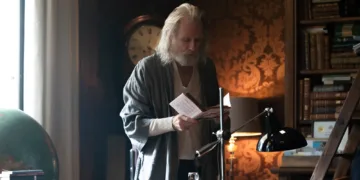
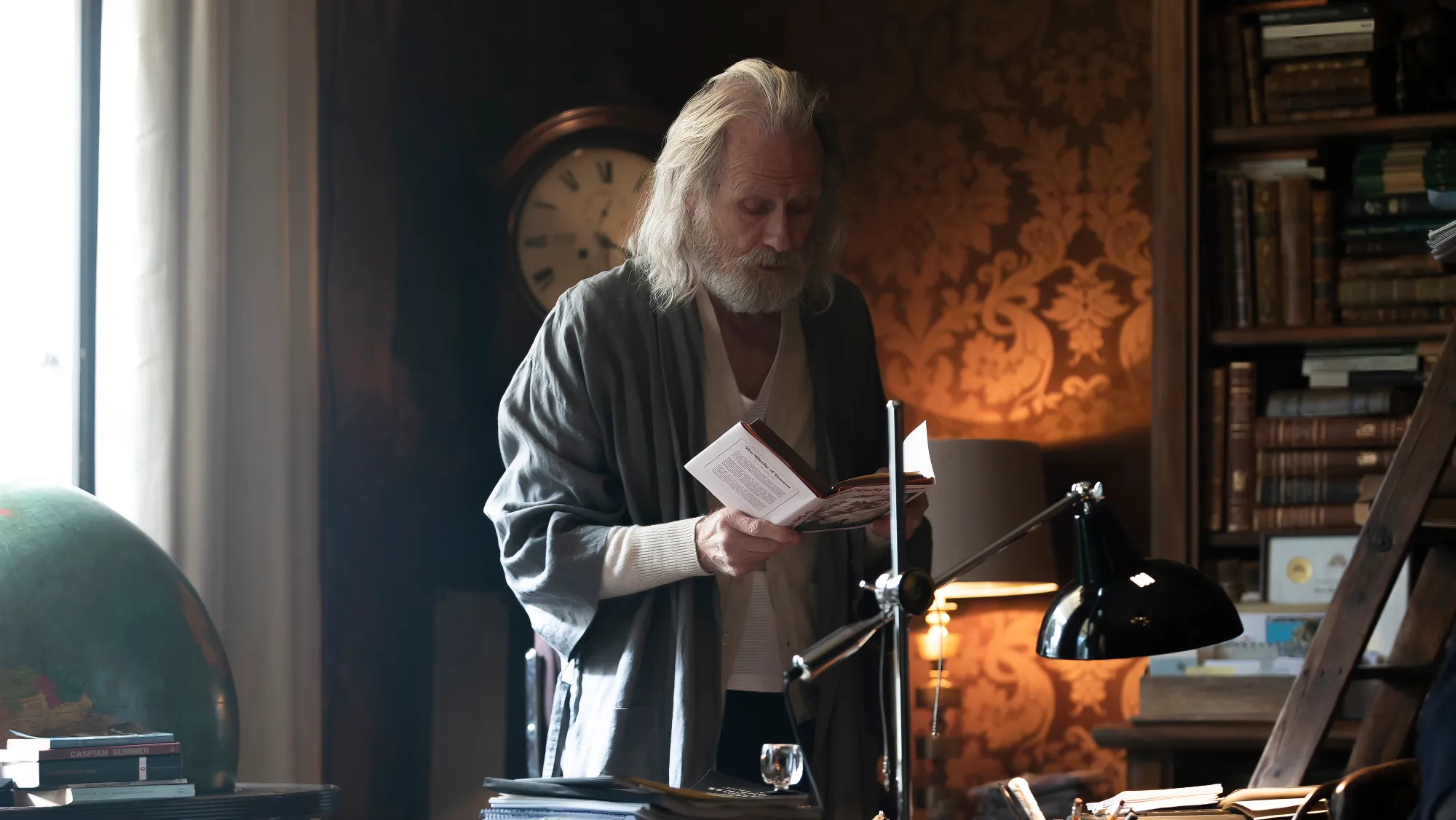
In the fading light of a distinguished career, the novelist A.N. Dyer lives a life of curated decay. His cavernous country manor, filled with the physical evidence of past glories, has become a comfortable prison mirroring his own mind: grand, but in a state of disrepair. Here, Dyer, a man undone by alcohol and a deep-seated bitterness, presides over his own decline, listening to old jazz records. The story of & Sons begins when he, sensing his end is near, issues a summons to his two estranged adult sons, Richard and Jamie.
Their arrival breaks the estate’s stagnant air, replacing it with the sharp tension of unresolved history. Richard arrives from New York with a professional motive, hoping to adapt his father’s masterwork for the screen. Jamie, a filmmaker, comes with a colder artistic purpose, intending to document his father’s suffering.
Both sons carry years of resentment for Dyer’s abandonment of their mother, Isabel, a betrayal that shattered their family. Living alongside the patriarch is his youngest son, Andy, a quiet teenager whose very presence is a monument to the family’s old wounds. The initial setup presents a familiar stage for a drama of late-life reckoning, a specific Western archetype where a difficult man must face the ruins of his personal legacy.
An Unconventional Revelation
The film abruptly pivots from its traditional foundation with a startling disclosure. Dyer informs his elder sons that Andy is not the child of an extramarital affair; he is, in fact, a clone, a perfect replication of Dyer himself. This introduction of a soft science-fiction element fractures the narrative, pushing a story of familiar domestic strife into a strange, speculative space.
The script, a product of Argentinian director Pablo Trapero and Canadian writer Sarah Polley, attempts to graft this high-concept idea onto the delicate bones of a family drama. This fusion produces a curious tonal discord. Moments of raw, emotional confrontation become tinged with an absurdity that feels intentionally humorous at times and simply awkward at others.
The revelation forces each character to re-evaluate his own identity. For the sons, their father becomes a man whose ego extends to literal self-replication. For Andy, his existence becomes a question of nature against will, a living embodiment of the phrase “autonomous reflection.”
The film’s narrative momentum sometimes falters as the characters struggle to process this unbelievable information. The larger philosophical questions the premise raises about the future of creative legacy and the ethics of genius are not always fully examined, leaving its most provocative ideas just out of reach.
Portraits of Pain and Resilience
The film’s emotional landscape is managed through its strong performances. Bill Nighy sheds his customary affability for the role of A.N. Dyer, presenting a disheveled and physically frail man animated by a monstrous narcissism. His unvarnished performance makes Dyer a magnetic black hole, a figure whose towering self-regard consumes all the oxygen in a room, leaving his children to suffocate in his wake.
As a counterpoint, Imelda Staunton offers a performance of immense poise and quiet strength as the ex-wife, Isabel. She is the story’s emotional anchor, providing a necessary presence that registers the family’s decades of pain with affecting precision. Her stillness is a form of resistance against Dyer’s loud despair. Her scenes with Andy are particularly sensitive, showing a connection that surpasses biological ties and suggests a different kind of family structure.
The sons are portrayed with a shared sense of inherited damage. Johnny Flynn’s Richard fights his father’s addictive tendencies, while George MacKay’s Jamie mirrors his father’s artistic coldness through the protective lens of a camera. Noah Jupe gives Andy a watchful intelligence, expertly capturing Nighy’s own physical tics and making the clone’s origin visually apparent before it is fully understood.
The Weight of Inheritance
& Sons positions itself as an inquiry into autonomy and the patterns passed down through generations. The film uses its central scientific conceit to make literal the question of whether a child can escape the programming of a parent. Director Pablo Trapero’s visual approach supports this theme, using static compositions and the manor’s oppressive interiors to create a palpable sense of claustrophobia.
Lingering shots hold on faces reacting to Dyer’s tirades, emphasizing their entrapment within his emotional orbit. The film’s ambition is clear in its attempt to merge a specific type of Anglo-American literary drama with a universally relevant speculative concept. Yet the execution feels unbalanced, with the bizarre premise sometimes undermining the genuine human study at its center.
The story offers a potent, if imperfect, statement on the fictions families build around themselves. It leaves one with a lingering question about what truly forms a person: the biological code they are given, or the life they manage to construct for themselves from the pieces left behind.
“& Sons” is an upcoming drama film directed by Pablo Trapero and co-written by Trapero and Sarah Polley, based on the novel of the same name by David Gilbert. It premiered at the Toronto International Film Festival on September 7, 2025. The film is produced by Infinity Hill, Matanza Cine, and Elevation Pictures. The story follows a reclusive author who, convinced he is about to die, summons his two estranged sons to reveal a secret about their teenage half-brother.
Full Credits
Director: Pablo Trapero
Writers: Pablo Trapero, Sarah Polley, David Gilbert
Producers and Executive Producers: Phin Glynn, Axel Kuschevatzky, Cindy Teperman, Pablo Trapero, Christina Piovesan, Emily Kulasa, Trudie Styler, Celine Rattray, Jackie Donohoe, Stephen Kelliher, Sophie Green, Kasia Neiman, Bahman Naraghi, Paul Telegedy, Alexandra Tynion, Olivia Tyson, Ori Eisen, Peter Sobiloff, Mike Sobiloff, Raj Khaware, Kunal Khaware, Alejandro Guillermo Roemmers, Manu Fabeiro, Jorge Perez Gaudio, Antonio Pita, Nicolas Veinburg
Cast: Bill Nighy, George MacKay, Noah Jupe, Imelda Staunton, Johnny Flynn, Dominic West, Anna Geislerová, Arthur Conti, Charlotte Dauphin
Director of Photography (Cinematographer): Diego Dussuel
Editors: Pablo Trapero, Gemma Cabello, Thom Smalley
Composer: Cristobal Tapia de Veer
The Review
& Sons
An ambitious and intellectually daring film, & Sons is anchored by a set of powerful, finely tuned performances. Bill Nighy is magnetic as the monstrous patriarch, and Imelda Staunton provides a necessary, grounding emotional center. While its high-concept premise is startlingly original, the film struggles to balance its speculative ideas with the sensitive family drama, resulting in an awkward tone. It raises profound questions about identity and inheritance but stops short of exploring them fully, making for a fascinating yet ultimately frustrating watch.
PROS
- A commanding and transformative central performance from Bill Nighy.
- Imelda Staunton delivers a subtle, emotionally powerful turn as the family's anchor.
- The unique science-fiction premise offers a bold and original take on legacy and identity.
- Atmospheric direction and cinematography create a potent mood of emotional claustrophobia.
CONS
- The fusion of genres results in a discordant and often awkward tone.
- Its most provocative philosophical ideas feel underdeveloped.
- The narrative sometimes loses momentum while grappling with its central conceit.
- The execution does not always match the ambition of its script.