
















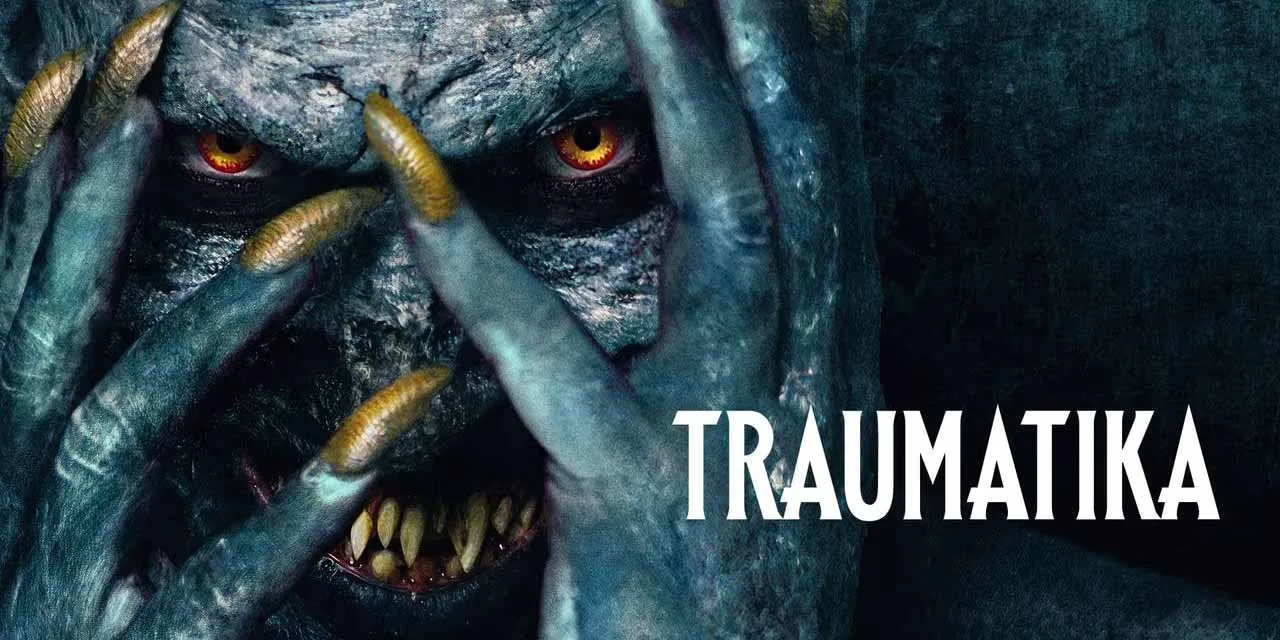

Horror has always been society’s preferred space for wrestling with its ugliest abstractions. In recent years, the genre’s great beast has been Trauma, a shapeless specter made manifest in film after film. Traumatika attempts to give this phantom a name and a face.
The film posits that deep psychological wounds are not merely experiences but active, malevolent entities, transferable curses passed down through generations. Our agent of this contagion is Volpaazu, the “taker of children,” a demon conveniently packaged within an Egyptian artifact, awaiting its inevitable unboxing in suburban America.
The immediate fallout lands on a young woman, Abigail, whose body and will are usurped, and a boy named Mikey, her terrified captive. They are the first links in a chain of suffering. The film promises a grim exploration of this violent inheritance, suggesting a story that sprawls across decades, connecting the dots between victims who may never even meet. It’s a somber and ambitious premise, one that aims to chart the anatomy of a spreading sickness.
Chronological Collapse
A film’s structure is its skeleton; without a sound one, the body cannot stand. Traumatika suffers from a severe case of narrative osteoporosis. Its story is shattered into fragments and scattered across a timeline that leaps from 1910 to 2003 to 2024 with a frantic, disorienting energy. One might argue this fractured approach is meant to mirror the splintered nature of traumatic memory.
Yet, as a cinematic device, it fails because it denies the audience a stable present from which to process the past. The constant temporal shifts create an intellectual distance, forcing the viewer to piece together a basic sequence of events instead of allowing for emotional immersion. The brief 80-minute runtime only magnifies the problem, giving each segment the weight of a rushed, incomplete anecdote.
This structural failure directly impacts the characters, who suffer from a kind of trauma-essentialism. They are not people who have experienced trauma; they are their trauma. Mikey and Alice (Abigail’s sister) are defined so completely by the horrible things that happened to them that they possess no other discernible traits, reducing them to walking symbols. The script’s approach to its own mythology is equally flimsy.
In one particularly modern moment of narrative laziness, a character learns the demon’s entire backstory from a website called, I kid you not, creepy-news-dot-com. We are left to assume Volpaazu’s ancient evil is subject to search engine optimization. It’s an exposition dump that cheapens the lore and treats the audience like a bored student in need of a cheat sheet.
Glimmers in a Fog of Cliché
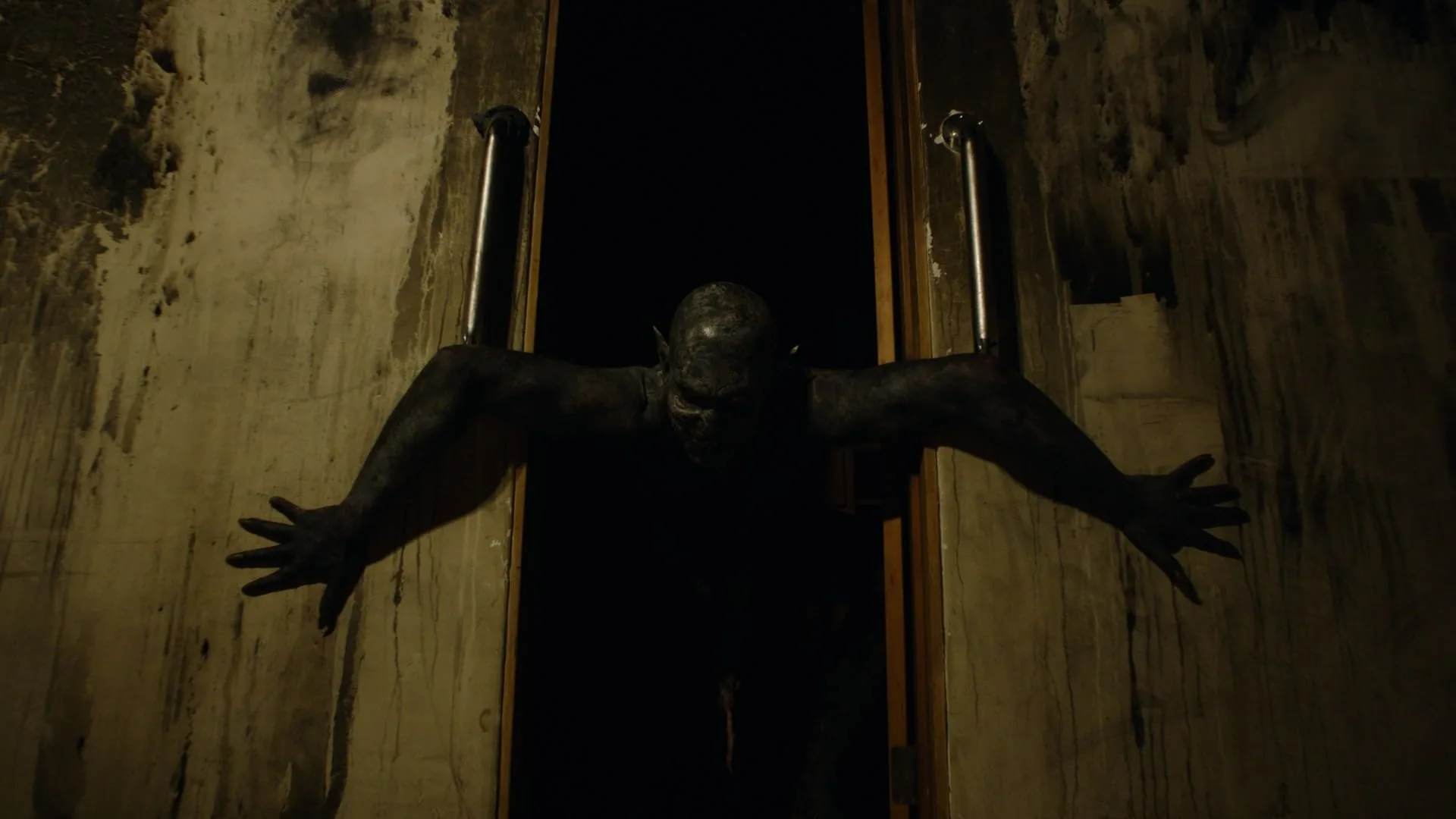
For all its narrative failings, the film is not without its moments of genuine dread. There are flashes of a much better movie here, potent images that momentarily break through the muddle. Director Pierre Tsigaridis clearly has an eye for unsettling visuals, often bathing his dilapidated sets in a sickly yellow light that creates a palpable sense of grime and decay.
The standout is Rebekah Kennedy’s performance as the possessed Abigail, a masterclass in physical unease. Her jerky, unnatural movements and dead-eyed stare generate a specific sort of fear that CGI creations rarely achieve. Certain images stick with you: the absurdly terrifying sight of an adult Mikey with a sack over his head, a crude mask hiding a shattered identity, or a static shot revealing a demon crawling on a distant ceiling.
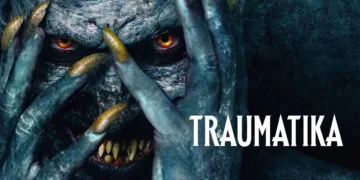
These effective flashes, however, are isolated islands in a vast sea of the familiar. The film serves as a checklist of tired horror tropes, a cinematic language spoken without any new accent or inflection. We have the generic, gray-skinned demon design, the obligatory spider-walk (a move so common it’s now almost a comfort blanket of genre recognition), and jump scares telegraphed by a sudden silence before a loud musical sting.
The plot is kicked off by the “cursed artifact from the Middle East,” a device rooted in a kind of lazy geographical fatalism where ancient, non-Western cultures are treated as monolithic sources of evil. Traumatika demonstrates a technical ability to look scary, but it lacks the creative conviction to feel new, borrowing its frights instead of earning them.
The Unresolved Trauma
Traumatika desperately wants to make a statement. Depicting trauma cinematically is a perilous task, a fine line between meaningful exploration and hollow exploitation. The film announces its intellectual intentions from the very first frame, opening with text that explicitly defines the five forms of childhood trauma.
Its thesis is clear and socially relevant: evil is not an innate quality but a learned behavior, a devastating consequence of abuse. This is a profound and difficult subject, one that requires a delicate and thoughtful hand. The film’s hand, however, is a sledgehammer. Its thematic exploration is superficial and painfully direct, a critical failure of “show, don’t tell.”
The story stops dead in its final act for a talk show segment where a character lectures the audience on trauma statistics. It is the opposite of art; it is a PowerPoint presentation interrupting a ghost story, revealing a profound lack of confidence in the film’s own symbolic power.
This clumsiness precedes a full thematic retreat. The story experiences a severe whiplash, abruptly shifting from a supernatural examination of abuse into a standard slasher film with a tacked-on satire of true crime media. This feels like an admission of defeat, as if the film found the philosophical weight of its own subject too heavy and fled to the simpler, more marketable territory of a masked killer.
The satire feels like it belongs to an entirely different movie, one clumsily sutured onto the first. This leaves the core questions about the cycle of violence unanswered and abandoned. Traumatika presents a deep wound but seems either unable or unwilling to properly examine it, leaving its ambitious ideas feeling unexplored and its grim story feeling ultimately empty.
“Traumatika,” an American horror film, premiered at FrightFest on August 24, 2024, and had a theatrical release in the United States on September 12, 2025, through Saban Films.
Full Credits
Director: Pierre Tsigaridis
Writers: Maxime Rancon, Pierre Tsigaridis
Producers: Jean-Pierre Morreale, Maxime Rancon, Pierre Tsigaridis
Cast: Rebekah Kennedy, Ranen Navat, Emily Goss, Susan Gayle Watts, A.J Bowen, Sean O’bryan, Sean Whalen, Maxime Rancon
Director of Photography (Cinematographer): Pierre Tsigaridis
Editors: Pierre Tsigaridis
Composer: Gioacchino Marincola
The Review
Traumatika
Traumatika reaches for a profound exploration of inherited pain but is crippled by a chaotic narrative and a script that prefers lecturing to storytelling. While occasional flashes of visual dread and a chilling lead performance show promise, the film ultimately collapses under the weight of its own ambition. It substitutes clichés for genuine insight and structural chaos for depth, resulting in a thematically muddled and emotionally hollow experience that squanders its potent central idea.
PROS
- Ambitious and socially relevant central theme.
- Strong, physically menacing lead performance from Rebekah Kennedy.
- Occasional moments of potent, genuinely unsettling visual horror.
- Effective cinematography that creates a grimy, decaying atmosphere.
CONS
- A fractured, non-linear narrative that feels confusing and rushed.
- Underdeveloped characters who function as symbols rather than people.
- Heavy reliance on worn-out horror tropes and clichés.
- Superficial, heavy-handed thematic execution that tells instead of shows.
- An abrupt and jarring tonal shift in the final act.