



























Streaming platforms have developed a potent form of alchemy, turning the past into marketable nostalgia. The 1990s, in particular, has become a favored setting, its cultural artifacts mined for aesthetics that offer comfort through familiarity. Netflix’s Boots initially appears to fit this mold, presenting a story set in 1990 about finding oneself.
Yet its chosen location is not a high school hallway or a suburban basement but the severe, unforgiving landscape of the U.S. Marine Corps boot camp at Parris Island. The series finds its unique tension in this paradox: a story of personal liberation set within an institution dedicated to obliterating individuality.
It centers on Cameron Cope, a young, closeted gay man who enlists not from a sense of duty but from a place of desperation. His decision to trade one form of oppression for another, seeking freedom within a system that criminalizes his existence, sets up a layered examination of identity, belonging, and the strange ways we construct a self.
The Barracks: Characters Forged in Fire
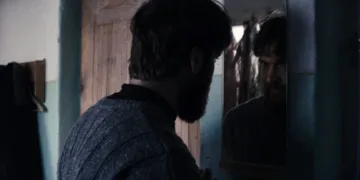
At the heart of the platoon is Miles Heizer’s finely tuned portrayal of Cameron Cope. Heizer uses a quiet physicality, a slight slump of the shoulders or a downward gaze, to communicate a lifetime of trying to make himself smaller. His performance is one of subtle shifts, showing how the rigid posture of a Marine is slowly, arduously adopted, a physical armor for his emotional vulnerability. The series cleverly externalizes his interior world through the device of an alter ego, a spectral, sassier version of himself who appears in moments of crisis.
This technique, a growing staple in modern television, works here as more than a gimmick. It is a visual representation of the queer tradition of camp and wit as survival tools, a defiant inner voice that refuses to be silenced by the shouted orders of his superiors. Cameron’s arc is not a simple transformation from weak to strong but a complex process of integrating his perceived softness with a newfound capacity for endurance.
This journey is shaped by the figures around him. His bond with Ray McAffey (Liam Oh) provides the initial emotional anchor, a friendship whose foundations are immediately tested by an environment that pits recruits against one another. The platoon is a cross-section of young American masculinity, featuring memorable individuals like John Bowman (Blake Burt), whose story of battling familial cruelty and fatphobia is handled with a refreshing lack of ridicule.
These recruits are brutalized and reshaped by their drill instructors, who are themselves more than simple archetypes. Cedrick Cooper brings a terrifying authority to Staff Sergeant McKinnon, the embodiment of the institution’s unyielding standards. It is Max Parker’s Sergeant Sullivan, however, who becomes the most compelling figure of authority. His intense, almost predatory focus on Cameron feels deeply personal, and the show patiently unspools the motivations behind his cruelty, revealing a man at war with his own nature.
Far from this world, Vera Farmiga’s appearances as Cameron’s mother are brief but potent. Her portrayal of Barbara is a masterclass in comic negligence, a woman so wrapped in her own dramas that her son’s enlistment barely registers. Her character provides the context for Cameron’s desperate search for structure and approval, making his choice to subject himself to the Marines feel tragically logical.
The Crucible of Identity
Boots uses the controlled environment of boot camp to stage a powerful exploration of identity. For Cameron, the act of becoming a Marine requires a constant, exhausting performance of straightness. The series is deeply attuned to the nuances of this act, showing how masculinity itself is a kind of uniform, a set of learned behaviors, vocal tones, and physical attitudes.

His struggle is not just to hide his sexuality but to avoid having his true self extinguished by the hyper-masculine persona he is forced to adopt. The fear that this performance might become permanent, that he might forget the person he was, gives the series its profound emotional weight. It presents identity not as a fixed state but as something fragile, something that must be actively defended against the immense pressure to conform.
The intense, shared suffering of basic training forges a potent sense of brotherhood among the recruits. The show examines this bond with a critical eye. It is a camaraderie born of institutionalized trauma, a survival mechanism that unites a diverse group of young men against a common antagonist: their instructors.
The narrative questions the authenticity of this connection, suggesting that it might be a temporary alliance that evaporates outside the confines of the base. This personal story is interwoven with a broader look at systemic prejudice. The institutional homophobia of the pre-“Don’t Ask, Don’t Tell” military is the story’s driving force. The series also depicts the ingrained misogyny of the armed forces through the character of Captain Fajardo (Ana Ayora), an officer fighting for respect in a male-dominated hierarchy.
Her journey runs parallel to Cameron’s, highlighting the different ways the institution polices the boundaries of acceptability. By showing how these different forms of prejudice operate, the series illustrates how Cameron’s perspective expands, moving from a personal struggle for survival to a nascent awareness of the larger structures of power that define his world.
Sound and Fury: Crafting the Boot Camp Experience
The show’s creators demonstrate a keen understanding of tone, expertly navigating the space between grim drama and surprising humor. The comedy is rarely situational; it arises from the sheer absurdity of the rituals of indoctrination and from Cameron’s sharp, internal observations. This tonal blend is crucial, as it makes the narrative’s darker elements palatable without diminishing their impact.

A scene of punishing physical exertion might be underscored by a character’s dry internal quip, a moment of levity that highlights the surreal nature of their reality. The writers’ ability to pivot from a moment of laughter to one of genuine emotional gravity is one of the series’ most refined qualities.
This careful balancing act is supported by a meticulously curated 1990s soundtrack. The use of pop music from artists like George Michael and Bananarama is a deliberate stylistic choice that creates a powerful sense of cognitive dissonance. A bright, upbeat pop song playing over a montage of recruits crawling through mud serves to emphasize the chasm between Cameron’s inner world and his external reality.
These songs are not just nostalgic decoration; they are thematic statements, sonic emblems of a life and an identity that refuse to be erased by the monotone cadence of military life. The direction and cinematography reinforce this sense of a world designed to overwhelm. Sweeping wide shots of Parris Island establish the recruits as insignificant figures in a vast, indifferent machine.
These are contrasted with tight, intimate close-ups that capture the sweat, fear, and defiant humanity on the faces of the young men. The visual language of the show expertly conveys the process of indoctrination, making the viewer feel the claustrophobia and the immense physical and psychological toll of becoming a Marine.
The Final Inspection
Ultimately, Boots presents a complicated and intentionally ambiguous message about the American military. It refuses to be a simple condemnation or a patriotic celebration. The series functions as an anthropological study, meticulously showing why the dehumanizing process of boot camp is effective in building soldiers, yet it never lets the audience forget the human cost of that process.

This nuanced position feels representative of a larger trend in streaming content, which often gestures toward a critique of powerful institutions while stopping short of a full-throated indictment, aiming to engage with sensitive topics without alienating a broad audience. It is a safe form of subversion. The show is at its most powerful when it channels these large, systemic questions through Cameron’s personal experience. By grounding the political in the personal, it makes abstract concepts like institutional homophobia feel immediate and tangible.
The decision to end the season on an unresolved note is a daring one in a television landscape that often prizes neat narrative conclusions. The finale leaves Cameron in a state of limbo, a graduate of boot camp but still a work in progress. It asks the audience to consider the true nature of his transformation.
Did he successfully integrate his identity into this new, rigid framework, or did he simply master the art of concealment? This lack of closure is a powerful thematic statement. It suggests that the formation of an identity is not a finite process with a clear endpoint but an ongoing negotiation between the self and the world. The series leaves us with the unsettling and deeply resonant idea that Cameron’s most significant battles are still ahead of him.
Boots is a military comedy-drama that premiered on Netflix on October 9, 2025. The eight-episode series is based on the memoir The Pink Marine by Greg Cope White and is set in the 1990s U.S. Marine Corps, a time when the “Don’t Ask, Don’t Tell” policy was in effect. It follows Cameron Cope (Miles Heizer), a closeted and directionless teen, and his best friend Ray McAffey (Liam Oh) as they endure the physically and emotionally grueling challenges of Marine boot camp. Executive produced by the late TV legend Norman Lear, the show is a coming-of-age story that uses humor and heart to explore themes of identity, friendship, and resilience within a rigidly masculine environment.
Full Credits
Director: Peter Hoar, Phil Abraham, Silas Howard, Kyle Patrick Alvarez, Tanya Hamilton
Writers: Andy Parker, Jennifer Cecil, Greg Cope White, Jonathan Caren, Andrea Ciannavei, Megan Ferrell Burke, Nick Jones Jr., Dominic Colon
Producers and Executive Producers: Norman Lear, Andy Parker, Rachel Davidson, Jennifer Cecil, Brent Miller, Peter Hoar, Scott Hornbacher
Cast: Miles Heizer, Max Parker, Vera Farmiga, Liam Oh, Cedrick Cooper, Ana Ayora, Angus O’Brien, Dominic Goodman, Kieron Moore, Nicholas Logan, Blake Burt, Rico Paris, Brandon Tyler Moore, Johnathan Nieves, Troy Leigh-Anne Johnson, Logan Gould, Jack Cameron Kay, Brett Dalton, Zach Roerig, Beau Mirchoff, Joy Osmanski
Composer: Jongnic Bontemps
The Review
Boots
Boots successfully subverts the typical 90s nostalgia framework by setting a profound story of queer identity and personal liberation within the brutally conformist crucible of Marine boot camp. Bolstered by compelling performances, masterful tonal balancing, and a meticulous exploration of institutional trauma and 'Don't Ask, Don't Tell' era homophobia, the series is a complex, richly layered character study. It refuses simple answers, leaving the audience with a powerful, unsettling, and resonant conclusion about the ongoing negotiation of self.
PROS
- Deep personal story set against the brutally conformist military boot camp.
- Finely tuned lead performance and compelling authority figures (e.g., Sergeant Sullivan).
- Expertly balances grim drama with sharp, absurd humor.
- Powerful exploration of identity, performance, and institutional homophobia.
- Meticulously curated 90s soundtrack and direction conveying psychological toll.
CONS
- Alter ego device is well-executed but follows a growing TV trend.
- Critique of powerful institutions avoids a full-throated indictment.
- Thematic ambiguity in the finale may frustrate some viewers seeking closure.