



























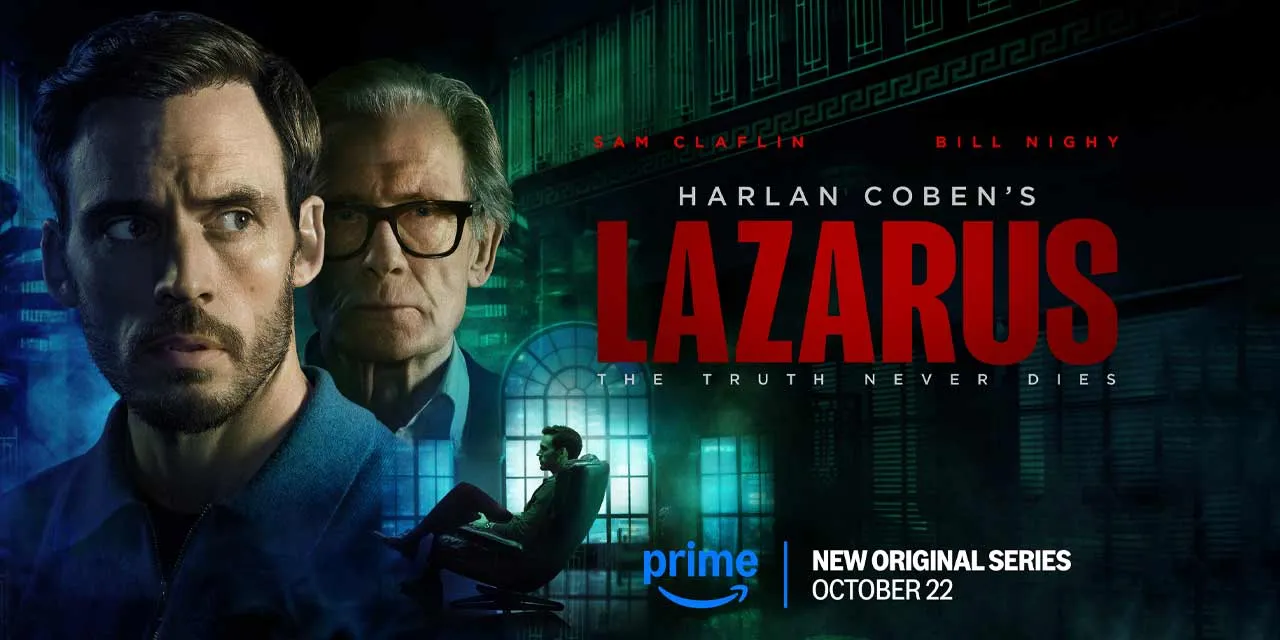

Lazarus arrives as an original series from Harlan Coben with Danny Brocklehurst, two writers known for clockwork mysteries built on buried secrets and sharp reversals. Across six episodes of psychological horror and thriller, the story introduces Dr. Joel “Laz” Lazarus, a forensic psychologist played by Sam Claflin, whose life fractures after the apparent suicide of his father, Dr. Jonathan Lazarus, a prominent psychiatrist portrayed by Bill Nighy.
Laz returns to his childhood home and sinks into disorienting grief that bends toward the supernatural. He begins to see his dead father and former patients from the old office, figures that may be visions or hallucinations. These appearances push him into an investigation that links his father’s death to a set of cold murder cases, including the long-untouched killing of his twin sister. The show commits to a chilling setup that mixes psychological damage with possible paranormal intrusion and pursues uncomfortable truths with steady focus.
Twists, Traumas, and the Streaming Structure
The series builds early strength through a twin-track mystery, an approach that reflects a streaming trend of folding genres together. Laz’s conversations with the dead act as a narrative motor, forcing him to confront what his father kept hidden.
That spectral thread intersects with a crime procedural as Laz, working with his police friend Seth McGovern, played by David Fynn, hunts for rational links between those patients and a suspected serial killer. The rhythm shifts between psychological drama and cold case inquiry, a welcome move away from formula-bound crime television and a signal that the limited series can carry hybrid storytelling without losing clarity.
The six-episode frame sets an early pace that feels clean and propulsive. The same frame exposes a recurring problem in streaming thrillers, namely plot density. The narrative carries the weight of about four episodes of core material, which invites repetition and sidesteps depth by stacking complications in the middle stretch.
Coben’s efficient misdirects and red herrings set the hook early, then turn into a hindrance as the story barrels forward. The last chapters lean on rapid-fire twists and frequent rug pulls, which thins the emotional charge of each reveal. An extended process of ruling suspects out makes the remaining culprits easier to spot, a move that lays bare the mechanism of the mystery and undercuts the story’s emotional line.
A central theme tracks the inheritance of harm across generations. Laz follows clues and also confronts his father’s professional and personal failures, a portrait of accountability and legacy that sits squarely in current conversations about power and its consequences. The ending tilts the series away from that thematic center.
A sharp cliffhanger pivots the story toward a very different show, a choice designed to entice a second season. Many viewers have come to expect self-contained limited series with finality, and this closing move signals a reluctance by platforms to commit to finite stories even when the material invites closure.
Character Depth and the Limitations of Trauma
Sam Claflin’s performance steadies the series. He plays Lazarus with concentrated grief and a quick slide toward instability, a combination that locks attention on the character’s spiraling state. The script identifies Laz as a forensic psychologist who should project control and analysis. The writing places him in such pronounced fragility from the start that his professional footing reads as shaky.
The collapse feels preordained rather than earned through stages, which closes off a stronger path, a therapist managing personal trauma while preserving a credible façade. Set pieces ask for repeated peaks of shouting and intensity, where a cooler register of pain might have deepened the arc.
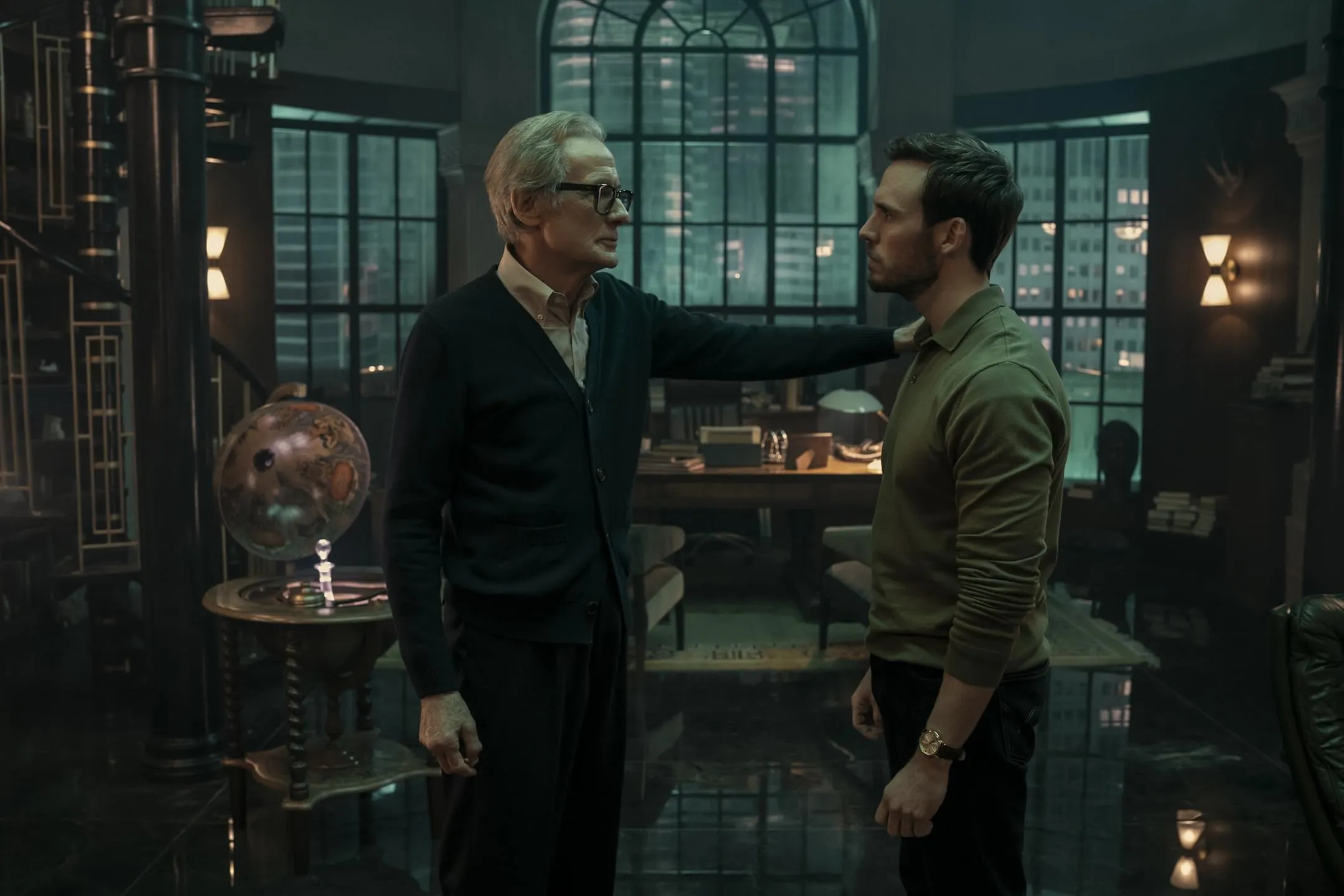
Bill Nighy offers a strong counterpart as Dr. Jonathan Lazarus through visions and flashbacks. He gives the figure an opaque authority and keeps judgment in flux. The father never lands as a simple monster, and Laz’s grievances carry force because the portrayal favors ambiguity over verdict.
The ensemble delivers through uneven material. Alexandra Roach’s Jenna, Laz’s sister, pairs deep trauma with quiet resilience and speaks to victims who live with the longest tail of family disaster. David Fynn’s Seth grounds scenes with logic and a touch of humor that keeps the investigation human.
Characters built to widen the plot, including the serial killer Arlo Jones, played by Jack Deam, receive limited attention, which hints at a sharper, harder-edged version of the show that the schedule cannot support. The casting lands, yet thin development for key players narrows the series’ reach on questions of harm, responsibility, and social cost. The script favors forward motion and surprise over the full psychological fallout that the premise invites.
The Gothic Aesthetic of Psychological Decay
The production embraces a gothic mood and a bone-chilling visual language. Cinematography builds a heightened reality that feels slightly outside of time, dodging the blur of interchangeable contemporary backdrops. Warm yellow light and deep shadow in domestic interiors create a cozy surface that sits against the darkness of the plot, a visual tension that keeps scenes unsettled.
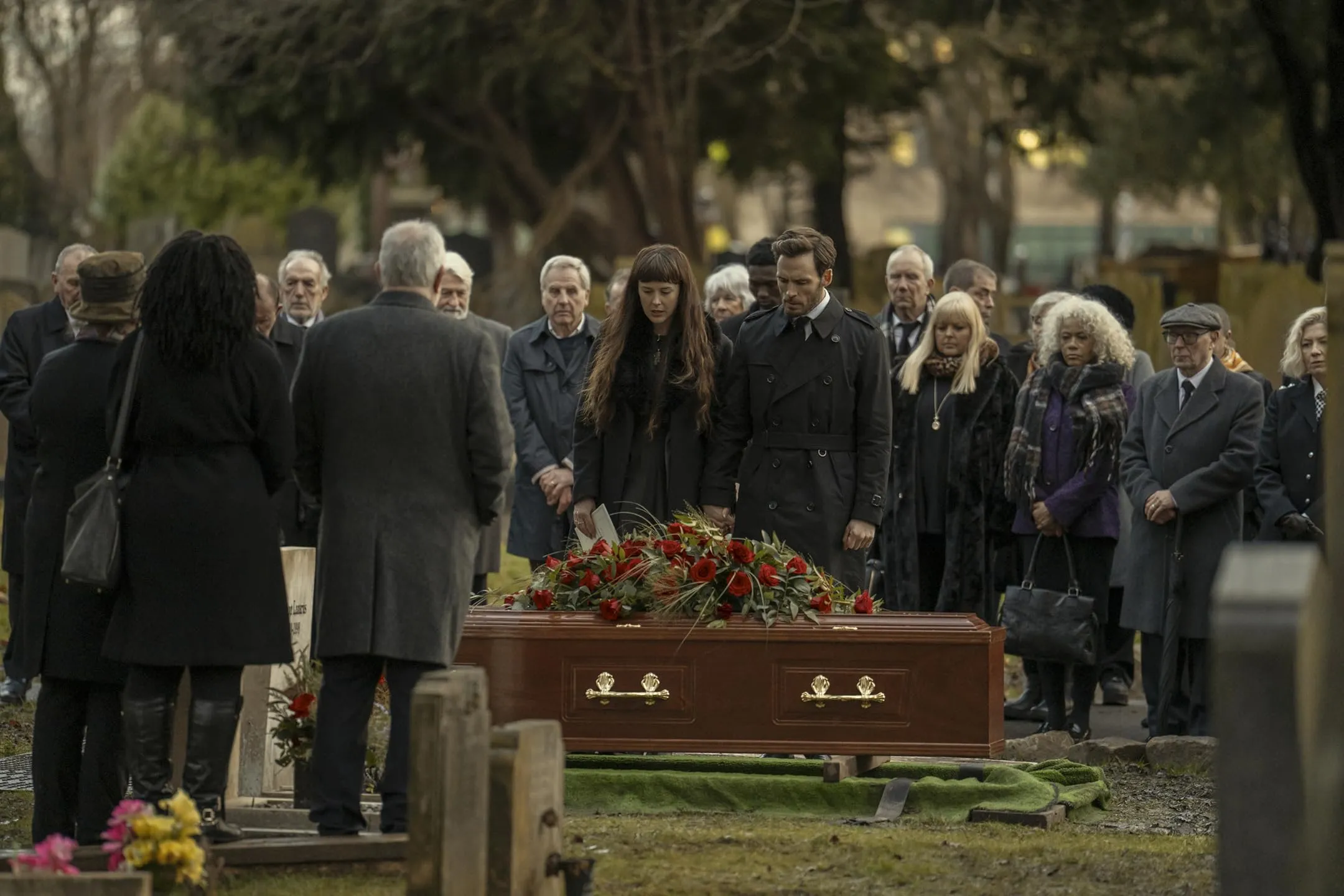
Production design shapes Laz’s world with care. Dr. Lazarus’s office stands out, a baroque room of warm woods and high ceilings that speaks to authority and the institutional weight of secrets. The supernatural imagery benefits from specific techniques. Blurred focus and a persistent lens sheen during visions fracture the image and externalize Laz’s fraying mind.
Those choices make the otherworldly presence feel immediate. Spectral figures arrive as abstract forms with jolts of violence, which sustains the horror through psychological erosion rather than gore. The aesthetic choices tie form to theme with precision, pressing on trauma and institutional decay while the story tests how much damage a legacy can carry into the present.
Harlan Coben’s Lazarus is a six-episode British psychological horror-thriller miniseries. Co-created and written by Harlan Coben and Danny Brocklehurst, the show follows forensic psychologist Joel “Laz” Lazarus (Sam Claflin), who returns home after his father, Dr. Jonathan Lazarus (Bill Nighy), dies by suicide and begins to experience disturbing visions that entangle him in a series of cold-case murders. The series premiered on Wednesday, October 22, 2025, and is available to stream exclusively on Prime Video.
Credits
Directors: Wayne Che Yip,
Writers: Harlan Coben, Danny Brocklehurst,
Producers and Executive Producers: Harlan Coben, Danny Brocklehurst, Nicola Shindler, Richard Fee, Sam Claflin, Wayne Che Yip, Matt Strevens,
Cast: Sam Claflin, Bill Nighy, Alexandra Roach, David Fynn, Karla Crome, Kate Ashfield, Ewan Horrocks, Curtis Tennant,
Director of Photography (Cinematographer): Adam Gillham, Ciro Candia,
Editors: Adam Green, John Greenhalgh,
Composer: David Buckley
The Review
Lazarus
Lazarus establishes a potent, visually arresting mystery centered on grief and inherited secrets. The superb performances from Sam Claflin and Bill Nighy ground a dark narrative that marries psychological thriller with gothic aesthetic. While the six-episode commitment allows for stylish atmosphere and strong initial suspense, the plot thins mid-season. The ultimate reliance on constant reversals in the final third weakens the emotional payoff. It succeeds as a gripping, quick watch, yet the unresolved ending feels like a frustrating bid for continuation rather than a satisfying conclusion to a tightly structured story.
PROS
- Visually rich, compelling gothic atmosphere and exceptional production design.
- Strong, committed performances from the lead cast, especially Sam Claflin.
- Strong, committed performances from the lead cast, especially Sam Claflin.
- Effective use of blurred cinematography to visually represent the protagonist's psychological state.
CONS
- The six-episode structure strains the plot, resulting in repetition and slow sections.
- An overwhelming reliance on twists in the final episodes makes the ultimate reveals feel ineffective.
- Character writing is frequently superficial, undermining the emotional stakes.
- The final cliffhanger feels abrupt and fails to provide a meaningful resolution to the central mysteries.