
























![Kingdom Hearts Collection [I-III] Review](https://gazettely.com/wp-content/uploads/2026/10/Kingdom-Hearts-Collection-I-III-1-360x180.webp "Kingdom Hearts Collection [I-III] Review: KHII Holds Steady as Newer Entries Fluctuate 37")





The documentary Writing Hawa, the feature debut of Afghan journalist-filmmaker Najiba Noori with co-director Rasul Noori, locates its pulse where private longing meets political ruin. The film studies existential desire inside a nation that loosens at the seams. Shot across five years and concluding with the rapid 2021 Taliban takeover, it follows Hawa, Noori’s Hazara mother, through a late-life reach for self-determination.
A childhood taken by patriarchy shadows her present, yet she sets two clear aims: to learn to read and write her own name and to build a textile business. The work forms a meditation on self-making in a collapsing time. It wonders if meaning can take shape when history presses toward erasure.
The Geometry of a Deferred Life
Hawa’s past reads like a sentence handed down without appeal. Married at thirteen to a man thirty years older, she lived under an order that denied choice. Her turn toward change becomes an act of authorship. Literacy arrives with a near-sacred charge; each letter traced at the urging of her young grandchildren rewires an inner system and permits her to inhabit her name.
The textile enterprise, rooted in traditional Hazara embroidery, stitches the hope of economic agency into a life taught to expect constraint. The image track carries a quieter sorrow. Her husband ages beside her, his mind touched by dementia.
Hawa speaks of a love once held for his cousin, and the confession reframes decades of duty. The daughter-filmmaker records the moment and meets a life that dreamed in silence. Hawa moves toward a resilient identity, an authenticity where tradition and new agency bind into the same thread.
When History Repeats Itself: The Cycle and the Fall
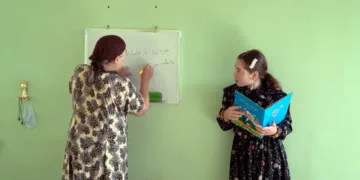
The film’s most severe existential chill gathers around Zahra, Hawa’s granddaughter and Najiba’s niece, thirteen years old, the same age that sealed Hawa’s fate. Zahra reaches the family home after fleeing an abusive father and arrives like a revenant from the past. Their brief sessions at the whiteboard, two learners spelling side by side, form a fragile vision of education.

The vision snaps. With Taliban forces nearing, Zahra returns and faces a marriage that echoes her grandmother’s early life. Hawa’s steps toward change sit within this circle of recurrence. Najiba Noori cuts between these small advances and broadcasts of national despair. Reports of the Doha peace accords and rising violence speak like a Greek chorus, measuring private ascent against public descent.
Noori’s voiceover remains spare and wounds with precision, assigning responsibility to external powers who, in her words, “decided the fate of the Afghan people on our behalf.” The sense of betrayal carries heat. That heat shapes the making of the film itself. Najiba leaves for France in 2021. Rasul stays and records the last dark passages from inside the structure as it gives way.
The Aesthetic of Witnessing
An intimate, embedded camera holds the tension of a family keeping vigil over its freedom. Much of the action settles inside a Kabul apartment, where arguments, confessions, and dense kinship fill the frame with unguarded immediacy.
The mood leans toward melancholy and contained rage, a quiet grief set to traditional Afghani strings such as the setar and rubab, in a score composed by Afshin Azizi. Noori turns to simple, resonant signs to map Hawa’s interior path. The loosening of a hijab inside the home registers spiritual expansion.
Color appears with intention, the blue of controlling tradition set against the red of hazardous, fervent modernity, and the domestic rooms gather symbolic weight. The closeness of the vantage gives the film its force and sets its perimeter.
Writing Hawa remains a carefully curated portrait that concentrates on women’s lives and reduces the on-screen presence of male conflict and explicit violence. The film works like a woven carpet. The pattern carries truth, and the rawest threads stay tucked from view by choice. What remains is a concentrated vision of survival and existential defiance.
Writing Hawa is a documentary feature film that premiered at the International Documentary Film Festival Amsterdam (IDFA) in November 2024. The film chronicles the life of Hawa, a 52-year-old Hazara woman, who begins her journey toward independence by learning to read and write and starting a textile business, forty years after being forced into marriage as a child. Filmed over five years, it also follows Hawa’s granddaughter, Zahra, and the filmmaker, Najiba Noori. The narrative powerfully documents the aspirations of three generations of Afghan women, juxtaposing their personal strides against the devastating backdrop of the Taliban’s return to power in 2021, which shattered their dreams. The film has been screened at various international festivals and was released theatrically in the Netherlands in September 2025. The platform for watching it will depend on the region and the deals made by its world sales company, First Hand Films, with limited theatrical runs available in locations like London’s Bertha DocHouse.
Credits
Title: Writing Hawa
Distributor: First Hand Films
Release date: World Premiere at IDFA (International Documentary Film Festival Amsterdam) in November 2024; Theatrical release in the Netherlands on September 11, 2025; UK release (Bertha DocHouse, London) from October 31, 2025.
Running time: 84 minutes, 85 minutes
Director: Najiba Noori
Writers: Najiba Noori, Afsaneh Salari
Producers and Executive Producers: Christian Popp, Hasse van Nunen, Renko Douze
Cast: Hawa Noori, Zahra Haidari, Fatima Noori, Musa Noori, Rasul Noori, Mahdi Noori, Zaher Noori, Mohammad Ali Khaliqi, Mehran Khaligi, Kian Khaliqi
Director of Photography (Cinematographer): Najiba Noori, Rasul Noori
Editors: Afsaneh Salari
Composer: Afshin Azizi
The Review
Writing Hawa
Writing Hawa is a profound study of how an authoritarian system imposes an external, fatalistic narrative upon the soul. Najiba Noori captures a devastatingly intimate confrontation between Hawa’s belated awakening and the nation’s tragic collapse. The film functions as both a searing memoir and a focused political indictment, examining the heavy cost of deferred dreams and inherited oppression. It is a vital document on the tragic, relentless cycle of fate endured by Afghan women. A deeply felt portrait of human resilience and resistance.
PROS
- Deeply intimate and essential perspective on the pursuit of self-authorship.
- Masterful juxtaposition of Hawa's personal ascent with Afghanistan's political collapse.
- Powerful use of symbolism, including literacy as a literal act of liberation and the subtle commentary of colors and dress.
- Moving emotional depth provided by the use of traditional Afghani string music.
- The raw, persistent anger conveyed through the filmmaker's selective voiceover commentary.
CONS
- The film adopts a controlled, selective focus that minimizes visceral violence and complex male conflict.
- Moments involving the political violence, such as the brother's attack, are presented abstractly, lessening their immediate, raw impact.
- The highly subjective nature of the familial filming, while providing intimacy, means the scope of Afghan society is limited.







