




























Song Sung Blue, Craig Brewer’s adaptation of Greg Kohs’ 2008 documentary, frames a sly, existential wager: perhaps the American dream hums through a well-tuned cover song. The film tracks Mike “Lightning” Sardina, a Vietnam veteran and mechanic played by Hugh Jackman, and Claire “Thunder” Stengl, a hairdresser played by Kate Hudson.
They collide on the Midwest tribute circuit, a dust-lit corridor of county fairs and rented lights, then build a Neil Diamond act inside Milwaukee’s working-class grid. The tone stays sentimental and reverent. Sequins glint. Amplifiers breathe. Brewer keeps the camera close to small stakes and treats Diamond’s catalog as an emotional archive that still holds charge.
Chiaroscuro of the Soul: The Duo’s Light
Performance fuels the film. Hudson gives Claire a plainspoken grit that reads clean on camera, a steady anchor for the gloss. Joy lands. Hurt lands harder. Jackman shapes Mike as a study in performed identity, a crowd-ready showman with visible fracture lines.
Brewer’s lighting design carves that double life with classical precision. Spotlights sculpt the stage bodies while offstage scenes sit in softer, cooler values. Faces bloom under key light; doubts linger in shadow. Shot choices favor medium frames that watch movement in and out of the beam, a visual score for what the music promises and what real life withholds.
The band calls itself a “Neil Diamond experience,” a telling label. Mike aims for interpretation, a channel for feeling. The film locates truth in delivery, in the way breath, phrasing, and stance tilt a familiar melody.
Brewer lets full songs run. “Soolaimon,” “Play Me,” and “Brother Love’s Traveling Salvation Show” arrive as complete set pieces, each cued to narrative beats. The cuts often defer to performance duration, so verses and choruses function as montage without montage. Small-time glory receives clear validation. Perfection gets pursued inside a local radius, and the camera respects the scale.
The Fractured Narrative Arc: Pacing and Pathology
The climb begins with local notoriety and swift help from a dentist-turned-manager, played by Fisher Stevens, plus a scene-stealing casino booker played by Jim Belushi. Domestic texture steadies the rise.
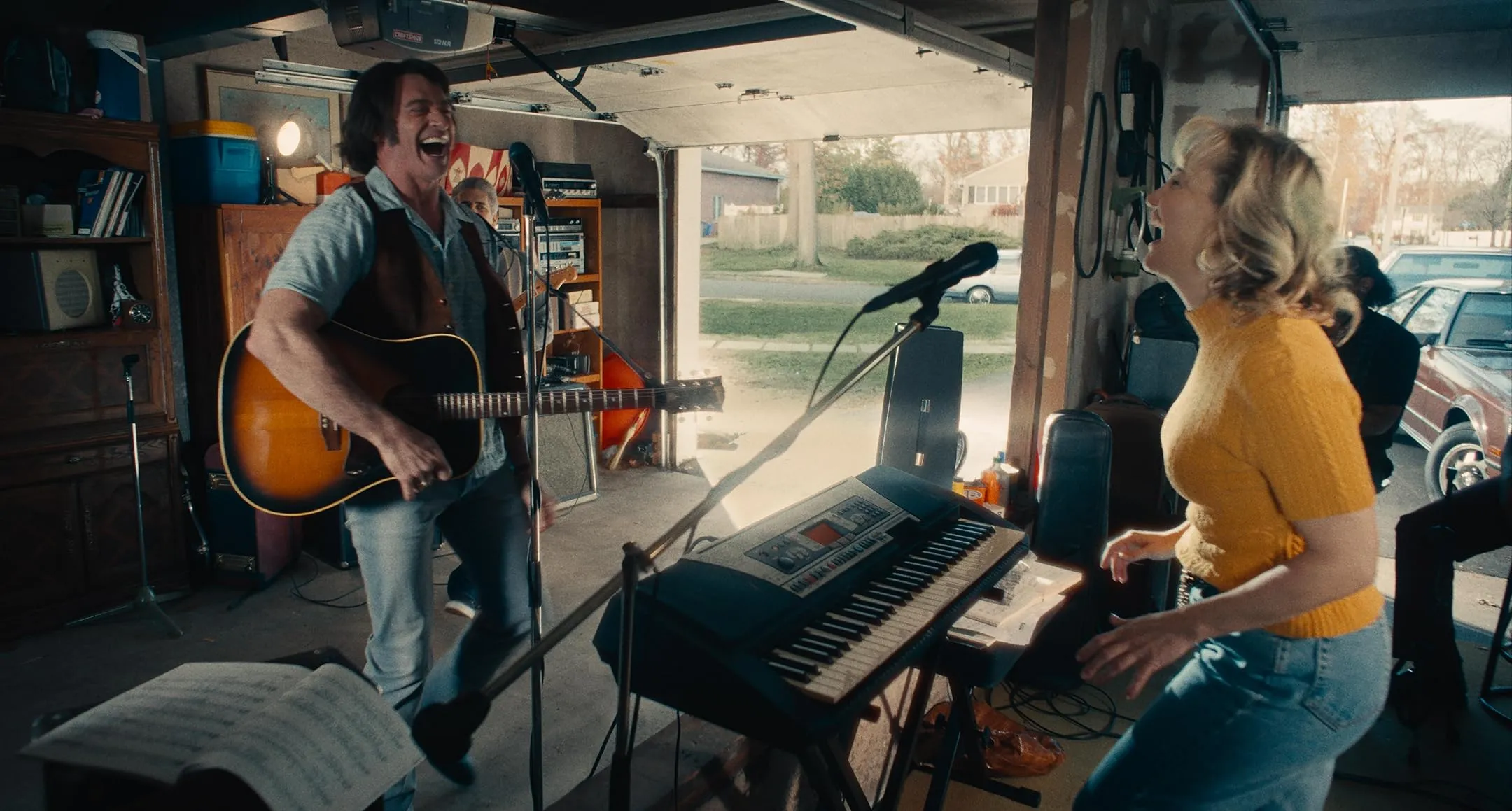
Claire’s daughter Rachel warms to Mike’s daughter Angelina, played by King Princess, and the stage family starts to feel possible. The wild apex arrives with an opening slot for Pearl Jam, a surreal confirmation that their act can land in big rooms. Then the axis tilts.
Claire’s accident resets the film’s geometry and drags the story into heavier air. Hudson charts anger and depression with careful modulation, and the marriage strains under the weight. The script reaches for an expanded case file: addiction, PTSD, Mike’s untreated heart condition, the thicket of healthcare paperwork, a major teen pregnancy.
The accumulation pinches the rhythm. Scenes hurry past problems that ask for diagnostic time, and the tonal register wobbles toward melodrama. A sincere core remains in view, yet the volume of crisis blurs nuance and flattens impact.
The Resilience Protocol: Brewer’s Neo-Noir of the Midwest
Brewer, whose filmography includes Hustle & Flow and Dolemite Is My Name, keeps faith with performers who chase self-definition through showmanship. The Neil Diamond act reads as a spiritual exercise. The camera and cut patterns keep returning to faces, hands, and microphones, as if the body could draft a contract with fate under hot lights.
The film carries a neo-noir temperament at the level of idea. Identity looks provisional. Choice feels contingent. Working-class constraints pen the couple into narrow corridors, and the act supplies the corridor with exit signs.
Music becomes the operating system for survival. National fame never functions as the metric. Love, craft, and the rush of a casino crowd shape a workable life. The final movement leaves the thesis in the air, carried by performance rather than speech. Keep singing. Tears follow the cue. The sound is big, the people ordinary, and the cinema pays attention.
Song Sung Blue is a biographical musical drama based on the true story of Mike and Claire Sardina, a married couple from Milwaukee who formed the popular Neil Diamond tribute band “Lightning & Thunder.” Directed and written by Craig Brewer, the film explores their journey navigating love, blended family dynamics, and immense personal tragedy while pursuing their musical dreams. The movie had its world premiere at the AFI Film Festival on October 26, 2025, and is scheduled for a wide theatrical release in the United States on December 25, 2025, distributed by Focus Features.
Credits
Title: Song Sung Blue
Distributor: Focus Features (US), Universal Pictures (International)
Release date: December 25, 2025 (United States wide release)
Rating: PG-13
Running time: 131 minutes
Director: Craig Brewer
Writers: Craig Brewer, Greg Kohs
Producers and Executive Producers: Craig Brewer, John Davis, John Fox, Greg Kohs, Erika Hampson
Cast: Hugh Jackman, Kate Hudson, Michael Imperioli, Fisher Stevens, Jim Belushi, Ella Anderson, King Princess, Mustafa Shakir, Hudson Hilbert Hensley
Director of Photography (Cinematographer): Amy Vincent
Editors: Billy Fox
Composer: Scott Bomar
The Review
Song Sung Blue
The film is a powerful showcase for its leads, who infuse a small-scale, sentimental story with genuine heart. Craig Brewer's script is overburdened by too many dramatic subplots, diminishing the emotional force through sheer density of tragedy. The sincerity of the performances, especially Hudson’s career-best dramatic work, and the film's validation of working-class dreams, make this an uplifting and resonant watch. It succeeds through conviction, overcoming its narrative flaws.
PROS
- Exceptional, high-voltage chemistry between Hugh Jackman and Kate Hudson.
- Hudson delivers a commanding, vanity-free dramatic performance.
- The film maintains a sincere, non-cynical tone regarding its underdog subjects.
- Strong musical direction; full-length Diamond songs are used effectively to propel the narrative.
CONS
- The screenplay is overstuffed, covering too many sensitive topics without adequate depth.
- Pacing issues in the second act cause some emotional moments to feel rushed.
- The narrative sometimes sacrifices grounded drama for jarring melodrama.