
























Jan Komasa’s Anniversary plays as a disquieting psychological thriller that tracks a country sliding toward totalitarian rule through the ritual clockwork of family milestones. The film uses five consecutive anniversaries in the Taylor household as a framing device, a tidy calendar that records a widening civic fracture. The East Coast family projects comfort and success, then splinters in plain view. The spark catches at home, around a dining table and inside a career, when Ellen Taylor, a liberal arts professor and the family matriarch, watches the ground shift under her feet.
The shift arrives with her son, Josh, and his partner, Liz Nettles, once Ellen’s student. Liz wrote a thesis that Ellen dismissed as radical and anti-democratic. That thesis reappears as a bestseller titled The Change. The book ignites an authoritarian movement that races through institutions and screens. Komasa’s narrative concentrates on the small abrasions between intimates and shows how political upheaval corrodes loyalty and habit. National breakdown appears as a domestic failure multiplied, a republic reduced to the size of a living room.
The Vague Spectre of “The Change”
The dystopia builds out of deliberate vagueness, a tactic I call Ideological Vapidity. The Change behaves like a slick crusade that promises a “no-party system,” a phrase that advertises unity and sells conformity to a single line. The program’s details stay offstage. That opacity gives the movement elastic force. People read into it what they desire or fear, and the blankness becomes a tool. History often rewards slogans and symbols that can be stamped on hats and billboards, quick phrases that travel faster than argument.
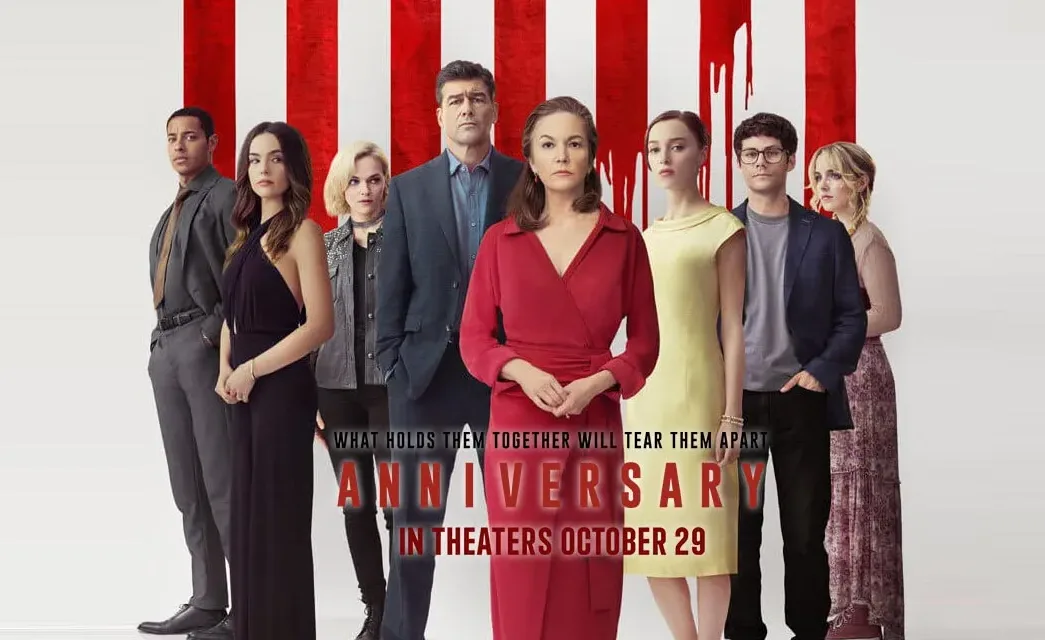
The new order’s branding saturates space. A redesigned U.S. flag relocates the stars to the middle of the stripes, a visual command for forced unity that looks tidy and feels coercive. Corporate-grade propaganda clips loop with expensive polish. Money flows from the Cumberland Company, which signals a managed rollout of power. The atmosphere suggests a venture-capital project that treats ideology like a product line.
Speech tightens. The Taylors learn to step around their own words in their Virginia house as restrictions pile up. Anna, the daughter who works in stand-up, illustrates the cost with painful clarity. Her public resistance to The Change invites danger, and the pattern feels familiar: comedians, professors, and journalists often meet the censors first. Drones drift, “census” workers pry, and the home reconfigures into a watchtower you live inside. The private sphere shrinks to the size of a whisper.
Komasa keeps the lens close. The crisis arrives filtered through fights between spouses, between siblings, between a professor and a former student who outmaneuvered her. Ellen’s academic judgment of Liz and Josh’s restless search for purpose supply the fuse that leads outward. The focus on a single upper-middle-class family risks an improbable scale, as if the nation’s fate hinged on one address in Virginia. Maybe that is the argument. Politics becomes bearable or unbearable at the breakfast table.
Komasa’s Aesthetics of Implosion
Komasa builds a quiet thriller of small rooms, close faces, and short distances. The terror lives in dinner conversations, careful pauses, and corridors. The film sets up an early sequence of warmth and celebration, then returns five years later to a cold inventory of costs. The comparison lands with a chill. Each character arrives slightly bent out of shape, like furniture that looks the same until you try to sit in it.

Crowded House’s “Don’t Dream It’s Over” carries a double load. First it scores a tender dance. Later it scores a darker passage. The song turns into a motif for stubborn hope and the fear that hope will not hold. A hummed chorus becomes a quiet act of defiance that might fail.
The Taylor home operates as the emotional and narrative anchor. Lucy Van Lonkhuyzen’s production design charts its shift from East Coast ease to a contested field. The house begins as an emblem of connection, then mirrors social decay, room by room.
It starts to feel unreliable, less a refuge, more a platform for ideological skirmishes. Piotr Sobońciski Jr.’s camerawork and the wardrobe choices follow the mood with restraint. Nothing screams for attention; the control is deliberate. The anniversary time jumps compress dread into neat parcels, a structural choice that speeds the psychological weathering of everyone on screen.
Performance and Transformation
The ensemble carries the film. Diane Lane’s Ellen projects intellect and wounded pride. Her anger toward Liz and toward the ideas in The Change powers her resistance and exposes her blind spots. She reads as the startled face of an academic class that believed it could define terms indefinitely, only to discover the dictionary had already been revised.

Phoebe Dynevor gives Liz an unnerving reserve. The performance withholds. The affect stays flat, the gaze predatory, and the character turns into an instrument that amplifies an ideology racing through the culture. The mystery around her motives doubles as a statement. An architect of control may run on petty grievance, then discover that grievance scales.
When Lane shares the frame with Kyle Chandler’s Paul, the parental tragedy registers in gestures and quick looks. Paul takes the peacemaker role and repeats that there are no sides. The reassurance lands like a bruise. The family splits along the grain while he asks for calm. A brief quarrel about what to name the dog says more about the marriage than any confession. The warmth remains visible, and you can feel it thinning.
Dylan O’Brien’s Josh provides the story’s most chilling arc. He begins as an anxious, scruffy writer with professional failures and a hunger for validation. He hardens into arrogance and contempt. Empathy falls away. The portrait shows a man who discovers purpose and loses himself, a civic conversion that looks like salvation to him and catastrophe to everyone else.
Around him, the cast keeps the temperature steady: Madeline Brewer gives Anna a spiky tenacity; Mckenna Grace makes Birdie’s quiet defiance feel lived-in; Zoey Deutch plays Cynthia as a study in sidelong glances and compressed judgment, a spouse who broadcasts fatigue without a word. The ensemble feels deep, and the film does not always make space for every layer. Cynthia, in particular, suggests a larger story at the edges of the frame.
The Parable of Proximity
Anniversary reads as a warning that feels fanciful and recognizable at once. The premise argues for debate as civic oxygen. The first move of total power targets the capacity to think differently, then teaches people to police their own speech. The echo with present concerns over polarization requires no diagram.
The film gathers its force from the cast, from the claustrophobic scale of its threat, and from Komasa’s control over a slow, observable slide. A problem remains by design. Liz’s motives stay blurred, and the doctrine inside The Change remains vague. The ambiguity courts philosophical interest and shaves some dramatic voltage.
The antagonist can read as a hollow conduit for a principle of domination, which creates distance where heat might go. Komasa’s project arrives topical and sincere. The work holds attention through performances and the chill of household politics, even as it stops short of staking a concrete claim about the ideology that seizes the country.
Anniversary is an American thriller film that follows a close-knit family as their lives begin to fall apart after the son introduces his parents to his new girlfriend, who is the driving force behind a controversial and rapidly rising political movement known as “The Change.” The film focuses on the family’s intimate struggle with loyalty and opposing ideologies as the nation itself stands on the edge of alarming uncertainty. Directed by Jan Komasa, the movie is scheduled for a wide theatrical release by Lionsgate Films on October 29, 2025.
Credits
Title: Anniversary
Distributor: Lionsgate
Release date: October 29, 2025
Rating: R
Running time: 111 minutes (1 hour 51 minutes)
Director: Jan Komasa
Writers: Lori Rosene-Gambino, Jan Komasa
Producers and Executive Producers: Nick Wechsler, Steve Schwartz, Paula Mae Schwartz, Kate Churchill, Diane Lane, Lori Rosene-Gambino, Morgan O’Sullivan, Michael Burns
Cast: Diane Lane, Kyle Chandler, Madeline Brewer, Zoey Deutch, Phoebe Dynevor, Mckenna Grace, Daryl McCormack, Dylan O’Brien, Flavia Watson, Paul Tylak, Jolly Abraham, Rebecca O’Mara, Selda Kaya
Director of Photography (Cinematographer): Piotr Sobociński Jr.
Editors: Michał Czarnecki
Composer: Danny Bensi, Saunder Jurriaans
The Review
Anniversary
Anniversary succeeds as a chilling domestic thriller, using the spectacular performances of Diane Lane and Dylan O'Brien to ground its descent into authoritarianism. Komasa masterfully builds dread within the claustrophobic confines of the family home. While the film is highly topical and compelling, its deliberate vagueness regarding the villain's motives and "The Change's" core ideology prevents it from becoming the incisive political statement it aims to be. It is a powerful family tragedy, if an incomplete political parable.
PROS
- Brilliant ensemble cast, led by Diane Lane and Kyle Chandler.
- Dylan O'Brien’s chilling performance capturing a profound transformation.
- Effective direction by Jan Komasa in establishing a mood of intimate terror.
- Masterful use of the family home and time jumps to track societal decay.
- Highly topical and relevant themes regarding censorship and political conformity.
CONS
- The central political ideology ("The Change") is too vague, undercutting the dramatic weight.
- Liz Nettles's motivation is never fully developed, leaving her as an abstract antagonist.
- Some parts of the star-studded ensemble cast are underutilized.
- The tight focus on one affluent family risks making the national crisis seem implausibly personal.