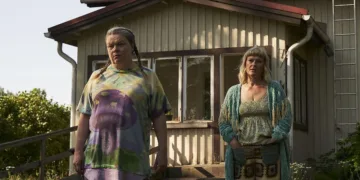





























Teemu Nikki’s {{100 Liters of Gold}} plays as a black comedy rooted in the provincial Finnish village of Sysmä, built on screwball momentum and specific local detail. The story builds around the tradition of sahti, a potent farmhouse ale that appears at nearly every community ceremony from births to weddings and funerals. Pirkko (Elina Knihtilä) and Taina (Pirjo Lonka) sit at the core of this world as two middle-aged sisters and third-generation masters of brewing, famous for their skill and for drinking what they make.
Their trouble starts after promising 100 liters of sahti for their younger sister Päivi’s wedding. They brew a batch they call a “perfect 10” and then finish every drop during a blackout spree. The aftermath triggers a frantic scramble to replace the “golden liquid,” sending them through petty theft and hardnosed debt collection under bright rural skies. The small-town frame shapes the film’s mood and gives the action a lived-in texture.
The Sweetness and The Sour: Comedy and Cultural Context
The film declares its intent as an absurd black comedy, paced by rhythmic gags that escalate through the sisters’ slapstick problem-solving. The humor lands while the script keeps a steady beat, and the setpieces keep pushing the errand forward. The portrait of local life feels precise, similar to the way regional Indian cinema spotlights community customs and artisanal work.
Sahti becomes a character through craft detail, from the wooden trough, or kuurina, to the self-awarded “perfect 10.” Comedy sits beside harder notes. Pirkko and Taina’s heavy drinking draws laughs, yet the film still marks the consequences, including Pirkko’s job loss and the Antabuse in their father’s routine.
Family history carries weight as well, with Taina’s guilt over the car crash that left Päivi disabled shaping her choices. This layering turns a beer-resupply caper into a story about responsibility and repair. For international viewers, the fusion of farce and cultural specificity lands in a space familiar to Indian parallel cinema or festival-oriented Hindi storytelling, where local ritual, community labor, and personal reckoning often share the frame.
A Nordic Western Aesthetic
Nikki’s direction, consistent with earlier portraits of outsiders under pressure, creates a defined visual plan. Working with cinematographer Jarmo Kiuru, he selects a 1:2.39 widescreen ratio and a deliberate cadence. A dusty, burnt yellow-orange palette suggests an endless Finnish summer and sets the sisters’ messy crimes against bright fields and roads.

The film adopts a 1960s Western motif. Showdowns with the cousin Ponu-Paavo (Jari Pehkonen) stage like outlaw face-offs. Costumes by Anna Vilppunen, battered American cars, and the score lock that approach in place. Music draws on Marco Biscarini, a student of Ennio Morricone, alongside Finnish rautalanka, which suits the Western frame and the rural setting.
The plot keeps a ticking-clock rhythm that generates tension even as the leads move with a casual swagger. The result shows how a firmly local narrative can travel through style, echoing how Indian filmmakers often carry village or small-town stories onto a global screen through strong genre hooks and music-image interplay.
Two Sisters, Strong Chemistry
Elina Knihtilä and Pirjo Lonka hold the emotional center as Pirkko and Taina. The performances feel assured and generous, grounded in long experience on stage and on camera. They treat the cartoonish situations with complete seriousness, which brings out intelligence and warmth below the rough surfaces. Pirkko behaves rudely and swings toward blackout territory.
Taina appears more measured, but guilt drives her from within. Their bond reads as affectionate and combative at once, a rhythm that feels specific to their village life. The ensemble adds fine detail. Ville Tiihonen’s Hauki-Hikkanen, an awkward and persistent admirer, quietly pushes the mission forward at key moments.
Across the cast, players commit to the bit and then peel it back, letting wounds and loyalties show. The sisterly rapport anchors the film’s cultural frame and comic structure, and it also mirrors relationship-driven comedies from India that pair broad situations with sincere family stakes.
100 Liters of Gold is a Finnish black comedy that centers on two middle-aged sisters, Pirkko and Taina, who are famed makers of sahti, a traditional Finnish farmhouse ale. Tasked with brewing 100 liters of the strong beer for their sister Päivi’s wedding, they end up drinking the entire batch themselves. The film, which had its World Premiere on 24 October 2024 at the Rome Film Festival, transforms into a race against the clock as the sisters, grappling with massive hangovers and reputation on the line, scramble to find a replacement supply in 24 hours. The film was an official submission for the Academy Award for Best International Feature Film and was distributed theatrically in Finland starting 28 March 2025. For international viewers, the movie has appeared on the festival circuit, including Tallinn Black Nights and Tromsø International Film Festival, and is available for acquisition globally, with distribution in Italy by I Wonder Pictures.
Credits
Title: 100 Liters of Gold (Original: 100 litraa sahtia)
Distributor: Nelonen Media / Finnkino (Finland), I Wonder Pictures (Italy)
Release date: 24 October 2024 (World Premiere, Rome Film Festival), 28 March 2025 (Finnish Theatrical)
Rating: 12 (Finnish Classification), M (Australian Classification), Not recommended under 12 yrs (Estonian Classification)
Running time: 88 minutes (1h 28m)
Director: Teemu Nikki
Writers: Teemu Nikki
Producers and Executive Producers: Jani Pösö, Andrea Romeo, Timo T. Lahtinen
Cast: Elina Knihtilä, Pirjo Lonka, Ville Tiihonen, Ria Kataja, Jari Pehkonen, Pertti Sveholm, Elmer Bäck, Jakob Öhrman, Vilma Melasniemi, Rami Rusinen
Director of Photography (Cinematographer): Jarmo Kiuru
Editors: Jussi Sandhu
Composer: Marco Biscarini
The Review
100 Liters of Gold
Verdict: Teemu Nikki delivers a culturally rich, high-spirited black comedy. The film finds genuine warmth and emotional weight beneath its farcical surface. Its unique Nordic Western aesthetic and strong lead performances elevate the material, making the drunken quest both absurdly funny and surprisingly poignant. The movie succeeds as a showcase of deep-seated familial complexities and regional authenticity.
PROS
- Exceptional chemistry and acting from the two lead actresses.
- Highly distinct visual style, incorporating a '60s Western aesthetic.
- Successful balancing of screwball comedy with serious themes of addiction and guilt.
- Strong cultural authenticity centered on the sahti tradition.
CONS
- The cyclical nature of the sisters' drinking may become repetitive for some viewers.
- The resolution of the deep family trauma feels slightly mismatched with the farcical tone.
- Pacing occasionally feels low-stakes despite the ticking clock premise.