

























![Kingdom Hearts Collection [I-III] Review](https://gazettely.com/wp-content/uploads/2026/10/Kingdom-Hearts-Collection-I-III-1-360x180.webp "Kingdom Hearts Collection [I-III] Review: KHII Holds Steady as Newer Entries Fluctuate 37")




The air in this quiet Polish village carries the sour edge of curdled milk and the pressure of long-held custom. For the people who live here, the dairy factory keeps the lights on, puts food on the table, and sets the rhythm of the day. Maja comes back after graduating from university with a clear hope: she wants her adult life to connect with the place that raised her.
She arrives with Milosz, her Black fiancé, and the village meets him with suspicion that reads as reflex. The tension lands first at home. Her father, Mirek, treats his authority as permanent and absolute, and Milosz’s presence cracks the image Mirek has built of himself as the unquestioned center of the family. At the same time, the factory faces an economic threat that points toward permanent closure, and that pressure tightens every conversation.
A possible lifeline comes packaged as a bizarre condition from the factory owner. He will pause the shutdown if Maja agrees to hold her wedding on factory grounds. The demand keeps growing. He insists that his own wife oversee the ceremony in full, reshaping a private milestone into a corporate marketing event.
The setup places Maja’s progressive values in direct contact with Mirek’s bigotry, and the story adds another spark early on with the unexpected death of the dairy manager. The vacancy turns into Mirek’s obsession. He sees a path to the manager role and starts treating the wedding like a career move, with little regard for what Maja wants. The village itself reinforces the stakes: tradition functions as a protective shell, and that shell hardens when global change presses against it.
A Study in Domestic Friction and Casting
Tomasz Karolak plays Mirek as a man fueled by rigid hierarchies and a deep lack of curiosity about anyone outside his narrow map of the world. Inside his own house, he becomes the antagonist, leaning on volume and aggression to cover professional insecurity. Karolak’s performance underlines the stubbornness of a patriarch who refuses self-examination, and the character is written with almost no space for redemption. The film’s social conflict runs through him, and his certainty becomes its own kind of cage.
Natalia Iwanska gives Maja the sharpness the story needs. She plays her as someone with an actual life beyond village limits, and that detail matters because it frames her return as a choice instead of a surrender. Iwanska captures the fatigue of someone forced to defend her identity in the place that still tries to define her. The performance keeps Maja from sliding into a simple symbol of modernity. She reads as a person trying to hold multiple loyalties at once: family history, adult values, and love.
Gamou Fall brings quiet dignity to Milosz, shaping him through restraint rather than speeches. He meets open hostility with patience, and that steadiness turns the village’s reactions into a kind of unintentional self-portrait. The louder the prejudice gets around him, the more absurd the surrounding behavior looks. Milosz’s presence also pushes the film into a cross-cultural register. He becomes a living test of how this community understands difference, and the script uses that test to measure which parts of local identity are rooted in care and which parts function as gatekeeping.
Agnieszka Suchora finds a careful line for Regina. She begins as a subservient wife, trained to shrink in Mirek’s shadow, and she starts to recover her agency with Maja’s support. Suchora lets Regina’s shift register through small adjustments, including the moment Regina recognizes her own value as a dairy business expert. That recognition challenges Mirek’s dominance in the only language he consistently respects: competence and status inside the factory hierarchy.
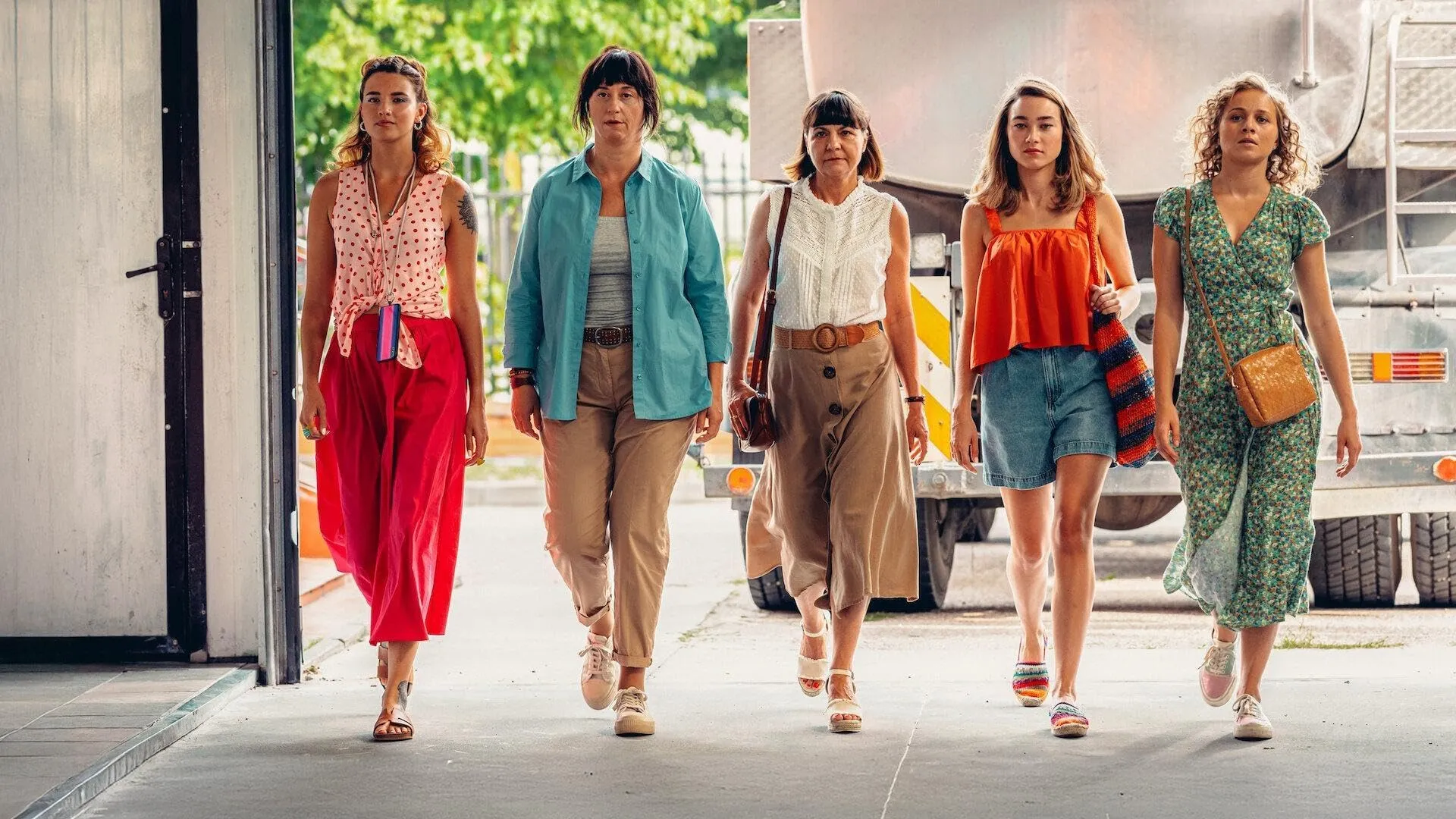
The ensemble of factory workers adds another social layer. The women engage in a quieter struggle for power as they compete to fill the manager position, and their plotting marks a change in local gender dynamics. They come across as more organized and capable than the men who have held control, and the actors lean into raw, unfiltered expressions that sell these characters as real people stuck inside an increasingly bizarre situation. In a story obsessed with roles and rank, the factory floor becomes a parallel stage to the family home, with similar fights playing out through workplace rituals.
Satirical Missteps and Cultural Polarities
The film aims for the classic comedy-of-errors shape, translated into a contemporary Polish setting. The intent is clear: misunderstandings, social friction, and escalating chaos tied to a wedding and a workplace crisis. The execution leans hard on offensive dialogue, and the rhythm comes out clumsy. Racist and patriarchal remarks become the primary engine for laughs, and the script does not provide enough narrative weight to press back against those views. The result is friction without real comic finesse, and the film keeps returning to the same kind of ugliness as its easiest punchline.

The structure echoes works like Meet the Parents, yet the film struggles to reach the same wit or empathy. The comparison highlights a problem of calibration. A comedy built around family introductions needs timing and perspective, and this one keeps defaulting to blunt prejudice as its big move. Mirek’s change in attitude follows that same pattern of convenience. He starts tolerating Milosz once he understands that the wedding can protect his job and keep the factory running. The shift reads as transactional, with personal benefit driving the acceptance.
That choice matters for the film’s cultural themes. The story sets up a generational split: a younger worldview that treats the world as connected, and an older mindset that clings to an insular past. Maja and Milosz represent the outward pull of modern life, while Mirek embodies a defensive local identity that defines itself through suspicion of outsiders. This tension could have carried a sharper look at identity and globalization, especially in a village where one employer shapes social life. The film gestures toward that terrain, then keeps retreating into broad caricature and crude lines.
Visually, the production looks polished. Saturated colors and clean compositions create an inviting surface, and the camera’s control suggests a contemporary commercial comedy. That visual confidence clashes with the regressive logic driving the script. The film presents itself with a modern sheen while its internal worldview stays stuck in a previous era. For a global audience, that mismatch creates a disjointed experience. The humor often fails to travel, and the reliance on blatant prejudice drains the charm that a lighter, sharper touch could have held onto.
Structural Bloat and the Logic of Distraction
The story strains under too many competing threads. It tries to carry a family wedding, a corporate rescue plot, a workplace succession battle, and a police investigation all at once. The pieces collide and block each other from building momentum. The dairy manager’s death sets the plot in motion, then fades into the background, and the emotional stakes lose a key anchor. That sidelining also makes the title feel detached from what the film spends its time exploring.
Pacing becomes uneven, especially during extended scenes with the CEO and his eccentric wife. They play as caricatures, and their presence pulls attention away from the family drama that should be doing the heavy lifting. The police officer subplot fragments the focus even further, built around attempts to solve mysteries that do not exist in a meaningful way. Each detour adds noise, and the main conflict keeps getting reset before it can deepen.
The film also feels engineered for second-screen viewing. It repeats its central points so frequently that the viewer never needs to do much work to track what matters. That repetition flattens tension and drains complexity. Character motivations stay simple, and the story leaves little room to explore the cultural specificity of its village setting beyond broad signals of tradition, prejudice, and workplace hierarchy. The actors push hard against those limits, but the script does not provide the focus needed for a cohesive whole.
By the end, the movie plays like a series of separate sketches stitched together, sprinting through crises without letting any one thread earn emotional investment. The tone swings between silly ideas and heavier themes about identity and change, and the film struggles to make those themes land with the weight they keep reaching for.
Death Before the Wedding (originally titled Zgon przed weselem) is a Polish comedy film that premiered globally on Netflix on February 12, 2025. As of early 2026, the film remains a prominent title in the platform’s international library, offering a satirical look at traditional Polish family dynamics. The story follows Maja as she returns to her small-town home to introduce her Black fiancé to her conservative parents. This personal milestone is complicated by a financial crisis at the local dairy factory, leading to a series of chaotic events that challenge the town’s social norms and her father’s rigid worldview. You can watch it exclusively on Netflix.
Full Credits
Title: Death Before the Wedding
Distributor: Netflix
Release date: February 12, 2025
Rating: TV-14
Running time: 106 minutes
Director: Tomasz Konecki, Iwona Ogonowska-Konecka
Writers: Hanna Węsierska, Karolina Szymczyk-Majchrzak
Producers and Executive Producers: Magdalena Szwedkowicz, Janusz Iwanowski
Cast: Agnieszka Suchora, Tomasz Karolak, Natalia Iwańska, Gamou Fall, Paulina Gałązka, Antoni Pawlicki, Robert Talarczyk, Monika Mariotti
Director of Photography (Cinematographer): Tomasz Madejski
Editors: Jarosław Barzan
Composer: Paweł Lucewicz
The Review
Death Before the Wedding
The film attempts to reconcile a backward protagonist with a modern world, but it fails to provide a convincing moral evolution. Mirek’s shift from bigotry to acceptance is purely transactional, motivated by job security rather than genuine growth. The script relies on coarse prejudice for humor, which feels dated and lacks the sharp wit necessary for effective satire. While the performances are capable and the production values are high, the narrative is too cluttered with unnecessary subplots. It functions as a shallow distraction that misses the chance to engage meaningfully with its cultural themes.
PROS
- Natalia Iwanska and Agnieszka Suchora bring depth and authenticity to their roles.
- The cinematography and lighting give the film a polished, professional look.
- The exploration of a mother finding her professional voice is a highlight of the story.
CONS
- The main character’s change of heart feels motivated by greed rather than a shift in values.
- Too many subplots, like the police investigation, distract from the central family drama.
- A heavy reliance on racist and sexist remarks undermines the comedic intent.







