
























![Kingdom Hearts Collection [I-III] Review](https://gazettely.com/wp-content/uploads/2026/10/Kingdom-Hearts-Collection-I-III-1-360x180.webp "Kingdom Hearts Collection [I-III] Review: KHII Holds Steady as Newer Entries Fluctuate 37")




London stands as a monument to density, a human-made weather system built from bodies, schedules, asphalt, and steel. The numbers land like a dare: nine million residents, more than two million vehicles, six hundred square miles laid out as a hard-edged grid. Many people treat that picture as nature’s opposite, a place where the wild gets erased by traffic lights.
Wild London turns that assumption into its opening target. David Attenborough returns to the city he calls home for this special, filmed during his centennial year, and he refuses the grief-heavy posture that dominates a lot of ecological filmmaking. The mood here runs warmer, even a little mischievous, like the film is quietly asking: are you sure you know what “natural” looks like?
The craft sells the argument before the narration finishes clearing its throat. Sunlight washes the streets with a softness that feels earned, not sentimental. The Thames gets a cinematic sheen through careful color grading, and the city starts to resemble a living organism instead of a machine. Attenborough presents himself as a neighbor, close enough to the everyday scene that the wildlife no longer feels like an exotic interruption.
He keeps pointing toward doorsteps, hedges, canals, rooflines, the overlooked edges where animals make a life beside us. That viewpoint carries a faint moral pressure (gentle, persistent). It offers relief for anyone exhausted by global environmental despair, and it recasts London as shared territory: people and animals moving through the same concrete geometry, each adapting, each imposing costs, each finding openings.
I went in ready to treat this as a pleasant urban footnote. The film keeps insisting it belongs in a larger conversation about how societies choose to live, what they notice, what they step over. It even makes the city feel like a public philosophy experiment dressed up as a nature program.
Avian Architects and Concrete Canyons
Birds come across as the city’s sharpest theorists. Peregrine falcons make the point with ruthless elegance. Attenborough remembers a time when these raptors faced extinction after he arrived in the city during the 1950s. Now they nest atop the Houses of Parliament, and they treat Charing Cross Hospital the way a cliff-dweller reads limestone.
The film calls our built environment “concrete canyons,” and the phrase carries a sly irony: human architecture drafted for commerce and governance gets repurposed as a hunting map. You can feel the reversal in the air, like the city’s symbolism has been quietly edited.
Pigeons show a different intelligence, less romantic and more street-smart. They abandon the old dependence on magnetic fields and steer through London using roads and landmarks, leaning on the same visual cues that guide a distracted pedestrian.
They even use the London Underground. The documentary watches them hop onto trains with the timing of a seasoned commuter, and it lands as both funny and unsettling: infrastructure trains the animals training themselves. Call it “urb-evolution” (the film does), a kind of adaptation that mirrors our own reliance on systems we barely think about until they fail.
The film resists any fantasy of polite nature. Hyde Park becomes contested ground, with green squadrons of parakeets taking the trees while coots conduct territorial warfare like tiny, feathered nationalists. A herring gull stalks the Serpentine with predatory patience, its glossy plumage seemingly earned through a diet of city pigeons. These sequences carry a blunt reminder: the hunt keeps its teeth. London changes the stage, trading hedgerows for pavement and ponds for curated water, and the animals keep doing what survival requires.
Subterranean Neighbors and Garden Highways
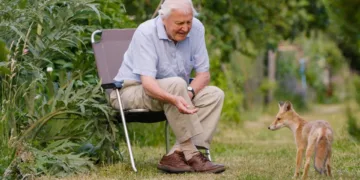
The emotional hinge arrives in a Tottenham allotment at dusk. Attenborough sits in a plain camping chair, and a young fox approaches him with a cautious confidence that feels almost scandalous. The scene dismantles the easy labels, the lazy vocabulary of “pest” and “vermin.” This fox reads as a fellow resident, a family man working the local food chain in the same city we pretend belongs to humans alone. It is intimate in a way that feels politically charged (a small encounter with big consequences). If a society can make room for this, what else can it re-learn?

The documentary keeps finding animals where the urban imagination says they should not be. Fallow deer use zebra crossings in Harold Hill, and the film lets the moment carry its own humor, like the deer has absorbed the etiquette of the place and decided to play along. Aesculapian snakes hang from branches above the Regent’s Canal, likely escapees from a research facility decades ago, now functioning as a natural answer to rodent control. It is a tidy twist of civic symbolism: the “problem” animal becomes the solution animal, and the city’s anxieties rearrange themselves.
Even small mammals get a kind of municipal support. Residents cut holes in garden fences to create “hedgehog highways,” giving the animals miles of passage in their search for mates. Then comes the film’s most startling note of time bending: the return of wild beavers. They vanished from the British landscape four centuries ago, and seeing them in a London wetland feels like a crack in the timeline, a reminder that absence can reverse. Nature looks patient here, almost opportunistic, waiting for a door to be left ajar.
The Paradox of the Oblivious Commuter
Human life still brings friction. Vehicles and domestic dogs remain daily hazards for the city’s hidden residents, and the documentary keeps that danger in view. It also pushes a philosophy of solidarity. People appear as protectors, not by grand gesture, but through small choices that accumulate. Attenborough holding a peregrine chick in his palm becomes a symbolic image of stewardship, a tactile statement about what kind of role humans can play inside this ecosystem.
The film’s driest joke sits in the background. Commuters rush past the camera with heads down, missing the high-stakes drama playing out inches away. The documentary names this “urban blindness,” and it stings because it feels accurate: eyes locked on digital screens while a deer walks a few feet behind us. London becomes a parable about attention, about what modern life trains people to ignore.
Attenborough ends with a beatific smile that carries the weight of a century of watching. He argues that letting the wild back in counts as a collective success. The film rejects the idea of the city as wasteland and imagines concrete serving the clerk and the falcon in the same breath. Coexistence becomes the experiment, and the animals become its evidence. A society that can live alongside these neighbors looks healthier, calmer, and maybe even wiser (a rare claim for a film set in traffic).
Wild London premiered on BBC One and BBC iPlayer on January 1, 2026, marking a celebratory start to the new year. This documentary special features David Attenborough exploring the wildlife of his own home city during his centennial year. Viewers can currently stream the film on BBC iPlayer in the United Kingdom, while global audiences can access it through BBC Studios distribution partners. The film focuses on the surprising biodiversity found within one of the most densely populated cities on Earth, highlighting how species have adapted to live alongside nine million human residents.
Full Credits
Title: Wild London
Distributor: BBC Studios, BBC One
Release date: January 1, 2026
Rating: TV-G
Running time: 60 minutes
Director: Joe Loncraine
Writers: David Attenborough, Joe Loncraine
Producers and Executive Producers: Tom Hugh-Jones, Gaby Bastyra, Jack Bootle, Tom Watt-Smith, David Mooney
Cast: David Attenborough
Director of Photography (Cinematographer): Joe Loncraine, Matt Maran
The Review
Wild London
Wild London succeeds as a poignant meditation on the persistence of the natural world. Attenborough transforms a familiar urban sprawl into a theater of survival and adaptation. The film offers an optimistic vision of a future where architecture and ecology align. It serves as a personal homecoming for a narrator who has seen the entire planet yet finds wonder in a Tottenham garden. This production is a rare instance of television that feels essential for our current era. It reminds us that we share our streets with silent, resilient neighbors.
PROS
- Exceptional photography that makes mundane city locations appear majestic.
- Intimate and moving footage of animal behavior within human spaces.
- A hopeful and constructive message regarding species recovery.
- Attenborough’s authoritative yet deeply personal narration style.
CONS
- Certain segments focusing on smaller insects feel brief compared to the mammal stories.
- The hour-long runtime leaves some viewers wanting more detail on Thames river life.







