
























![Kingdom Hearts Collection [I-III] Review](https://gazettely.com/wp-content/uploads/2026/10/Kingdom-Hearts-Collection-I-III-1-360x180.webp "Kingdom Hearts Collection [I-III] Review: KHII Holds Steady as Newer Entries Fluctuate 37")




A surveyor droid drops onto a gray, silent sphere. The machine acts on behalf of Weatherfused, following a directive to convert a dead world through complete ecological change. Skyformer frames industry as a tool with a biological target. In Early Access, the usual attention on money is absent, and the game ties progress to atmospheric pressure and oxygen. You begin on a vast desert with no air, a blank surface built to show the impact of every system you assemble. You play as a lone machine assigned to repair a broken planet, and the experience hangs on the shift from that first stillness to a surface that supports growth.
That transformation becomes the game’s throughline. Each expansion of your base shows up in the planet’s data readouts, with numbers that move in small steps as infrastructure spreads. The landscape stays barren long enough to keep the stakes visible, pushing you to treat every structure as part of a long plan. Pipes, power, and production are tied to the chemistry of the sky, so a new line on the ground carries meaning beyond throughput. The target is habitability for creators waiting beyond the planet, and the game keeps that pressure in view. Every tree you help bring about and every cloud you help form changes what the world is.
Logistical Innovation: Drones and Resource Limits
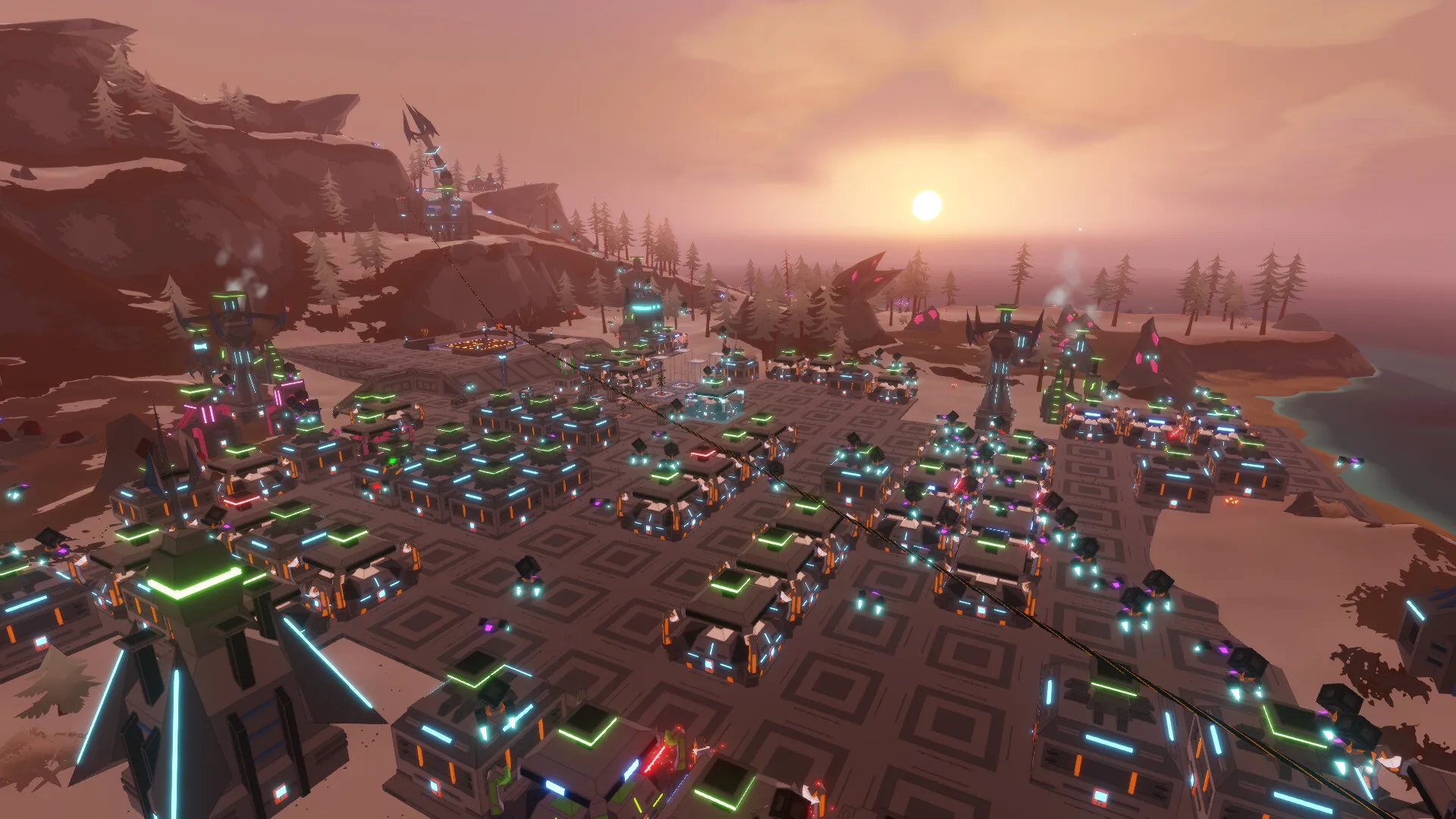
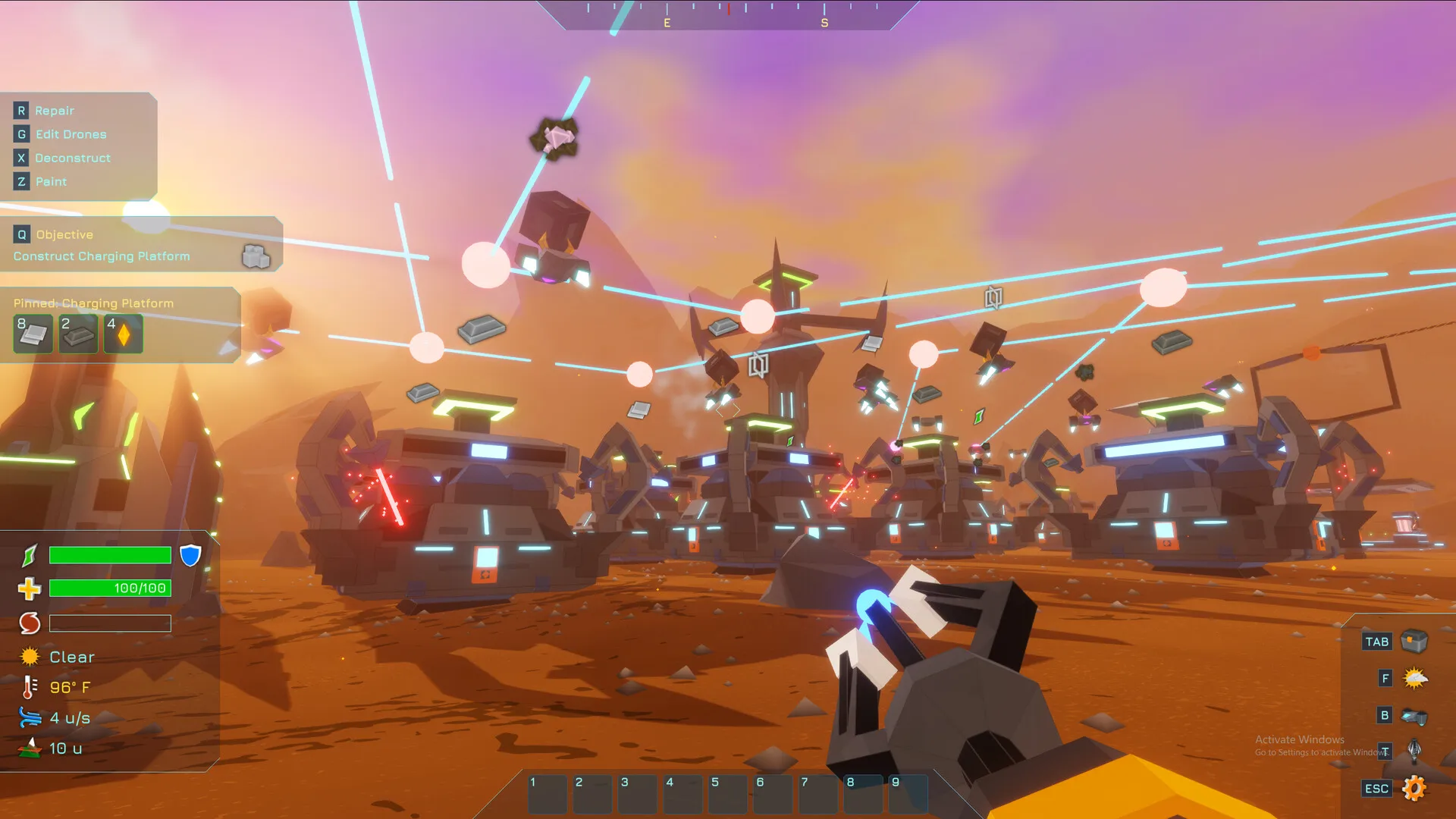
Skyformer takes a sharp turn from the factory standards associated with Factorio and Satisfactory. Conveyor belts are absent, and production moves through a drone hive. You set up logistics by defining specific lanes between structures, then watch resources travel through open air. That single choice turns the entire build into a three-dimensional routing problem, where space above the factory matters as much as space on the ground.
The system asks you to plan around flight paths and power access from the first serious build. Drones depend on the power grid, and each building needs coverage from your electrical infrastructure. Extraction adds another constraint through resource nodes with fixed maximum output. Yield comes from prioritization, since output caps make every decision about where materials go feel final and practical. You choose which lines earn scarce resources, and that choice affects everything downstream.
The loop stays clear: connect mines to processors, then feed final outputs into pipelines. What changes is the mental model. You organize complex production without the safety of endless belt lines, so the usual fix of adding another belt run never arrives. Instead, you troubleshoot air traffic. Drone control towers help once bases grow large, giving you a way to manage the sprawl and see how the network is behaving at a distance. Piloting a drone provides a clean view of the factory layout, and that perspective helps you spot congestion where lanes cross or cluster.
Player movement matches the tone of this logistics design. Traversal is quick, with ziplines that let you cross the industrial zone at speed. It fits the rhythm of automated workers moving overhead and keeps your attention on routing rather than walking. Time goes into drone density, lane planning, and the way power coverage shapes what can operate.
As your base expands, the factory starts to resemble a living organism, with traffic patterns and energy demand acting like circulation. Power management becomes the main limiter on growth, since reach into new territory depends on extending electrical coverage. Building towers to push that reach outward creates an expansion style that feels separate from belt-focused builders, and it keeps your attention on the airspace your machines need.
The Living World: Weather and Visual Evolution
Weather functions as a mechanical obstacle with physical consequences. Storms carry real force, with high winds and lightning that can damage structures and drain power reserves. That pushes base design toward protection, since exposed systems carry risk. Walls and roofs become part of the build language, and planning starts to include sheltered corridors for sensitive logistics.
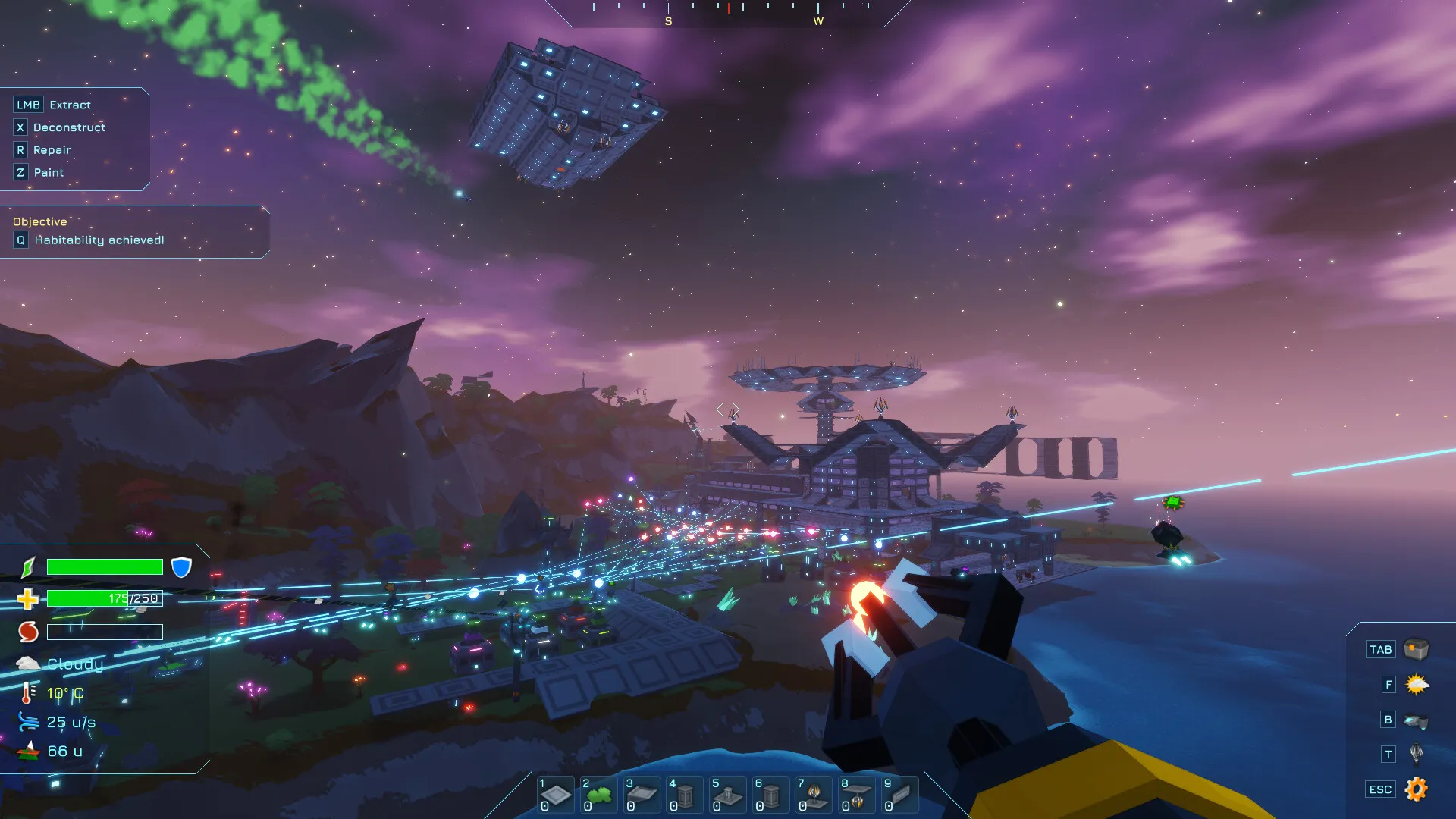
The environment also feeds back into your toolset. You can build structures that predict weather patterns, adding a layer of planning around incoming conditions. Lightning rods turn storms into a resource by capturing strikes and converting them into energy, giving you a reason to watch the sky for more than threat detection. This connection between danger and opportunity keeps weather integrated with your power plan and your expansion tempo.
Progress shows itself through the planet’s appearance. You begin in a gray wasteland, then colors shift as the atmosphere stabilizes. Vegetation arrives, and the surface moves toward forests that signal the planet responding to your work. Watching that evolution plays like a visible reward for systems that usually stay abstract in factory games, and it gives the long-term goal an immediate, readable payoff.
That same climate work introduces new risks that you have to treat as part of the simulation. Adjusting atmospheric conditions can trigger unintended effects, and certain stability targets can destroy buildings placed at high altitudes. Planetary stats become something you monitor with the same attention you give to production ratios, since a bad threshold can turn into a structural crisis.
The push and pull between industrial growth and environmental reaction gives the game a sense of conflict that sits inside the mechanics. Your factory changes the sky, and the sky changes what your factory can survive. Weather simulation also keeps sessions from lining up in identical ways, since you stay alert for cloud movement and signs of danger that can reshape your priorities on the fly. The relationship between the base and the atmosphere stays central, and it makes the world feel responsive to your presence.
Survival Systems and Technical Presentation
Survival mechanics set the pace for exploration through strict energy limits. An energy meter caps activity, and basic movement and building draw from your battery. Recharge pads become essential infrastructure, since you need places to recover power to keep moving. If your energy hits zero, you respawn back at base and lose your inventory, creating a cycle where expansion and recovery sit side by side. Reaching distant resources often means laying down a trail of power pads so your range grows in planned steps.
The structure recalls the tether system in Astroneer, with a tighter feel in Skyformer because energy pressure stays constant during exploration. That pressure changes how you read distance. A resource node can be visible and still feel far away, because the path to it needs power coverage and safe return routes.
The presentation supports the systems without demanding heavy hardware. The low poly art style builds a digital look that reads like a neon landscape, and the game runs fast under that aesthetic. The file size is listed at 500MB, and that small footprint supports players on older machines or limited VRAM. High frame rates remain common even after factories grow large, which matters in a game where you spend so much time monitoring motion in the air.
Guidance arrives through short messages that point you forward without extended tutorials. That keeps discovery intact, since you learn the rules by engaging with them and watching consequences unfold. The save structure reinforces that weight. Progress is permanent, and the game treats mistakes as problems you solve inside the same world.
A bad terraforming choice can damage your factory, and the path forward involves repairs rather than loading an older file. That permanence adds consequence to every major decision, since long-term impacts can land hours after a build goes up. The simple visual layer hides a dense simulation focused on physics and chemistry, and the reward comes from treating the planet as a system you have to understand before you reshape it.
The Review
Skyformer
Skyformer provides a refreshing take on the automation genre. It swaps conveyor belts for a drone driven logistics system. The inclusion of a reactive weather engine forces meaningful architectural choices. While the survival energy mechanics feel restrictive, the visual evolution of the planet rewards the effort. It is a technically efficient project that demands careful planning. It offers a distinct loop for factory enthusiasts who want more environmental interaction.
PROS
- Innovative drone based logistics
- Weather systems affect gameplay
- Low system requirements
- Rewarding visual progression
CONS
- Restrictive energy survival meter
- Strict save structure
- Limited Early Access content
- Steep learning curve for logistics







