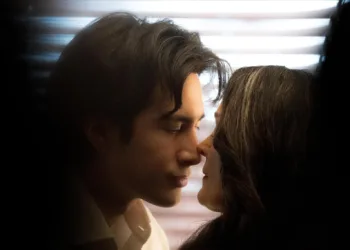































Joseph Chen-Chieh Hsu’s Double Happiness builds its conflict around a carefully staged deception steeped in cultural meaning. The story follows Tim Kao (Liu Kuang-Ting), a tightly wound chef, and his fiancée Daisy Wu (Jennifer Yu). Tim, desperate to satisfy his divorced parents Frank and Carina, who refuse to share the same room, devises a reckless solution: two wedding banquets held at the same time, in separate halls of the Grand Hotel in Taipei.
The traditional “double happiness” character, usually an ornamental sign joining two symbols for joy, turns into a pointed metaphor for an enforced togetherness that never quite materializes, since the families remain divided even under one roof.
Set inside the imposing, gilded interiors of this landmark hotel, the film steps directly into the pressure of East Asian family expectations. Hsu uses the absurd premise to think through how established wedding traditions interact with the complicated, contemporary reality of families shaped by divorce, remarriage, and competing loyalties.
Narrative Chaos and Emotional Rupture
Hsu’s visual approach echoes the precarious balancing act of the story. The film takes place over one frantic wedding day, built on urgent pacing and extended tracking shots that sweep through corridors, kitchens, and banquet halls.

These stretches of continuous movement generate tension and a sense of procedural labor as the couple and the hotel staff rush to handle crises: a sudden typhoon that threatens the event, a collapsing champagne tower, and the scramble to secure a specific ingredient such as cuttlefish ink. The first half operates as a hiccup-filled wedding farce, with carefully timed mishaps and near-collisions. The final act changes direction and settles into an intense psychological drama.
The shift concentrates on Tim’s unresolved childhood pain, with flashbacks that sketch his emotional state after his parents’ separation and frame the story around an Oedipal struggle. The film has difficulty keeping comedy and psychological seriousness in balance, and the tonal shift feels strained. A surreal fantasy passage appears midway through the narrative, built with conspicuously artificial visual effects, and this sequence interrupts the rhythm of the film and raises questions about its purpose.
Contrasting Performances and Prioritized Perspectives
The emotional charge of Double Happiness grows out of the interplay between the lead performers, who bring different acting textures to the screen. Liu Kuang-Ting plays Tim with an inward, tightly coiled intensity that recalls method-inflected technique, expressing the strain of filial duty in every small, anxious gesture. Jennifer Yu’s Daisy stands beside him with a looser, more spontaneous energy, quick with visible reactions and open emotions. Hsu brings these styles into the same film in a coherent way, yet the script clearly concentrates on Tim’s psychology.
His fixation on his parents, the distant father Frank and the CEO mother Carina, shapes the narrative viewpoint and filters many scenes through his emotional crisis. Daisy takes part in the wedding scheme from the start, yet her role often recedes once Tim’s internal turmoil moves to the foreground. Around them, a strong group of supporting actors fills out the family and hotel environment.
Veteran performer Kuei-Mei Yang plays Carina with a grounded, painful warmth that cuts through the noise of the hotel setting. Her work, alongside that of the other experienced actors, gives dimension to characters who might otherwise feel like simple types inside the constant movement and confusion of the dual receptions.
Ritual, Real Estate, and Modern Family
Double Happiness invests heavily in cultural texture. The film pays close attention to East Asian marriage customs, with specific nods to Taiwanese and Hong Kong practices such as feng shui and the eight-character rule used for matching couples. The Grand Hotel functions as a charged visual and cultural symbol, a monumental space tied to ceremony and hierarchy that seems designed to contain ritual behavior.
Its previous appearances in Edward Yang’s Yi Yi and Ang Lee’s Eat Drink Man Woman place Hsu’s film inside an ongoing conversation about Taiwanese family life on screen and link Double Happiness to an existing cinematic map of Taipei’s social spaces. Hsu’s script gestures toward psycho-analytical concerns, especially in its treatment of Tim’s relationship to his parents, yet the film’s most persuasive argument lies in its closing stance on contemporary family arrangements.
The ending affirms the parents’ separate lives and remarriages and avoids the conventional reconciliation that often concludes wedding-centered films. This closing note aligns the story with a more contemporary, globally attuned view of family structures that adjust and endure beyond strict, traditional demands.
Double Happiness is a Taiwanese comedy-drama that premiered at the 38th Tokyo International Film Festival on October 28, 2025. The movie centers on Tim Kao, a meticulous head chef who, trying to appease his divorced parents, must orchestrate two simultaneous wedding receptions for himself and his Hong Kong fiancée, Daisy Wu, at the same hotel without either parent discovering the deception. The film is currently circulating the festival circuit and has secured Asia-Pacific sales through Moebius Entertainment. Information regarding its wider theatrical or streaming release platform is not yet available as of November 30, 2025.
Full Credits
Title: Double Happiness (雙囍)
Distributor: Moebius Entertainment (Asia-Pacific Sales), Splash Pictures (Production Company)
Release date: World Premiere on October 28, 2025, at the 38th Tokyo International Film Festival.
Running time: 130 minutes
Director: Joseph Chen-chieh Hsu
Writers: Joseph Chen-chieh Hsu, Hsieh Pei-jui
Producers and Executive Producers: Clifford Miu, Zhang Linhan, Annie Yang, Tony Luo, Eric Huang, Rita Lin, Simon Chen
Cast: Liu Kuan-ting, Jennifer Yu, Kuei-mei Yang, Chung Hua Tou, Tenky Tin, 9m88, Robinson Yang
Director of Photography (Cinematographer): Chen Ko Chin
Editors: Chen Chun-hung
The Review
Double Happiness
The film is a fascinating, if sometimes uneven, attempt to use high-stakes farce to explore deep-seated familial trauma within a grand, ritualized cultural setting. Director Hsu successfully captures the manic energy of deception and the crushing weight of tradition, bolstered by strong performances from its leads, particularly their contrasting acting styles. However, the film struggles to seamlessly blend its rapid-fire comedy with its sudden, serious psychological turn, and the abrupt surreal sequence detracts from the emotional consistency. It remains a visually striking work that offers a resonant look at the changing landscape of East Asian family expectations.
PROS
- Rich detail in presenting Taiwanese and Hong Kong wedding customs and family expectations.
- Effective contrast between Liu Kuang-Ting's intense, introverted style and Jennifer Yu's spontaneous, expressive performance.
- Excellent use of the Grand Hotel as a loaded, gilded space representing the weight of tradition.
- Respects the modern reality of diverse, non-traditional families by avoiding a simplistic reconciliation ending.
CONS
- Difficulty integrating the farcical comedy with the later intense psychological drama.
- The film heavily prioritizes Tim's trauma, downplaying Daisy's perspective in the central conflict.
- The sudden introduction of surrealism and its unrealistic CGI effects disrupt the narrative flow.
- Many supporting players risk becoming types due to the plot's chaotic nature.