
























![Kingdom Hearts Collection [I-III] Review](https://gazettely.com/wp-content/uploads/2026/10/Kingdom-Hearts-Collection-I-III-1-360x180.webp "Kingdom Hearts Collection [I-III] Review: KHII Holds Steady as Newer Entries Fluctuate 37")



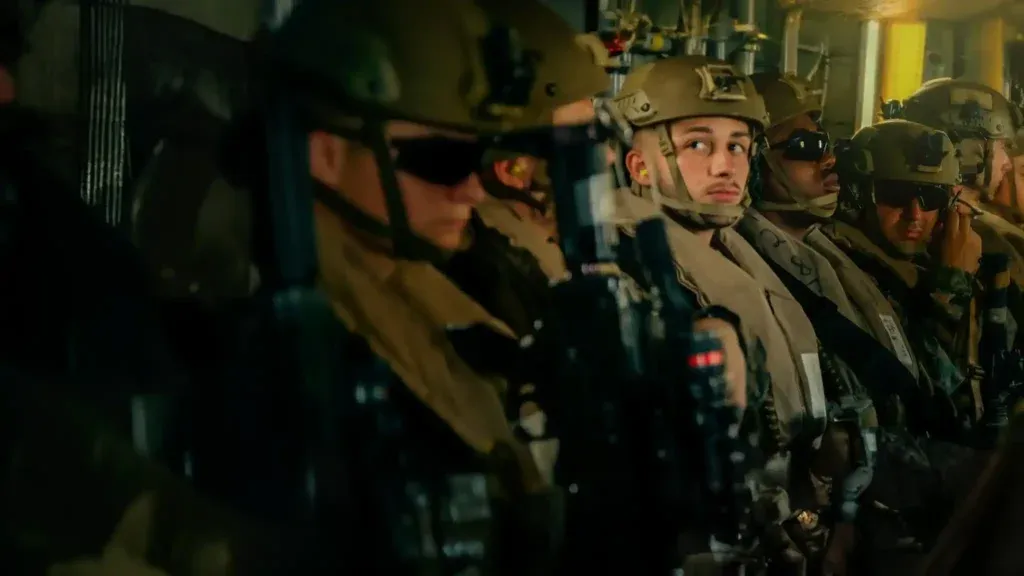

Marines, a four-part docuseries, concentrates on the operations of the U.S. Marine Corps. Directed by Chelsea Yarnell, the series follows the 31st Marine Expeditionary Unit (MEU), a permanently forward deployed contingent in the Pacific based at Camp Hansen in Okinawa, Japan. The unit is formally described as America’s force in readiness, with personnel expected to answer global crises at very short notice.
The series builds its main through line around the 31st MEU’s preparation for and execution of Certification Exercises (CERTEX), mission essential, task based training that the unit must pass before it can deploy on naval aircraft carriers.
Marines presents this process as an intimate and seemingly unvarnished portrait of military life, where high stakes professional drills share space with personal reflections on service. From the outset, the series underlines the geopolitical stakes that frame this permanent posture of readiness.
Operational Reality and the Cost of Training
The production gains striking access to the 31st MEU, filming on warships such as the USS America and USS Green Bay, in their living quarters, and during rigorous, highly realistic drills. That level of access shifts the emphasis away from familiar images of basic training or battlefield combat and toward the sophisticated logistics and operational demands of a unit already deployed.
The show patiently traces air, ground, and sea elements working together. This attention to procedure foregrounds the high risk built into training itself. The series states that more service members die in training accidents than in combat, a sober statistic that shapes the tension around every exercise involving live ammunition.
The documentary also glances toward the changing conditions of modern warfare. It addresses the use of drones and robotics and the strain this technology places on traditional roles, citing its effect on the Scout Sniper group. Stylized black and white simulations translate these complex operations for viewers outside the military world.
The Uniform and the Individual: A Study in Contradiction
Marines becomes most pointed when it turns to the people who make up the unit. Interviewed Marines span the hierarchy, from young Lance Corporals to experienced Staff Sergeants, helicopter Captains, and the unit commander, Colonel Chris Neidziocha.
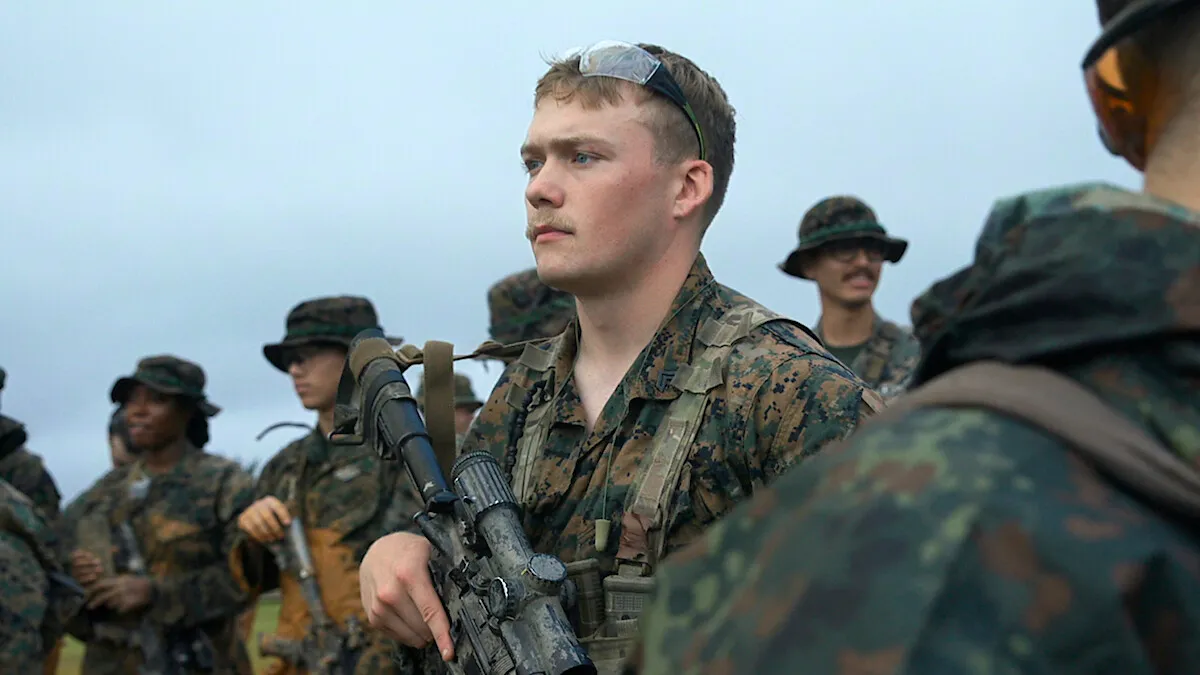
Representation appears in the foreground through Lieutenant Samantha Miller, the first woman to hold her role, who speaks candidly about leadership and the work of earning trust. The series takes shape as an accelerated coming of age story, recording the conflicting impulses that pull these young service members in different directions. Junior enlisted machine gunners talk with a brash confidence about violence or the need to prove their intelligence, while an older officer, the Captain pilot, voices a calm and somber awareness of what deployment might cost in human lives.
The show works to humanize its subjects through casual moments of camaraderie, humor, and emotional openness, including acknowledgements of homesickness and the emotional stress of service. Marines touches on mental health by addressing the pressure felt by soldiers who fear they have “not done enough.” The series’ sustained attention to the Weight of Readiness presents service as an ongoing exchange, where separation from civilian life and the constant possibility of death, even in practice scenarios, remain accepted costs.
Pacing, Presentation, and Cultural Positioning
The concise four episode structure functions efficiently, with the Certification Exercises (CERTEX) providing a clear narrative spine that keeps tension and momentum in play. Marines tries to hold together two scales of experience: an existential geopolitical backdrop defined by the persistent threat of conflict with nations such as China or Russia, and the intimate, sometimes high school like rhythms of young adults sharing tight quarters.
This back and forth has become a recognizable rhythm in current streaming documentaries. The wide array of featured Marines, spread across many specialties and ranks, carries a cost. Individual arcs sometimes feel thin, and viewers may find it difficult to keep track of each personal story. For audiences without a particular fascination with military procedure, the sustained focus on drills and operational steps can start to feel heavy.
The series acts as a clear window into the culture and operational reality of a rarely depicted unit. It offers a detailed view of the operational mindset and the lived experience of readiness. The evident respect for its subjects keeps the documentary from pursuing an extensive political or systemic critique of the military industrial apparatus that surrounds them.
The documentary series Marines premiered on Netflix on November 10, 2025, coinciding with the 250th anniversary of the founding of the U.S. Marine Corps. This four-part series offers an intimate, inside look at the 31st Marine Expeditionary Unit (MEU) as they undergo rigorous training and prepare for deployment as America’s “force in readiness” in the Indo-Pacific region. The series is currently available for streaming on the Netflix platform.
Credits
Title: Marines
Distributor: Netflix
Release date: November 10, 2025
Running time: Four episodes, approximately 45 minutes per episode.
Director: Chelsea Yarnell
Producers and Executive Producers: Darryl Frank, Justin Falvey, Sebastian Junger, Kimberly Woodard, Greg Henry, Isaac Holub, George Kralovansky, Katie Goldstein, Arielle Kilker, James Haygood, Katherine LeBlond, Rodrigo Brazão, Roman Petrov, Minna De Los Santos
Editors: James Haygood, Rodrigo Brazão
The Review
Marines
Marines grants invaluable, intimate access to a continuously deployed military unit, successfully moving beyond familiar clichés of service. It expertly captures the paradox of the "force in readiness," showing the physical rigor and emotional weight carried by young service members. While its broad scope sacrifices deep character arcs and it editorially avoids deep systemic questions, it stands as a crucial and illuminating document of contemporary American military culture.
PROS
- Exceptional Access to a forward-deployed unit (31st MEU) and operational environment.
- Humanizes Soldiers by showing the emotional strain, homesickness, and mental health challenges.
- Efficient Pacing in the four-episode structure, using the CERTEX arc effectively.
- Addresses Modern Warfare by showing the integration of robotics and its impact on traditional roles.
- Features diverse ranks and representation, including a female officer in a key leadership role.
CONS
- Sacrifices Character Depth due to the wide range of individuals covered.
- Avoids Systemic Critique, positioning the series more as observational and less as analytical exposé.
- Training Monotony can set in for viewers who are not specifically interested in military drills and procedures.
- Contradictory Tone emerges when juxtaposing mature conversations with juvenile expressions of motivation.







