



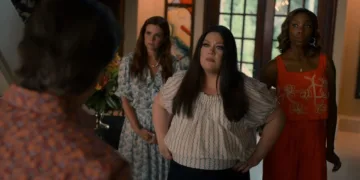
























Sallywood arrives as a curious cinematic memo. Writer director Xaque Gruber shapes it as semi autobiographical fiction drawn from his time as personal assistant to Hollywood veteran Sally Kirkland. The film works as an epistolary comedy (half confession, half tribute), a love letter from an acolyte that tracks the move of Zack (Tyler Steelman), an earnest Mainer whose fixation on Kirkland, ignited by her Oscar nominated performance in the 1987 film Anna, sends him westward.
Kirkland, in a gesture that feels self mythologizing and self corrective, plays a version of herself. The film sets up a split focus between the starry eyed aspirant and the seasoned actress struggling to remain visible.
The tone tries for a fragile balance between light showbiz comedy and a more private intimacy. The running time stays lean; the ambition stays modest. The result is an eighty two minute reflection on a life path stitched together from a wayward moose and a discounted VHS tape.
The Muse and the Mirror of the Self
The film draws its strongest charge from the relationship between its two central figures, Kirkland and Steelman. Their intergenerational friendship functions as the emotional anchor of the piece, supplying a measured sweetness and a sense of truth that cuts through the stock Hollywood clichés around them.
Kirkland’s work plays like meta textual self invention. She appears radiant yet stripped of glamour, presenting herself as wildly offbeat, fearless, and disarmingly self aware. The camera watches smaller vulnerabilities, whether she counts loose change for groceries or coaxes an agent. The film gives her room to reclaim her story and stresses the durability of the working artist.
Zack emerges as a “superfan as savior” figure. His non sexual adoration and shared dream prod her to keep seeking a final, affirming career chapter. Their chemistry has an easy charm, a bond built on shared reverence for what cinema might still make possible. That connection lifts the material from simple showbiz send up into pockets of emotional weight, a small scale symbiosis between a seasoned maker and an idealistic admirer.
The Economics of “Residual Stardom”
The satirical streak in Sallywood grows from a recognizable social reality, the industrial scale disposal of women in show business once they pass a certain age. The phrase “residual stardom” fits Sally’s situation. She functions as a known commodity that has slipped past its peak trading value, still circulating on the cultural capital of a single awards season from the 1980s.

The film exposes the shaky economics of fame. A running gag about Kirkland’s need for cash, especially the 1800 dollar garage bill for her car, repeats the point that awards season applause rarely becomes long term security. An Oscar nomination brings prestige yet often no real liquidity. The script touches on ageism and sexism through the petty humiliations of chasing C list roles, including serious consideration of a “Rashomon in space with zombies” project from a filmmaker with dubious ethics.
That satirical impulse does not always keep a steady tone. Supporting players like Eric Roberts as parasitic agent Clem and Keith Carradine as jaded filmmaker George Corrigan appear as broad caricatures that feed a clunky, cornball comedy vibe. The script leans on repeated gags about her sexual history and the mix up with Sally Kellerman, and the recycling saps energy from the sharper observations introduced early. The film struggles to hold on to its sting.
Montage, Mimesis, and Muddled Form
The structure mirrors the project’s handmade origins. Sallywood settles into a hybrid aesthetic, part dramatic re creation, part archival footage that includes the Golden Globe win, and part pseudo documentary built from sporadic, jarring talking head interviews. That formal restlessness can leave the piece feeling disjointed or blurred around the edges. Constant shifts in viewpoint and abrupt cuts interrupt the narrative rhythm the film seems to seek.
The earnestness of this personal structure often collides with a taste for the outlandish. Exaggerated, almost cartoon level performances from the supporting cast, paired with a jazzy, near “Sims” style muzak score, thin out the film’s pathos. The piece returns again and again to the goofy option at moments when the material seems to call for plain, unvarnished candor.
A final, quietly philosophical tension lives in the way the story shares attention. Zack’s aspirational arc, pleasant and kindly drawn, often takes most of the running time. Sally Kirkland’s life, with its struggle, decades of artistic persistence, and direct brush with mortality, feels like the sharper and more urgent engine. The film plays as a limited biopic that fixes on one relationship between artist and admirer and shapes a small scale tribute to friendship, while the mechanics of stardom remain largely in the background.
The film Sallywood premiered on November 8, 2024, for a limited theatrical engagement before its digital release. This semi-autobiographical comedy, written and directed by Xaque Gruber, stars actress Sally Kirkland playing herself as she teams up with her young superfan and personal assistant, Zack (Tyler Steelman), to revive her career in a notoriously unforgiving industry. The movie blends fictional events with real-life struggles, creating a unique portrait of the enduring spirit of an artist. It is available to watch on demand across various digital platforms, including Amazon Video, Fandango At Home, and Plex.
Credits
Title: Sallywood
Distributor: Sneak Preview Entertainment, Digital Distribution (Amazon Video, Fandango At Home, Plex)
Release date: November 8, 2024
Running time: 95 minutes
Director: Xaque Gruber
Writers: Xaque Gruber
Producers: Steven J. Wolfe, Julia Taylor-Stanley
Executive Producers: Sally Kirkland, Jill Demby Guest, Joann M. Scuderi, Elaine J. Constantine, Fae Kopacka, Angeline Rose Troy, Doris Davis, Richard Lambert, Diane Thelen
Cast: Sally Kirkland, Tyler Steelman, Tom Connolly, Jennifer Tilly, Eric Roberts, Lenny von Dohlen, Keith Carradine, Maria Conchita Alonso, Michael Lerner, Kay Lenz
Director of Photography (Cinematographer): Mathias Fain
Editors: Andrew Wilsak
Composer: Jim Covell
The Review
Sallywood
Sallywood is a deeply personal film, succeeding as a unique tribute to a magnetic, underutilized actress and the power of intergenerational admiration. While its satirical elements are tonally inconsistent and its structure often muddled by documentary and fictional elements, the compelling chemistry and self-aware performance by Sally Kirkland provide a strong, beating heart. It is an affecting, minor-key film about the harsh economics of fame and the enduring spirit of an artist.
PROS
- Sally Kirkland’s self-aware, compelling performance as herself is the film's strongest asset.
- The charming and sweet intergenerational friendship between Sally and Zack provides deep emotional resonance.
- The film offers an insightful, unfiltered look at the financial precariousness and ageism faced by veteran actors in Hollywood.
- The project serves as a sincere, personal tribute from the director, Xaque Gruber, to his former boss and muse.
CONS
- The tonal inconsistency between gentle drama and broad, cornball satire is jarring.
- The blending of styles (fictional scenes, archival footage, mock-interviews) often feels disjointed and structurally muddled.
- Some recurring jokes, particularly about famous lovers and mistaken identity, grow repetitive and cheapen the satire.
- The narrative balance is uneven, with Zack’s storyline sometimes eclipsing Sally's more potent, central struggle.