
























![Kingdom Hearts Collection [I-III] Review](https://gazettely.com/wp-content/uploads/2026/10/Kingdom-Hearts-Collection-I-III-1-360x180.webp "Kingdom Hearts Collection [I-III] Review: KHII Holds Steady as Newer Entries Fluctuate 37")



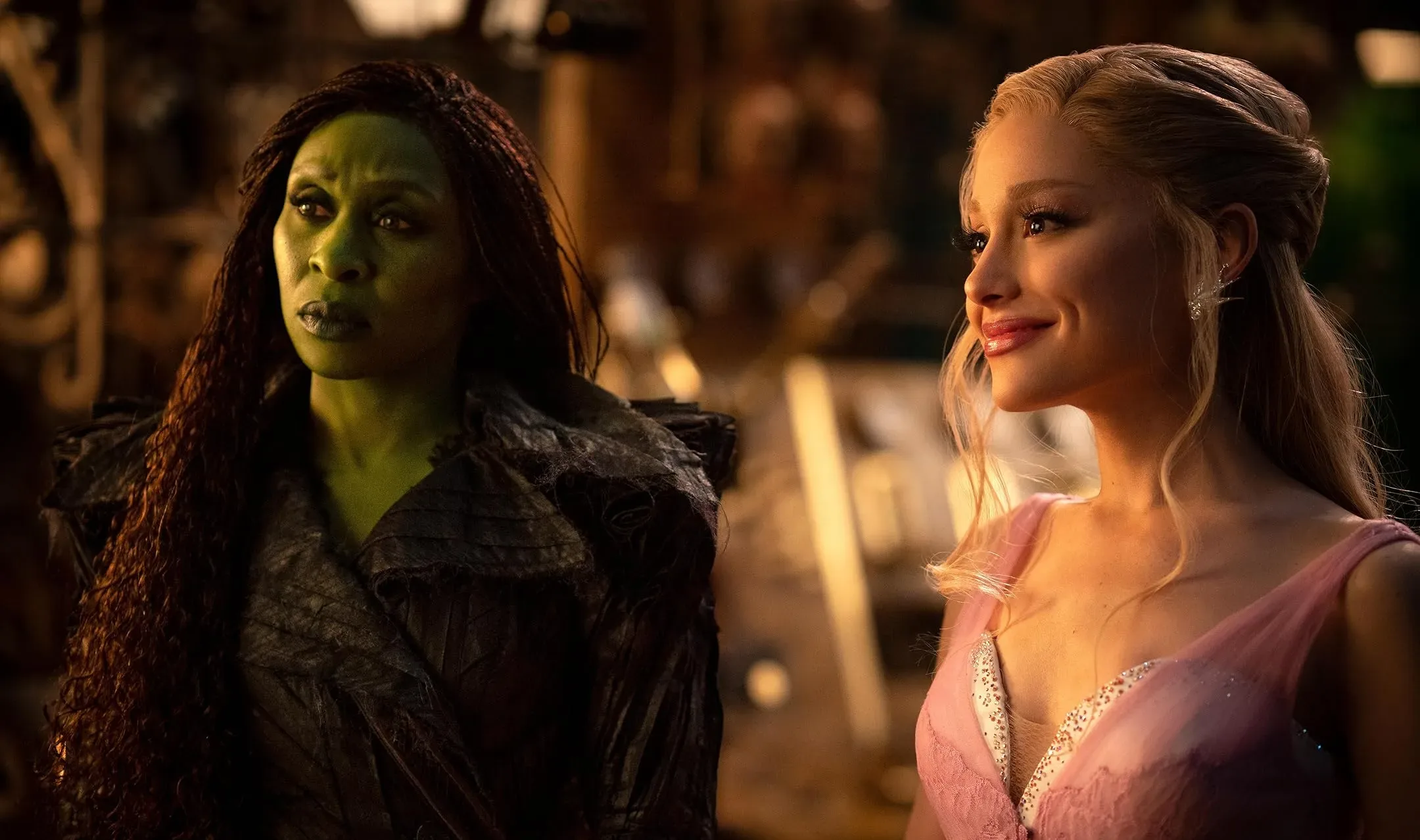

Wicked: For Good opens exactly where its predecessor leaves off: a witch in flight and a friendship cracked by the machinery of government. Elphaba, now an exile and a convenient scapegoat, has been successfully branded as the Wicked Witch of the West, a monster scripted by the Emerald City’s ruling apparatus. At the same time, Glinda rises through the civic hierarchy, performing the role of the Good Witch while serving the Wizard’s increasingly authoritarian project.
The film traces the deterioration of their bond against an atmosphere of tightening control. Oz undergoes a rapid political decay, a kind of soft autocratization (the phrase feels almost built for a political science syllabus), where the persecution of outsiders becomes a key tool of governance. The central emotional conflict acquires a distinctly political charge: two women find themselves pushed onto opposing sides of a carefully engineered lie that covers an entire society.
Duets of Despair and Dignity
The second chapter’s energy sits squarely with its two leads. Cynthia Erivo and Ariana Grande take on roles that demand immense vocal force and substantial dramatic range, and they become the gravitational center of a film whose structure sometimes seems ready to drift away from them.
Erivo’s Elphaba retains a striking, unforced emotional intensity. Her trajectory in For Good functions as a study of the limits of righteous anger. Once the state has labeled her a fiend, she adopts the legend of the “Wicked Witch” as a form of political and personal resistance, a choice crystallized in her ferocious solo, “No Good Deed.” Erivo channels the sorrow of a revolutionary figure who feels undone by the very nature of her extraordinary power. The character’s basic kindness and commitment to fairness remain visible under the green skin and the ever-growing myth of her supposed evil, which gives the performance a quiet moral ache.
The film devotes substantial attention to Glinda’s evolution, which effectively reshapes the narrative into her story alongside Elphaba’s. Grande moves the character from a self-absorbed, pink-clad naïf into someone caught in profound internal conflict. Glinda’s early “goodness” operates as a piece of social engineering; her magic (as the film reveals) functions as a manufactured instrument for the ruling apparatus.
Her rising anxiety becomes tangible as her public position ties her to genuine wrongdoing and places her loyalty to Elphaba under severe strain. Grande handles this introspection with surprising tenderness, especially in her solo “The Girl in the Bubble,” where the character confronts the moral price of her privilege. The performance turns Glinda into a detailed case study in how the craving to be “liked” in public life can steer a conscience away from its better instincts.
The connection between these two women, the way their opposing trajectories still feed a shared emotional life, gives the film its clearest emotional anchor. The closing duet, “For Good,” operates as a philosophical summation of their story, an earnest statement of faith in intimate bonds holding their shape within a world bent toward upheaval.
Statecraft and Stuttering Structure
Wicked: For Good presents itself as a political allegory with sharp relevance to current global anxieties. Oz slides into a paranoid dictatorship where the government actively encourages hatred toward outgroups. The campaign against the talking animals, stripped of rights and dignity, reads as a direct analog to historical and contemporary patterns of othering and scapegoat creation, the sort of cyclical cruelty that keeps reappearing in different costumes.
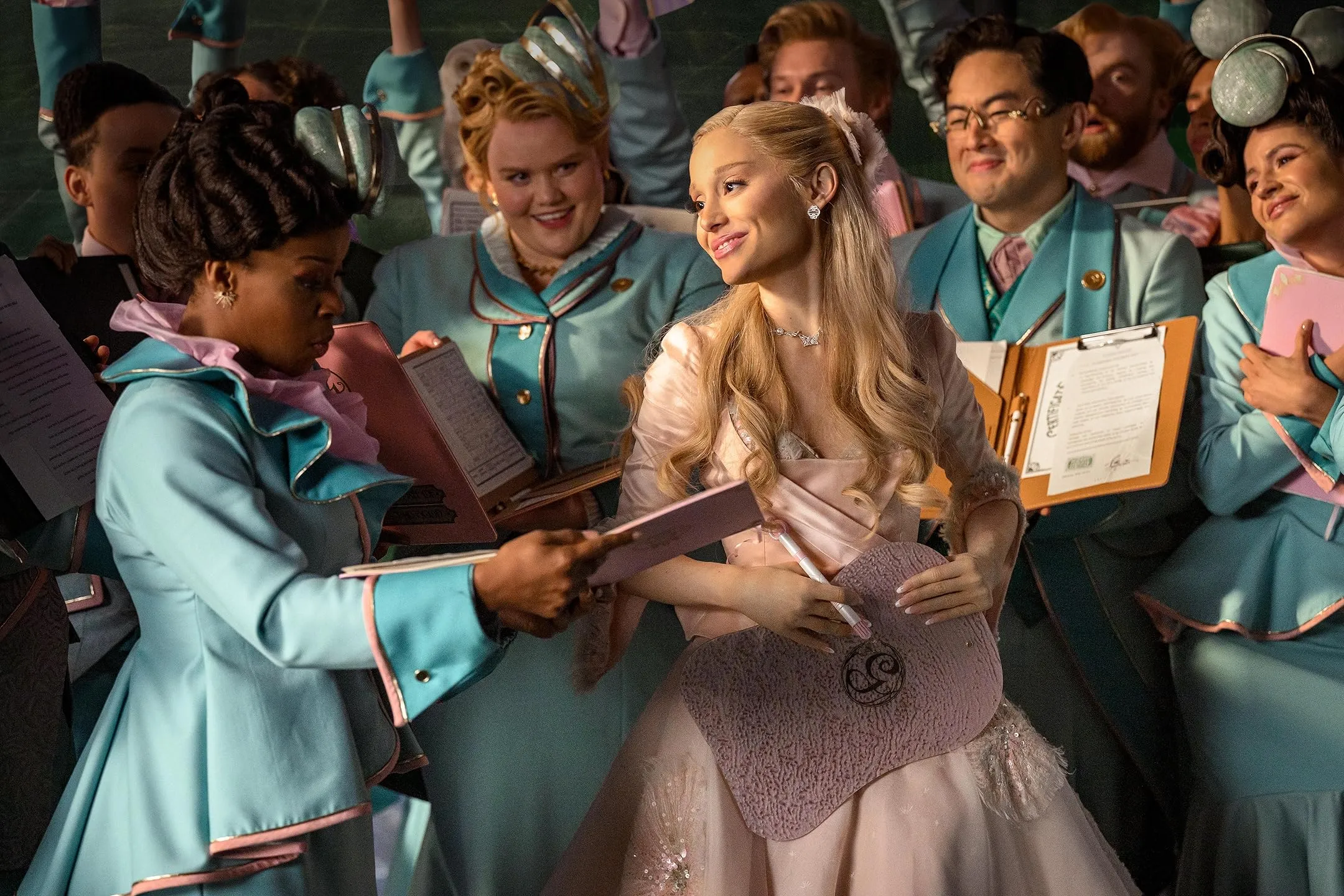
This machinery of control turns around the Wizard and Madame Morrible. Jeff Goldblum plays the Wizard as an entertainingly oily con artist who leans on “blarney” and media spectacle (explicitly framed as propaganda) to steer the crowd.
Michelle Yeoh’s Morrible emerges as the far more chilling presence, a ruthless and calculating political operator who designs the Wizard’s “huckster-in-chief” persona. The narrative structure underlines a simple point: the Wizard stands as the visible mascot of power, while Morrible functions as the true engine driving despotism.
The film’s allegorical ambition runs up against the demands of adapting the stage show’s fragmented second act. The storytelling grows conspicuously dense with plot, which produces stretches of uneven pacing. The film sometimes trips over its own scope, cutting between characters and locations in an effort to keep all the narrative plates spinning.
The subplots focused on supporting figures such as the love-struck Munchkin Boq and Elphaba’s resentful sister Nessarose feel particularly hurried, shifting into an almost exaggerated melodrama as they rapidly become the Tin Man and the Wicked Witch of the East. The cinematic scale delivers grand scope while also letting structural cohesion slip at key moments.
Revising the Canon and the New Score
The musical architecture of For Good, visually and aurally lush thanks to rich orchestrations and underscoring, faces the unenviable assignment of following an earlier set of songs that already supplied the franchise’s undisputed “bangers.” This second half lacks the same immediate, hook-driven impact as the major numbers from the first installment.
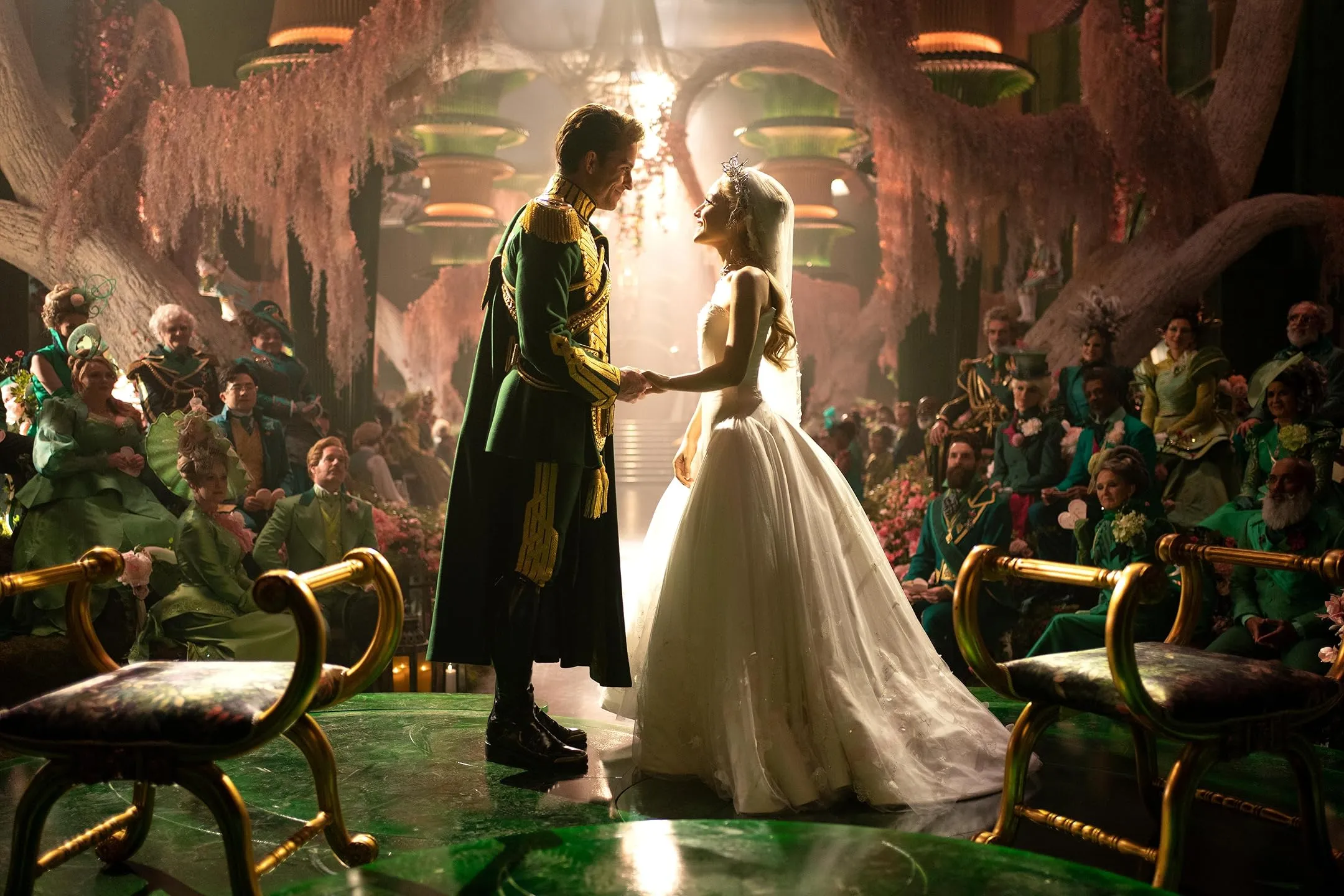
The material that remains carries significant character weight. Erivo’s “No Good Deed” stands as a full-throttle vocal showcase, and the title duet supplies an emotional density that offsets some of the narrative jumps. Stephen Schwartz contributes two new songs to the film: “The Girl in the Bubble” grants Glinda vital dramatic introspection, and Elphaba’s “No Place Like Home” reorients Dorothy’s famous mantra into something more forward-looking and character-specific. These pieces may not occupy the top tier of the Schwartz songbook, yet they function as essential musical steps in the film’s character arcs.
The film also adopts a sidequel structure, threading its events through the timeline of The Wizard of Oz. The audience receives origin stories for Dorothy’s future allies: the Scarecrow (Fiyero), the Tin Man (Boq), and the Cowardly Lion (seen briefly as a cowering beast). Dorothy herself appears only at a distance, described as a “mulish farm girl,” an external presence who never quite joins the inner circle of the narrative.
This interplay with the established canon provides a clever puzzle-box quality for viewers who know the 1939 film, yet the brisk, explanatory handling of these moments can make them feel confusing or outright strange for those who come in without that prior knowledge. The film’s self-referential mythology carries both appeal and a tendency to complicate its own structure.
Spectacular Design and Supporting Mechanics
Visually, Wicked: For Good maintains the extravagant spectacle of the first film. Nathan Crowley’s production design and Paul Tazewell’s finely detailed costuming continue to assemble a dazzling, retina-testing environment.
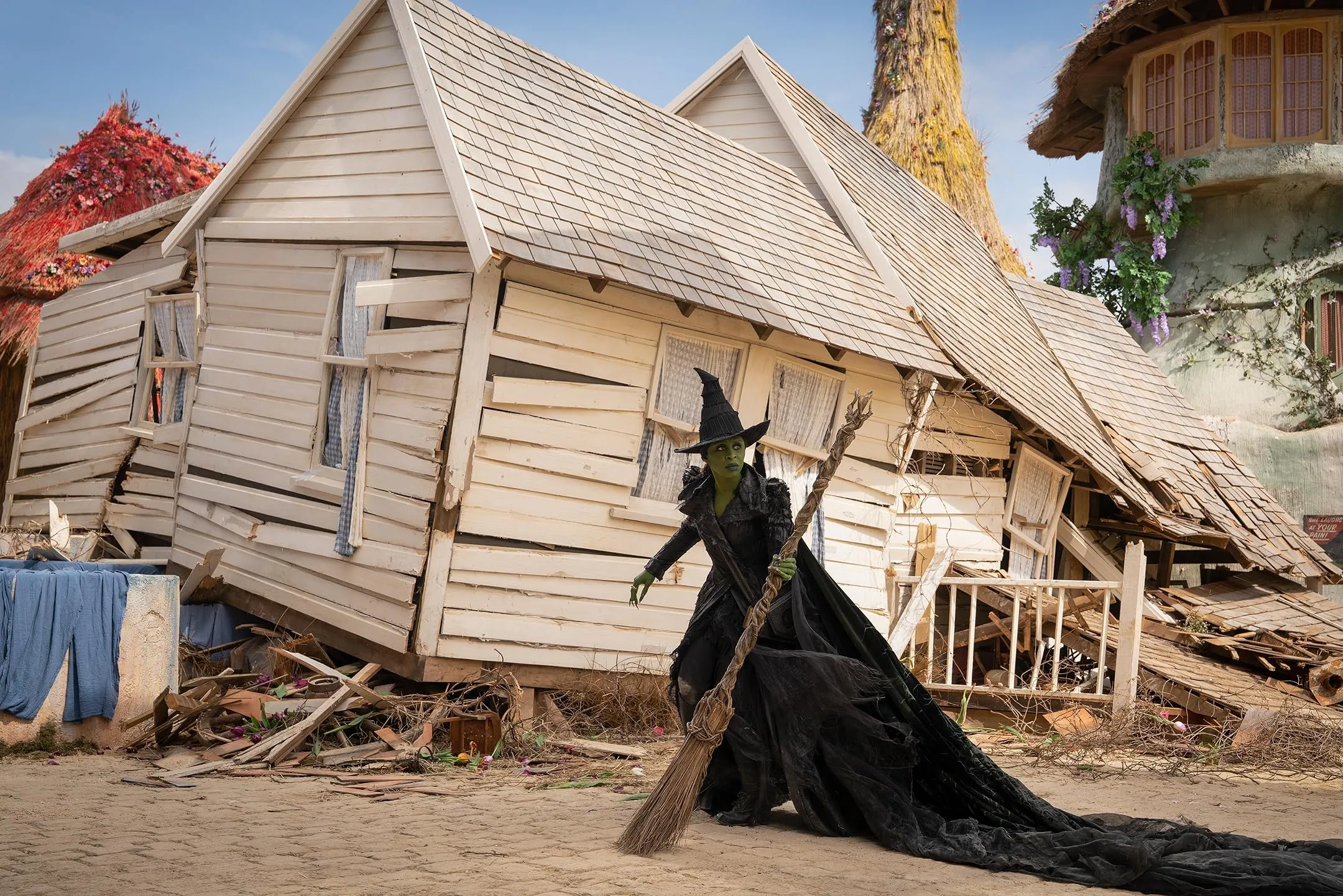
This installment leans into a darker, yet consistently beautiful, visual palette that aligns with its more serious interests. Jon M. Chu’s maximalist approach appears in the elaborate set pieces and processions, often accompanied by swirling camera moves and densely packed frames. The technique sustains a strong sense of wonder, though the frequent dependence on virtual effects occasionally strains believability and creates a subtle distance from the physical reality of Oz.
The supporting ensemble operates within a framework that offers them less expressive space. Jonathan Bailey’s Fiyero, the man caught between the two central women, functions primarily as a symbol, a figure forced to declare allegiance in a conflict that treats moral clarity as a rigid requirement. His progression, ending in his transformation into the Scarecrow, feels like a necessary mechanical checkpoint rather than a fully developed emotional journey.
Marissa Bode’s Nessarose and Ethan Slater’s Boq receive similarly compressed material, designed chiefly to set up the required prehistory for the Tin Man and the Wicked Witch of the East. These narrative turns matter to the lore and to the sidequel architecture, yet they operate mainly as supporting mechanics that frame the grander philosophical and emotional spectacle of Elphaba and Glinda’s enduring, bittersweet connection.
Wicked: For Good is the second installment of the two-part film adaptation of the beloved Broadway musical. Distributed by Universal Pictures, the movie is scheduled for wide theatrical release in the United States on November 21, 2025, and will likely be available for streaming on platforms associated with Universal (such as Peacock) sometime after its theatrical run concludes. It continues the story of Elphaba and Glinda as their friendship is tested amidst the rising tyranny of the Wizard of Oz’s regime.
Credits
Title: Wicked: For Good
Distributor: Universal Pictures
Release date: November 21, 2025
Rating: PG
Running time: 137 minutes (2 hours and 17 minutes)
Director: Jon M. Chu
Writers: Winnie Holzman, Dana Fox, Gregory Maguire (novel)
Producers and Executive Producers: Marc Platt, David Stone, Dana Fox, Winnie Holzman, Jared LeBoff, David Nicksay, Stephen Schwartz
Cast: Cynthia Erivo, Ariana Grande, Jonathan Bailey, Ethan Slater, Bowen Yang, Marissa Bode, Michelle Yeoh, Jeff Goldblum, Colman Domingo, Peter Dinklage, Bronwyn James, Sharon D. Clarke
Director of Photography (Cinematographer): Alice Brooks
Editors: Myron Kerstein
Composer: John Powell, Stephen Schwartz
The Review
Wicked: For Good
The film succeeds as a powerful contemplation of political deception and the resilience of female companionship. While the structure occasionally falters under the weight of its complex plot points and its attempt to bridge the stage musical with established Oz canon, the central performances from Erivo and Grande elevate the material far past its structural unevenness. It is a visually spectacular, emotionally resonant conclusion to the two-part saga that reinforces the film's timely allegorical power.
PROS
- Cynthia Erivo and Ariana Grande deliver stellar dramatic and vocal performances, especially in their final duet, "For Good."
- The complex, mutually nourishing friendship between Elphaba and Glinda provides the film's profound and affecting emotional center.
- The film offers a highly relevant commentary on propaganda, authoritarianism, and the demonization of outcasts (the persecution of talking animals).
- The continued dazzling quality of the production design, costuming, and orchestrations ensures a spectacular visual and aural experience.
- The film successfully grounds Glinda's evolution from narcissist to reluctant heroine, providing her character with significant depth.
CONS
- The second act feels noticeably plot-heavy, fragmented, and occasionally haphazard, leading to sequences that drag or feel rushed.
- The arcs for characters like Boq and Nessarose are handled too quickly, resulting in clunky or overly melodramatic transitions required by the source material.
- The most instantly memorable songs were in the first film; this installment's tunes, while character-driven, are less catchy.
- The direct weaving of The Wizard of Oz canon and the origin stories of Dorothy’s companions can feel confusing or bizarre without prior knowledge, straining the narrative flow.







