








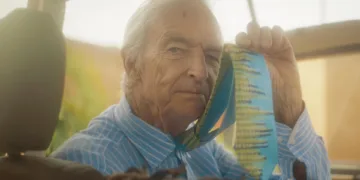



















The conflict over the West Philippine Sea (WPS) usually appears in discussions framed by international law and maritime borders, distant from daily life. Baby Ruth Villarama’s documentary Food Delivery: Fresh from the West Philippine Sea brings that debate back to the shoreline.
The film opens at the waterline, far from diplomatic briefing rooms and historical treaties, and lingers on the concrete, bodily experience of living on a fragile maritime frontier. This focus ties a sprawling geopolitical struggle to the everyday routines of Filipino communities. The title carries a pointed dual meaning. It refers to the resupply runs that keep remote outposts functioning and, at the same time, to the essential labor of fisherfolk drawing food from contested waters.
The film presents defense of maritime territory as inseparable from the repeated act of securing a meal. Villarama shapes the work as visual ethnography, observing how a global power contest enters local life and meets resistance through labor, courage, and collective practice, shifting the frame from legal debate to immediate human cost.
Two Life Circuits on the Water
The documentary’s core design follows two intertwined groups, fisherfolk and armed service personnel, and treats them as linked circuits in a single maritime system. This parallel structure develops the idea of a shared seafaring consciousness, where survival and defense form connected facets of archipelagic identity.
Local fisherfolk, represented by figures like Arnel Satam, appear on screen as they endure harassment from larger foreign government vessels near fishing grounds such as the Scarborough Shoal. Their experience shows the distance between international legal affirmation, including the 2016 Permanent Court of Arbitration ruling, and the harsh limits of enforcement at sea. Persistent intrusion threatens a livelihood built across generations, eroding catches and deepening economic strain.
Their response, however, often carries quiet defiance and practical wisdom. Satam explains that territorial markers lose meaning once his family’s hunger enters the equation. His view pushes the audience to recognize that, for people working these waters, hunger can feel more immediate than the abstract idea of a legal violation. The film records the resilience of this community in detail, following their efforts to sustain morale and solidarity while facing a rising climate of intimidation.
A second thread focuses on uniformed members of the Navy and Coast Guard who conduct high-speed “food delivery” missions to tiny, distant islands. These passages reveal the personal toll of service. The soldiers charged with upholding the national claim occupy harsh and isolated postings. The documentary pays attention to struggles that stretch beyond the tension with foreign forces, such as unreliable mobile connectivity that keeps them from consistently sending money home.
This attention to institutional neglect in the middle of personal danger sharpens the film’s critique of the state’s dependence on people whose basic needs go unmet. By interlacing these two circuits of daily risk, the work links national sovereignty to a community’s claim over its long-standing resource base, pairing the soldier who defends the water with the fisherman who draws sustenance from it.
Cinematics of Confrontation and Contrast
Villarama’s documentary method combines raw, observational images with plainly articulated political context, a strategy that invites viewers across cultures into the story. The cinematography stresses the oppositions inherent in the setting. Wide, gliding shots present the almost ethereal beauty of the yamang dagat (the sea’s treasure) and, in the same frame, the vast ocean that dwarfs small Filipino boats. This visual approach speaks to a rooted cultural reverence for the sea while underlining the danger that surrounds fragile vessels.
The editing pattern tries to match the disorienting, multi-layered character of the WPS dispute. Scenes shift quickly between a tense radio exchange with a Chinese vessel, a resupply trip in which live goats cry out on a speeding boat, and an intimate medical check on a fisherman. This fly-on-the-wall stance avoids a polished fictional arc and keeps faith with the messy, overlapping pressures that shape life on this frontier. Some viewers may read the structure as scattered, yet the constant movement between perspectives mirrors the many directions from which pressure arrives.
Sound design deepens the sense of immersion in this maritime environment. The film leans on the unnerving churn of water, the knock of waves, and the brittle crackle of short-wave radio chatter. The musical score raises more questions. It aims to honor the gravity and bravery of those on screen but at times tilts toward heightened drama.
In those moments the music risks prescribing emotion for scenes that already carry sharp tension, such as footage of a smaller craft being encircled by a foreign vessel. The film’s technical framework also includes archival news material and animated maps and graphics early in the running time. These choices supply legal and geographic reference points so that viewers who might not know the 2016 Permanent Court of Arbitration ruling or the layout of the exclusive economic zone can still follow the stakes of the conflict and place the human stories within an international legal frame.
Resilience, Identity, and Global Context
The most striking feature of Food Delivery lies in its portrayal of resistance through Filipino resilience. The documentary traces how solidarity, shared humor, and insistence on dignity inside severe hardship become tools for staying alive. The film reframes the contest over the WPS as a defense of cultural and economic identity rooted in the sea. For an archipelagic nation, the water functions as a border and a lifeline, a source of sustenance, trade, and inherited practice.
The documentary’s imagery presses these ideas into memorable symbols. In one scene, a Filipino flag is fixed to a tiny floating buoy and set adrift in the immense, indifferent ocean. The image distills fragile hope into a single gesture, a small and visible mark of claim and defiance set against an environment that appears both limitless and hostile. The scene condenses the story’s scale, presenting a fierce refusal to yield in the face of scarce resources and immense opposition.
Events surrounding the film’s release intensify its meaning. Accounts of cancellations and pressure applied to halt screenings echo the patterns of erasure and neglect that the documentary records on the water. This parallel broadens the argument. The film suggests that abandoning these frontliners or suppressing their accounts surrenders the very territory they struggle to hold.
Villarama’s documentary positions itself as a form of defense that relies on visibility, aiming its lens at people whose work secures the maritime frontier. The project carries a dual role: it explains the costs of maritime encroachment to viewers unfamiliar with the WPS and urges recognition and support for those whose everyday labor enacts sovereignty on a contested sea.
Food Delivery: Fresh from the West Philippine Sea is a documentary film centered on the critical and perilous situation in the contested West Philippine Sea (WPS). The film chronicles the lives of Filipino fishermen and the Navy/Coast Guard personnel who risk their safety to deliver essential supplies and defend the nation’s maritime boundaries against Chinese encroachment. Although initially slated for a Philippine film festival premiere in March 2025, it was abruptly withdrawn due to alleged “external factors.” The documentary had its world premiere at the Doc Edge Festival in Auckland, New Zealand, on June 30, 2025, and later saw a limited release in the Philippines starting in late July 2025. As of today, December 10, 2025, its wide streaming release date has yet to be officially announced, but it has been screened at various international film festivals and select local cinemas, receiving critical attention for its urgency and raw footage.
Full Credits
Title: Food Delivery: Fresh from the West Philippine Sea
Distributor: Voyage Studios, Rich Mix (UK release), Doc Edge (New Zealand Festival)
Release date: June 30, 2025 (World Premiere, New Zealand), July 27, 2025 (Philippine Premiere)
Rating: PG
Running time: 83 minutes, 85 minutes (approx. 1 hour 23–25 minutes)
Director: Baby Ruth Villarama
Writers: Baby Ruth Villarama
Producers and Executive Producers: Ferdinand Lapuz, Chuck Gutierrez, Jaime G. Baltazar, Howard Calleja, Alvi Siongco, André Del Rosario, Rey Cuerdo, Lincia Daniel
Cast: Arnel Satam, Ozman Pumicpic, Filipino Fisherfolk, Philippine Coast Guard Personnel, Philippine Navy Personnel
Director of Photography (Cinematographer): Sadhana Buxani, Ivan Torres, Glenn de Guzman
Editors: Chuck Gutierrez
Composer: Emerzon Texon
The Review
Food Delivery: Fresh from the West Philippine Sea
Food Delivery is a necessary, raw piece of documentary journalism that effectively humanizes the geopolitical struggle over the West Philippine Sea. By focusing on the intertwined fates of fishermen and soldiers, the film makes the abstract concept of sovereignty profoundly tangible and personal. Though the narrative occasionally drifts, its stunning, immediate footage and powerful cultural context make it an urgent call for awareness and solidarity. The film delivers a timely, essential message about resilience under pressure.
PROS
- Effectively grounds a complex geopolitical issue in the daily lives and personal stakes of ordinary people (fisherfolk and soldiers).
- Captures the high-tension reality of confrontations and the raw, immense beauty of the sea.
- Provides crucial insight into Filipino resilience and the deep cultural connection to the sea (yamang dagat).
- The film’s struggle to be screened (censorship attempts) underscores the importance and sensitivity of its subject matter.
CONS
- The observational style occasionally results in a scattered feel, jumping between subjects without always sharpening the overall human impact.
- The score can be heavy-handed and over-dramatize scenes that are already inherently tense.
- The film is intentionally one-sided, not exploring the perspective or legal arguments of the opposing side.
- Fails to fully examine the role or failings of domestic government support systems for the affected communities.