





















![Kingdom Hearts Collection [I-III] Review](https://gazettely.com/wp-content/uploads/2026/10/Kingdom-Hearts-Collection-I-III-1-360x180.webp "Kingdom Hearts Collection [I-III] Review: KHII Holds Steady as Newer Entries Fluctuate 40")


The contemporary American Western behaves less like a victory parade and more like an autopsy report on idealism that did not survive. Frontier Crucible treats the genre as a cadaver on the table, an examination of decay and of the cost of conquest. Director Travis Mills adapts Harry Whittington’s 1961 novel Desert Stake-Out and threads through it a modern, nihilistic streak.
Set in the harsh Arizona Territory of the 1870s, the film locates its driving force in necessity with heroism drained out of it. Every choice feels transactional, every action filtered through the need to endure. The grim aesthetic recalls hyper-violent revisionist Westerns, which makes sense for a production that shares a producer with Bone Tomahawk.
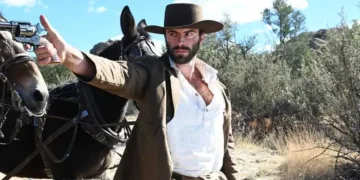
The story itself has a clean spine: Merrick Beckford (Myles Clohessy), a determined former soldier, must transport vital medical supplies across dangerous Apache territory to the desperate town of San Carlos. His humanitarian task collapses almost immediately after he encounters two victims and three opportunistic outlaws. From there the film shapes itself into a somber character study about moral erosion and the effort to survive under extreme pressure.
The Contradictions of the Wayfarer’s Code
The makeshift traveling party operates like a small-scale society under siege, and the chemistry among them carries a sense of potency mixed with strain. Self-interest governs the road; cooperation functions as a fragile truce, easily sacrificed to the physical and psychological demands of the landscape.
Merrick Beckford serves as the nominal lead, defined by relentless commitment to his cargo and to San Carlos. Myles Clohessy plays him as a figure carved from duty and rigidity, reaching for the laconic strongman profile that belongs firmly to the Western tradition. A peculiar linguistic affectation cuts against that archetype.
Beckford speaks in a mannered, almost archaic register, an “old English” rhythm that separates him from the dust, the grit and the immediate violence around him. The performance hints at a man shaped by a background or education that does not equip him for the raw frontier economy of pain and power. This intellectual coating creates distance, a sort of philosophical armor that keeps the audience from fully embracing him as an approachable hero.
The outlaws supply the human threat that Beckford’s idealistic cargo invites. Thomas Jane’s Mule stands out as an older, worn menace whose Southern drawl coats his villainy in a convincing layer of seediness. Armie Hammer’s Edmund carries a forceful screen presence, projecting a quiet, sadistic edge that communicates plenty without many words. Ryan Masson, playing the restless Billy, completes the trio with impulsive, youthful volatility that gives the group its chaotic pulse.
The push and pull among these characters drives the film. The outlaws intend to seize the supplies and steer the group north, while Beckford remains locked on his southbound objective. Each exchange plays like a contained standoff built on mutual distrust.
Valerie (Mary Stickley), the wife of an injured traveler, offers a focal point for the remaining emotional reserves of the group, a reminder that the supplies are tied to lives, a concrete counterpoint to abstract principle. The Apaches appear as a constant, brutal external pressure. They function less as individual characters than as an elemental presence, a shadow at the edge of the frame that amplifies the fractures in this improvised community.
The Aesthetic of Perpetual Twilight
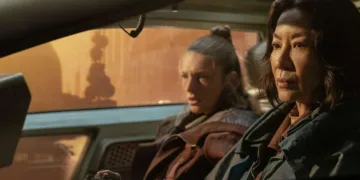
The film’s visual and sonic design forms its most persuasive achievement, creating an unbroken sense of place and dread. Maxime Alexandre’s cinematography looks spectacular. Monument Valley’s vistas link the film to the historical iconography of the Western, while the chosen palette reworks that legacy into something anxious and uncanny. Alexandre leans on “dusk”, late afternoon sliding into evening, as the governing light.

The orange glow and saturated tones are striking, composing images that feel both expansive and suffocating. The landscape appears beautiful, a natural world rendered in painterly detail, while the behavior it frames reeks of rot. The shots become a kind of philosophical joke: the world looks gorgeous while the people inside it poison everything.
Mills’ direction leans into familiar genre mechanisms. He allows tension to accumulate with patience, holding on silence and sparing musical cues so that the viewer sits inside the discomfort. This approach produces a talk-heavy middle stretch that some viewers may read as sluggish. The pacing operates as a calculated risk, extending the psychological wear on the characters so that the eventual outbreak of physical violence lands with added weight.
The soundtrack choice feels eccentric but effective. Sean Rowe contributes eight songs, built around a distinctly blue tone and a low vocal register that seems to rumble up from the soil. The tracks are placed with intent, acting less like conventional score and more like cultural relics drifting through the story. They frame transitions and offer a mournful commentary on the characters’ prospects, echoing the way folk music once carried narrative weight in classical cinema.
The film closes on an unflinching barrage of graphic violence. Practical effects sell the impact of these climactic moments with a harsh credibility, testing how much carnage an audience is willing to sit through. The final stretch of hyper-violence feels like a brutal punctuation mark on the longer project of psychological attrition.
Redemption Lost in the Dust
Frontier Crucible functions as a stark meditation on virtue under extreme pressure. The film sits within the tradition of the revisionist Western, where the clean division between black hats and white hats has already eroded. The emptiness of the plains mirrors the moral vacuum inside these characters.
Redemption and survival form the primary thematic axis. Beckford’s mission serves as an attempt at atonement for a past that the film only suggests, yet the story presents redemption as largely unreachable for nearly everyone involved. Human frailty and self-interest dominate the frame. The trek exposes the buried, often base motives of the traveling companions. No one rises to uncomplicated hero status; people cling to existence, and that existence carries the stain of ethical compromise.
The film’s structure will feel familiar to viewers who know contemporary Westerns, yet the individual components work together with steady effectiveness. The project succeeds as a concentrated character study, mapping the gradual decline of desperate people pushed into close quarters. The plot performs its duties yet occasionally bends plausibility, especially when it tries to weave together assorted secrets and aims.
The viewing experience remains harsh and atmospheric. The striking cinematography and distinctive sound design lift the material. Its heavy subject matter and refusal to flinch from graphic detail will likely appeal to a loyal circle of genre devotees, marking Frontier Crucible as a strong, thoroughly bleak modern Western.
Frontier Crucible is a brutal Western thriller set in the Arizona Territory of the 1870s. The story follows Merrick Beckford, a former soldier tasked with delivering a wagon load of essential medical supplies across hostile Apache territory. To complete his desperate mission, Beckford is forced into a volatile alliance with a trio of dangerous outlaws and a couple seeking survival. Directed by Travis Mills, the film premiered in theaters and on digital platforms on December 5, 2025. It is distributed by Well Go USA Entertainment.
Full Credits
Title: Frontier Crucible
Distributor: Well Go USA Entertainment
Release date: December 5, 2025
Rating: R
Running time: 125 minutes
Director: Travis Mills
Writers: Harry Whittington, S. Craig Zahler (uncredited)
Producers and Executive Producers: Dallas Sonnier, David Guglielmo, Lillian Campbell, Thomas Jane, Courtney Lauren Penn, Amanda Presmyk
Cast: Myles Clohessy, Thomas Jane, Armie Hammer, Mary Stickley, Eli Brown, Ryan Masson, William H. Macy, Zane Holtz, Eddie Spears
Director of Photography (Cinematographer): Maxime Alexandre
Editors: Jared Bentley
Composer: Sean Rowe
The Review
Frontier Crucible
Frontier Crucible is a visually stunning, relentlessly brutal Western that successfully leverages genre conventions to explore the utter corrosion of morality on the frontier. While the pacing sometimes drags and the lead performance carries an unnecessary affectation, the intense character dynamics and exceptional technical execution make it a compelling, albeit bleak, journey for dedicated fans of the modern, darker Western genre.
PROS
- Maxime Alexandre's "dusk" aesthetic creates a gorgeous, distinct, and highly atmospheric visual world.
- The use of Sean Rowe's blues tracks provides effective, atmospheric commentary and excellent sonic texture.
- The film features unflinching, realistic violence achieved through convincing practical effects, reinforcing the narrative's severity.
- Thomas Jane and Armie Hammer deliver memorable, intense performances as the predatory outlaws.
CONS
- The middle section is often sluggish and overly "talky," disrupting the film's narrative momentum.
- Clohessy's character's affected, antiquated speaking style feels unnatural and detracts from the realism of the setting.
- The plot is functionally robust but follows predictable genre beats, limiting its potential for true surprise.