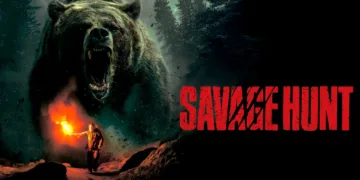


























Set against the rugged, unforgiving backdrop of Western Montana, Savage Hunt stages a classic man versus nature conflict. The camera repeatedly frames this terrain so it feels like a harsh, alien plateau rather than a familiar slice of the American West; the hills and tree lines flatten into stark planes, a kind of accidental Eastern European tableau carved out of North American soil. The narrative moves quickly.
A construction crew pushes into the wilderness to prepare a resort, heavy machinery biting into the tree line. That intrusion triggers a run of brutal, escalating attacks from a massive grizzly bear. The violence lands with a raw, physical jolt, and the sense of threat feels immediate, which forces local authorities to summon Joe Regan, a tracker haunted by past failures.
Regan fits the mold of the neo-noir antihero, worn down and reluctant, pulled back into a shadowy line of work he tried to escape. The film burns through its opening movements at speed, and in its stronger passages the rush of incident, the harsh landscape, and Regan’s grim presence combine to create a genuinely unnerving current of dread. For a while, it feels like a predator story shot through with noir.
Chiaroscuro and the Creature’s Presence
The film’s visual design has a confident surface that sometimes gives weight to the pulp underneath. Director Roel Reiné shows a sharp eye for where to place the camera. Handheld work in the chase sequences tightens the frame around bodies and branches, producing a jittery, claustrophobic texture; the forest paths smear into streaks of mud and motion, like a sensory maze where the viewer’s footing slips with every cut.
In those stretches, composition and movement work together to guide the audience’s attention and to toy with spatial certainty. The cinematography channels a strain of expressionistic dread: trees loom like vertical prison bars, foreground objects slice across the frame, and the woods begin to feel like a psychological trap as much as a physical location.
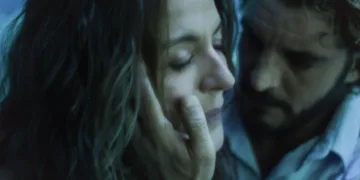
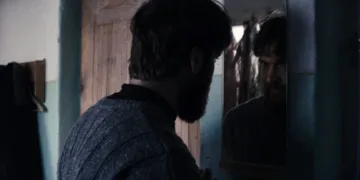
Lighting choices deepen that effect. Flares and practical sources carve figures out of the darkness with sharp contrasts, and the image leans into chiaroscuro in a way that suits the material. Faces flare into relief, then sink back into shadow. The bear’s territory often reads as a corridor of black and sickly color punctures, a recognizably noir playbook adapted to a backwoods setting. In these moments, the formal craft tightens the screws and shapes the viewer’s fear beat by beat.
The illusion collapses once the creature itself becomes the focus. The grizzly, intended as an implacable force of nature, wavers between convincing presence and hollow effect. When the film uses real animal footage or practical work, the bear carries a heavy, terrifying sense of mass. The body feels solid, the movement has weight, and the animal’s anger gains a physical credibility that supports its role as avenger of the forest. That tangible presence pins the violence to something that feels real.
Then the movie cuts to digital augmentation and the spell breaks. The CGI shots look flimsy, sometimes like crude overlays pasted into the frame whenever the story requires direct contact or elaborate action such as the bear being shot. The seams show. The central antagonist starts to look like a budget spreadsheet in fur. What begins as a near-mythic figure of nature’s wrath slides into a visual-effects problem set, and the film’s core threat shifts from existential to unintentionally comic.
Moral Gray Zones and Melodrama’s Drag
The script reaches for moral ambiguity through a creature feature template. It frames the conflict through environmentalism pitted against corporate development and sets that larger clash beside broken human relationships. There is an environmental stand-off with a resort project. There are divorcing and secretly divorced families grinding through their private battles. On paper, the layers might create a dense ethical field: human encroachment on the land, selfishness at home, all feeding a story about consequences. On screen, the accumulation feels misjudged.
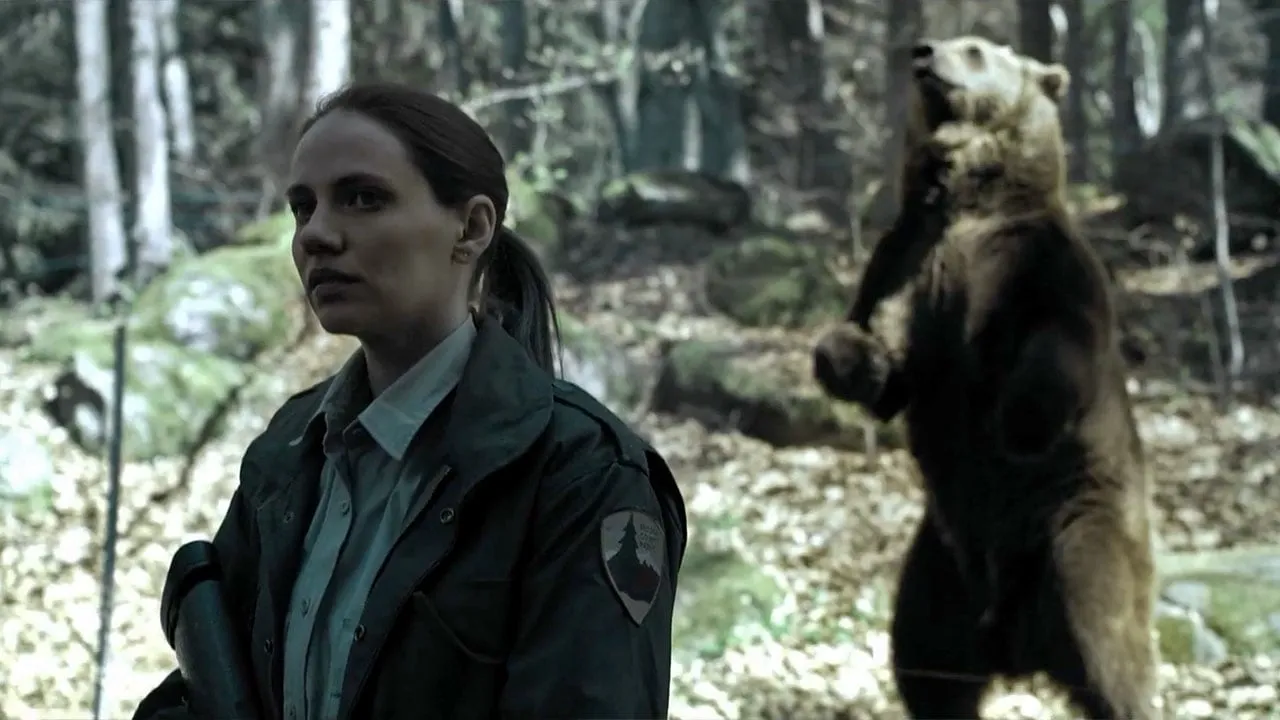
Most of the characters register as deeply unappealing, and their emotional arcs rarely pull the viewer into their fight for survival. Their choices lean toward baffling. People walk into danger without clear motive. Plans hinge on decisions that read as self-sabotage. After a while, their trajectory feels less like free will under pressure and more like a script dutifully marching them toward the next grisly incident. The audience faces repeated requests for sympathy with people who seem determined to sprint toward the bear.
Instead of a rich philosophical undercurrent about ecology, responsibility, and human frailty, the film leans into blunt melodrama. The central conflict arrives with the impact of a blunt instrument and stays there, never developing into the layered tangle that could mirror the moral questions raised by the premise. Those disconnects between idea and execution erode the psychological tension that the camerawork sometimes musters. A daytime bear rampage on a Montana street, where nobody reacts or reaches for a firearm, tears a hole in any claim to psychological realism.
The movie’s identity feels split. The storytelling leans toward noisy interpersonal quarrels that clog the space where primal fear could take hold. The elegant, simple terror of a predator story competes with noisy domestic trouble. By the time the script reaches for catharsis, the bear begins to seem like the only figure capable of editing the screenplay, and that might be the most persuasive motivation in the film.
Pacing, Paranoia, and the Duel’s Redemption
Savage Hunt keeps a fast, almost breathless rhythm. Scenes snap forward with little pause, and the structure relies on abrupt, flickering shifts in the timeline that occasionally muddle the sense of immediate danger. The speed promises urgency, yet the suspense rarely settles into a steady state. The narrative attention drifts away from the existential horror attached to the bear and locks onto the thinning family drama, which reduces the animal’s menace each time domestic conflict takes the foreground.
The film still carries a clear thematic intention. It frames the grizzly as a force of nature that exacts payment for human intrusion and destruction. That idea lends the violence a moral shape and connects the attacks to the earlier images of machinery chewing into the landscape. The movie finally finds a cleaner structure in its last act. The final twenty minutes tighten around a stripped-down hunter against hunted confrontation.
The staging narrows, the goal becomes simpler, and the camera returns to a more exacting focus on bodies, space, and threat. For a brief stretch, Savage Hunt feels like the film suggested by its premise, a lean duel between a damaged tracker and an implacable animal, charged with tension that had been missing.
That late surge cannot erase the recurring technical problems or the thinly written human material that precede it. Savage Hunt tries to function as two different movies, a raw creature feature and a knotty family drama, and the visual missteps combined with the unengaging script sap strength from both ambitions. The result plays like a noir-tinged eco-thriller caught between the moral terror it sketches and the melodrama it insists on staging.
Savage Hunt is a 2025 creature feature that unfolds in the Montana wilderness where a construction project, intended for a new resort, disturbs a massive grizzly bear, triggering a series of deadly attacks on humans. The film was distributed by companies including Defiant Screen Entertainment for digital and DVD release in regions like Australia and New Zealand, and Pioneer in Russia. It premiered internationally with an earliest known release date of August 28, 2025, in Russia, and has an approximate running time of 1 hour and 28 minutes. The movie carries a rating of PG-15 in some territories, signaling strong thematic material and violence.
Full Credits
Title: Savage Hunt
Distributor: Defiant Screen Entertainment, Pioneer, Yango Play
Release date: August 28, 2025 (Russia/CIS)
Rating: PG-15
Running time: 1 hour 28 minutes
Director: Roel Reiné
Writers: Chad Law, Christopher Jolley, Roel Reiné (uncredited or partial credit)
Producers and Executive Producers: Midwest, Pro Cinema, Underdogg Entertainment (Production Companies listed)
Cast: James Oliver Wheatley, Colin Mace, Anthony Barclay, Priya Blackburn, Noush Skaugen, Fotina Papatheodorou, Katrin Vankova, Jonas Talkington, Martin Radoev
Director of Photography (Cinematographer): Roel Reiné
Editors: Roel Reiné
Composer: Roel Reiné
The Review
Savage Hunt
Savage Hunt is a film of frustrating dichotomy. It possesses a sharp thematic edge regarding environmental payback and features brief moments of compelling, practically-shot terror, particularly in the final duel. These highs are consistently undercut by a flimsy script populated by insufferable characters and a disastrously inconsistent digital portrayal of its core antagonist. The film’s ambition for complex human drama muddles its primal horror premise, leaving it a competent piece of cinematography often ruined by its own inability to commit to its central beast.
PROS
- Features strong visual composition, good use of lighting (flares), and kinetic handheld camera work in chase scenes.
- Strong core message about environmentalism and the cost of human encroachment on nature.
- Maintains a quick pace that ensures the film never truly drags, especially in the opening.
- The final showdown briefly achieves the superior, focused suspense the rest of the film lacks.
CONS
- Central flaw where effective practical footage is ruined by poor, unconvincing CGI insertions.
- Characters are generally unlikable and make frustratingly illogical decisions.
- Overwrought, messy family and socio-political subplots distract from the main horror.
- Moments of unbelievable plot choices that pull the audience out of the world's reality.