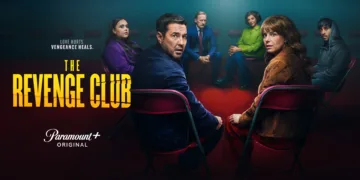





























Divorce often produces ruinous emotional fallout. The Revenge Club, a dark comedy-thriller on Paramount+, channels that fallout into a sharply observed piece of contemporary drama. The series, adapted from J.D. Pennington’s novel The Othello Club, gathers six people at a conventional divorce support group. Their acrimonious splits generate a shared rage that refuses to stay hidden beneath polite façades. Rather than pursue licensed therapy, the group converts into an informal collective intent on retaliating against the ex-partners who upended their lives.
From there the plot advances into a sequence of black-humored, increasingly extreme schemes. The narrative opens in medias res with police interrogations and a central admission that “people are dead.” Flashbacks and interview-style scenes then map how jokey acts of retribution escalated into severe, lethal outcomes. The series tracks a contemporary cultural feeling: a desire for emotional vindication amid perceived injustices.
The Ensemble as a Study in Societal Grievance
Much of the series’ force comes from careful characterization and the varied British ensemble. The actors invest the material with collective intensity that often compensates for the plot’s more improbable turns. Aimée-Ffion Edwards anchors the show as Emily, whose devastation after betrayal by both her husband and her best friend leaves her stripped of home and business.
Her bitterness and fragile truthfulness establish the series’ opening moral energy. Martin Compston’s Calum is a father confronted by an ex-wife who uses their daughter as leverage, and Compston traces Calum’s movement from stunned parent to an angered agent of retaliation.
Douglas Henshall’s Steven is the de facto planner. He is an ex-military man whose outward composure hides deep grievance after being forced from his home. He converts private fury into methodical action. Meera Syal’s Rita occupies a middle-aged vantage of having felt invisible for years; her lines and dark humor critique cultural patterns around aging and female emotional neglect.
Sharon Rooney’s Rachel arrives with an upbeat exterior while carrying a key secret about a toxic marriage, which creates a study of concealed suffering. The ensemble forms a brittle alliance forged by resentment and frustration. The actors give these roles a weight that keeps the material grounded, producing a kind of low-budget Ocean’s Eleven aesthetic that reflects the mess and indignity of life after betrayal.
Narrative Fragmentation and the Dark Heart of Revenge
The show’s premise taps into a common appetite for catharsis. The execution, however, frequently leans toward the absurd. Individual episodes devote themselves to staging elaborate missions aimed at each member’s tormentor. Early capers include tarot-card cons, engineered rat infestations, and break-ins to steal exam papers. These episodes play as amoral pranks and create a suburban spy-caper sensibility. That choice aligns the series with a current tendency in streaming drama to foreground heightened wish fulfillment above strict procedural plausibility.
The series asks viewers to accept ordinary people becoming competent orchestrators of elaborate plots, which tests suspension of disbelief. Its central compensation arrives as the story grows darker over time. Light revenge evolves into dangerous action and then into a psychological thriller. The show’s flash-forward structure repeatedly reminds the audience of the lethal stakes attached to the characters’ schemes.
The drama organizes itself around an ethical question drawn from the characters’ choices: whether revenge can operate as a path toward emotional repair. The progression from domestic caper to fatal escalation follows a pattern now common in serialized streaming narratives, where personal dramas accelerate into high-stakes conflicts to sustain audience engagement.
Stylistic Tensions and Future Trends in Streaming Drama
Production values give The Revenge Club a polished, high-budget mini-series sheen, and that technical finish reflects the direction by Tim Kirkby. The series’ tonal approach, however, is unsettled. It moves across psychological misery, black comedy, and conventional thriller, and those transitions can disorient. That tonal range reflects a present industry challenge: the push to combine elements from multiple popular modes in order to reach assorted audience tastes.

The cast’s emotional work remains the anchor for viewers. Grief, humiliation, and rage rooted in betrayal form the series’ emotional foundation and make the characters’ motives accessible even when the plotting grows outlandish. The format of character-specific revenge episodes contained within an overarching deadly mystery feels like a practical model for future serialized shows.
That structure provides immediate episodic payoff while preserving a longer mystery that encourages ongoing viewing. The Revenge Club functions as a darkly entertaining thriller with strong performances and a focus on the recognizable pain of rejection. Its blend of episodic mischief and escalating peril gestures toward an industry pattern in which personal grievances are dramatized into sustained, high-stakes serial storytelling.
The Revenge Club is a dark comedy-thriller series that premiered on Friday, December 12, 2025. All six episodes of the UK original series are available to binge exclusively on the Paramount+ streaming platform. Based on J.D. Pennington’s novel The Othello Club, the show centers on a group of heartbroken strangers who meet at a divorce support group and form an unlikely alliance to execute elaborate revenge schemes against their ex-partners. This cathartic but wildly misguided plan quickly escalates from mischievous pranks to fatal accidents, blurring the line between justice and murder.
Full Credits
Title: The Revenge Club
Distributor: Paramount+ (UK & Ireland)
Release date: December 12, 2025
Running time: 6 episodes (Episode length typically around 45–60 minutes for UK limited series)
Director: Tim Kirkby, Daniel O’Hara
Writers: Gabbie Asher (Creator), Matt Jones, Adam Usden
Producers and Executive Producers: Margot Gavan Duffy (Producer), Gabbie Asher (Executive Producer), J.D. Pennington (Executive Producer), Alison Jackson (Executive Producer), Jess Connell (Executive Producer)
Cast: Martin Compston, Aimée-Ffion Edwards, Meera Syal, Sharon Rooney, Douglas Henshall, Chaneil Kular, Amit Shah, Niamh Walsh, Wil Coban, Christina Bennington, Aoife Kennan, Rob Malone, Eoin Duffy
The Review
The Revenge Club
The Revenge Club is an entertaining, high-energy thriller that capitalizes on a strong ensemble cast and a universally relatable emotional core: the misery of betrayal. While the plots are wildly implausible and the show struggles to unify its various genres—shifting awkwardly between dark caper and fatal drama—its magnetic performances keep the escalating mystery compelling. It serves as highly bingeable television, effectively transforming shared trauma into guilty, black-hearted fun.
PROS
- The British acting talent delivers powerful, engaging performances that ground the fantastical premise.
- It effectively captures the raw bitterness and pain of divorce and betrayal, fueling the audience's investment.
- The flash-forward, police interrogation structure creates an immediate, strong central mystery.
- The shift between tones and the constant escalation of schemes make it consistently entertaining and highly bingeable.
CONS
- The revenge plots are often ridiculous and strain suspension of disbelief, lacking logical foundation.
- The show struggles to balance its identity, resulting in a sometimes disorienting "gallimaufry of tones" (caper, thriller, comedy).
- The core concept of a revenge group is not fresh, relying heavily on the execution to distinguish itself.