































Goodbye June arrives as Kate Winslet’s first time directing, a debut freighted with expectation. The screenplay, written by her son Joe Anders, roots the story in familial loss and personal grief. The film presents itself as a family drama about terminal illness and the urgent need for reconciliation.
It opens with four adult children gathering at a Gloucestershire hospital where their mother, June (Helen Mirren), has been given a terminal diagnosis and is not expected to live beyond the few weeks before Christmas. That timetable compels this fractured family to face long-avoided histories. The project interrogates how people live in close, often awkward proximity to one another when final liminality has been imposed.
The Architecture of Archetypes and the Burden of Performance
A dominant trait of the film is its ensemble emphasis. The cast is formidable, yet their gifts contend with a script that prefers clean outlines to layered complexity. Winslet’s cast encounters character writing that often reads as pre-written shapes. The existential dimension here is the sudden demand for accounting, a last survey of life. That dread is present, but it often meets fixed emotional paths, arranged and predictable.
Helen Mirren anchors the film as June. She embodies acceptance with a controlled, stoic grace. Her small, quiet moments register a restrained power. When she is alone, in rooms lit by subdued hospital light, Mirren’s expressions stage an almost silent terror beneath a composed surface. She reflects the fear of vanishing, a fear the film gestures toward without allowing a full examination.
Bernie, played by Timothy Spall, takes on the role of father and husband. He is drawn as a gruff, beer-holding denier, a presence that leans toward caricature. His refusal to acknowledge June’s condition opens as an odd, mildly comic obstinacy. Spall works to suggest a private history of devotion and buried sorrow. The film then moves him into a sudden outbreak of grief, an emotional shift that arrives as if scripted to guarantee that each principal relationship receives closure. That shift does not always earn its weight on screen.
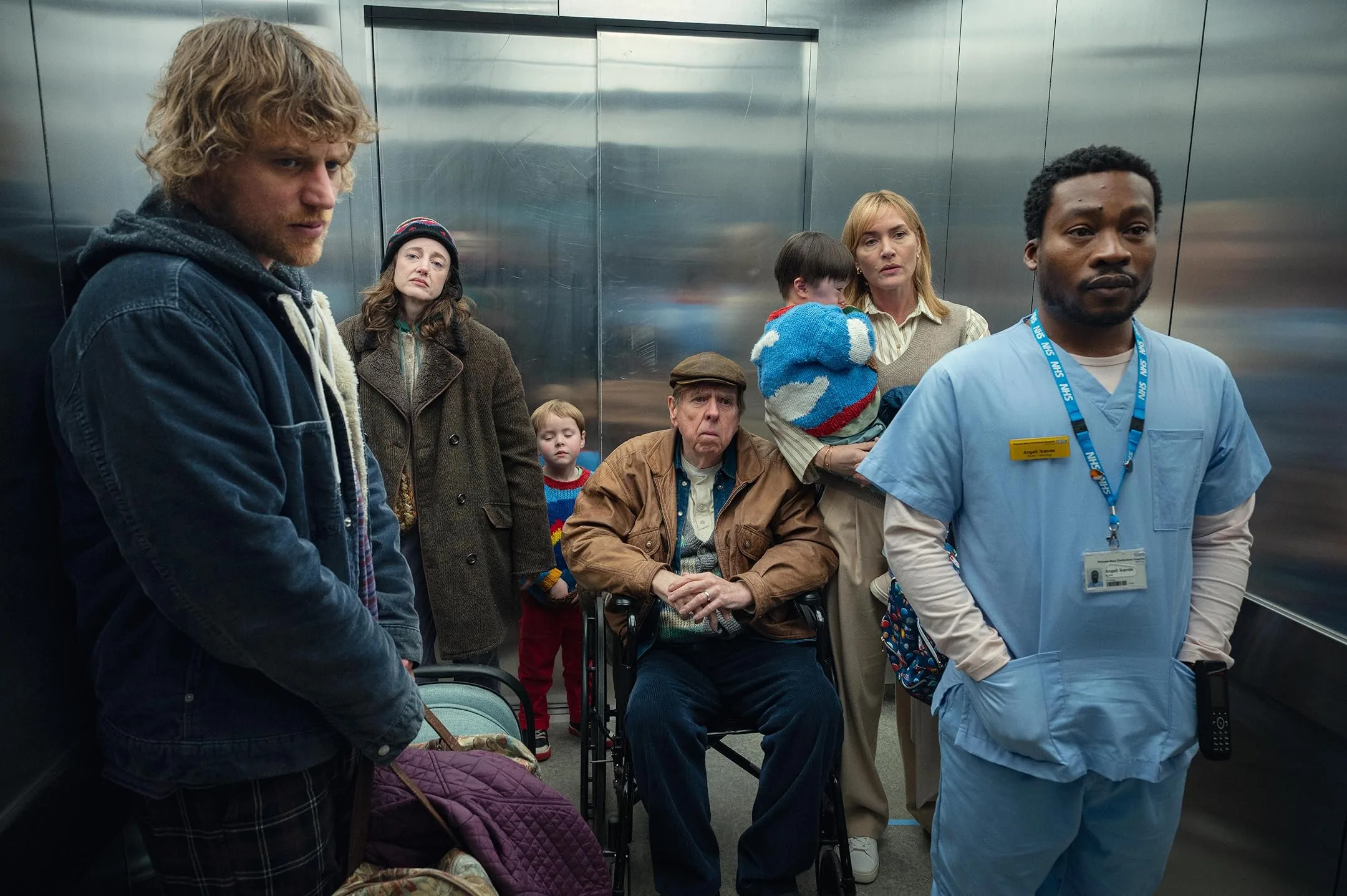
The four siblings appear as recognisable dramatic types, each mapped to a particular function in the family dynamic. Julia, played by Winslet, carries organized responsibility and professional order, her control thinly disguising exhaustion. Molly, portrayed by Andrea Riseborough, exists in high-strung, combustible mode, her anger framed by a defensive, eco-conscious domesticity. Connor, played by Johnny Flynn, is the sensitive man stalled in an adolescent posture, defined by duty rather than growth. Toni Collette’s Helen plays the free spirit returned from abroad; this incarnation feels added to supply eccentricity, and it often reads as detached from the film’s stated aim of emotional realism.
Despite these schematic outlines, the ensemble frequently rescues the written material. Performances supply history and tenderness to dialogue that on the page might appear blunt. Andrea Riseborough brings a contained, fierce energy to Molly that arrests attention and sustains the sisterly friction. Even so, the screenplay’s architecture favors formula: contrived two-person confrontations steer the narrative toward tidy reconciliations. Those set-piece exchanges aim to unpick long resentments, but they steer the characters along expected arcs and blunt the endurance of pain that real estrangement often entails.
Fisayo Akinade’s Nurse Angel offers a strikingly luminous presence. He performs as a gentle, composed confessor within the hospital’s sanitized spaces. Akinade’s most affecting moment comes in a conversation with Connor about the wish for a “good goodbye.” That scene provides the film’s clearest humanist insight, a moral center for the action as it unfolds. The character operates almost as a vessel for the film’s loftiest aims, a quiet moral force whose steadiness highlights the contrivances around him.
The Gilded Cage of Visual Tone
Winslet’s directorial choices privilege the actors. She grants prolonged attention to faces and gestures, allowing close-ups to perform the bulk of the film’s emotional work. This actor-first sensibility explains the emphasis on intimate framing over elaborate visual design. The consequence is that the camera often accentuates the characters’ archetypal outlines; emotional heft must be supplied through performance rather than emerging from richly textured writing.
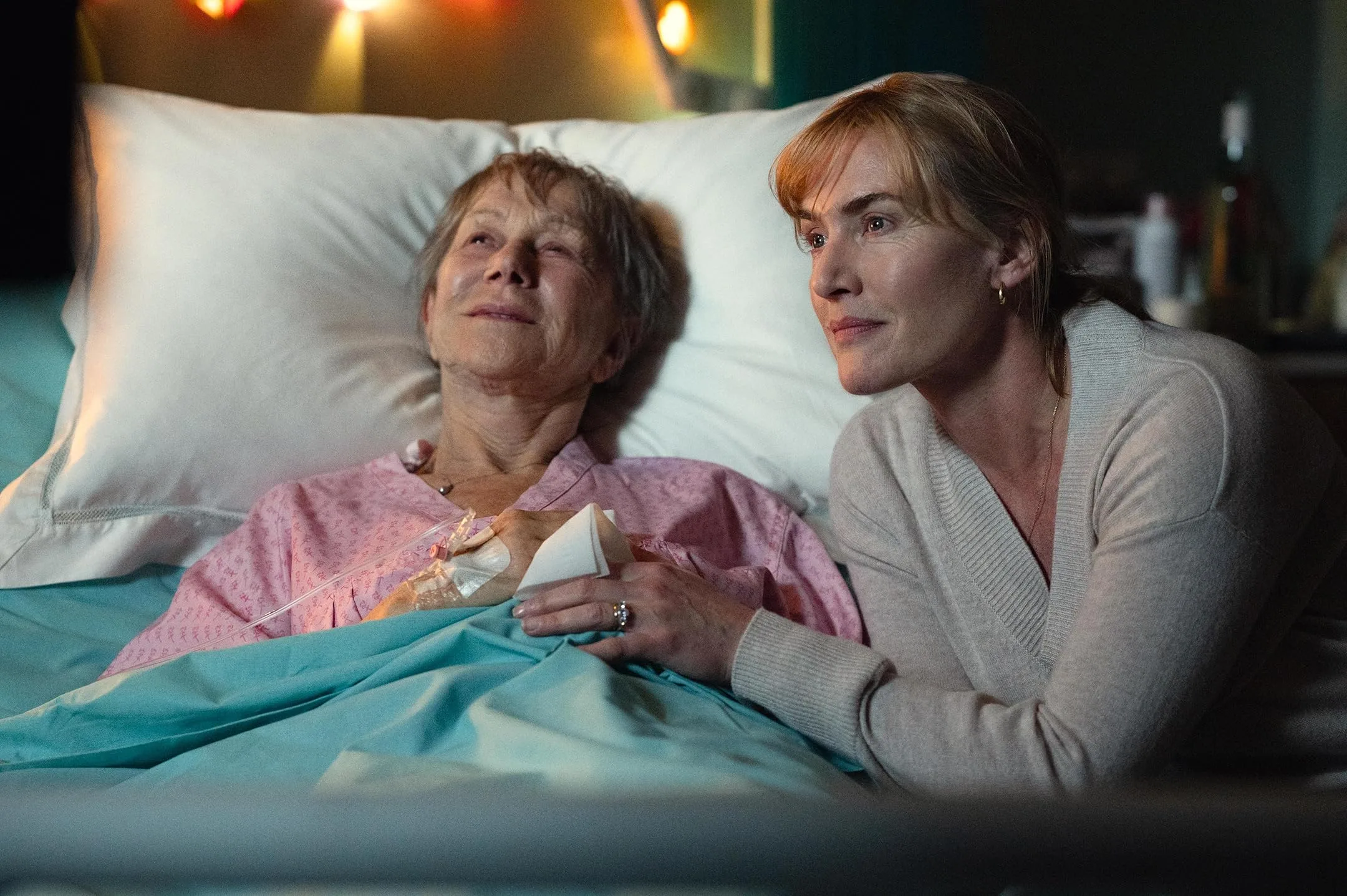
The principal locations remain June’s hospital room and its adjoining corridors, yet the cinematography resists clinical austerity. Alwin H. Küchler’s lens bathes the interiors in warm, gold-flecked light that leans toward the beatific. The hospital reads less like a place of stark crisis and more like an almost comforting enclosure. Ben Harlan’s piano-led score underlines a sweet melancholy, inviting viewers to comply with the film’s emotional cues. These aesthetic choices soften the harshness of proximity to death and render the setting into an emotionally snug space.
Directorial devices aim to fill the film’s narrow geography with activity. The arrival of a Christmas tree and a lengthy sequence of grandchildren staging a Nativity play transform the hospital into a site of staged seasonal bustle. Those moments seek to create heartening confusion, but they can feel orchestrated to provide sentiment rather than to deepen dramatic truth. Winslet avoids making the film feel physically suffocating by sustaining a smooth, unobtrusive visual approach, yet she embraces the text’s preference for an emotionally comfortable tone. Festive inclusions align the film with the seasonal tearjerker form, steering the narrative’s affect toward assured reactions.
Grief, Sentimentality, and the Failure of Confrontation
The film stakes itself on a confrontation with mortality and on the idea that proximity to death grants the living a chance at a considered farewell. It begins by presenting a frank appraisal of terminal illness, including the cessation of treatment and the blunt certainty of prognosis. The script, however, repeatedly trades that frankness for structural consolation. The dramatic line moves away from the opaque, intractable realities of regret and unresolved injury, preferring emotional ease.
Family dysfunction serves as the story’s engine, yet the screenplay treats reconciliation as a series of neat steps. Longstanding rifts surface in charged dialogue, and those moments can feel vividly true. Still, the film resolves grievances with an expediency that flattens the slow, often unglamorous labor of forgiveness. Characters stand a short distance from healing and cross it within single scenes, as if genuine emotional work were a sequence of conversations. The Christmas deadline attempts to heighten stakes, and it functions primarily as a device that demands tears and seasonal warmth.
Where the script finds purchase, it does so in specific, intimate exchanges. The confrontations between Julia and Molly produce sparks of truth that ring with history and consequence. These flashes, however, are intermittently overwhelmed by a prevailing reliance on familiar moves. Hurdles appear and are cleared with an economy that often reads as dramaturgical convenience, directed toward the next ensemble moment. The two-hour span can feel extended by the film’s steady conviction that tidy emotional resolution equals profundity.
Goodbye June aims for a deep reckoning with loss. It seeks texture and complexity, and it houses moments that genuinely approach that aim. Yet its dependence on clear-cut archetypes and a schematic plot concession the final effect to predictability. The film functions as an effective tearjerker, offering designed emotional release within a holiday frame. It sacrifices messy, unresolved truth for tidy closure and, in that trade, limits the lasting impression of its inquiry into fear, mortality, and the ethics of farewell.
Goodbye June is a Christmas family drama film marking the feature directorial debut of celebrated actress Kate Winslet. It centers on four adult siblings who return home for the holidays after their mother, June, receives a terminal cancer diagnosis, forcing the estranged family to confront their deep-seated conflicts before her time runs out. The film was released for a limited theatrical run in the UK and US on December 12, 2025, and is available for streaming globally on Netflix starting December 24, 2025.
Full Credits
Title: Goodbye June
Distributor: Netflix
Release date: December 12, 2025 (Limited Theatrical), December 24, 2025 (Streaming)
Rating: R
Running time: 114 minutes
Director: Kate Winslet
Writers: Joe Anders
Producers and Executive Producers: Kate Winslet, Kate Solomon
Cast: Helen Mirren, Kate Winslet, Toni Collette, Andrea Riseborough, Johnny Flynn, Timothy Spall, Fisayo Akinade, Stephen Merchant, Jeremy Swift, Raza Jaffrey
Director of Photography (Cinematographer): Alwin H. Küchler
Editors: Lucia Zucchetti
Composer: Ben Harlan
The Review
Goodbye June
The film is an elegantly acted, structurally simple study of grief that prioritizes catharsis over complexity. While the stellar ensemble lends weight to moments of intimate feeling, the script’s reliance on archetypes and tidy resolutions prevents a deep, unflinching confrontation with mortality. It is a highly polished, emotionally manipulative work, ultimately achieving a sweet sentimentality at the expense of authentic existential depth.
PROS
- Helen Mirren, Andrea Riseborough, and the entire cast elevate the material with convincing emotional depth.
- Her focus on the actors and use of close-ups are effective and unostentatious.
- Key one-on-one scenes between siblings feel raw and achieve genuine emotional resonance.
- His performance brings a welcome, gentle wisdom and humanity to the core conflict.
CONS
- The characters are thinly drawn archetypes, often functioning as dramatic cliches.
- Character conflicts are resolved too neatly and predictably, robbing the drama of impact.
- The Christmas setting and forced celebratory devices (e.g., the Nativity play) feel manipulative.
- The predictable progression makes the two-hour runtime feel prolonged and unnecessarily extended.