























![Kingdom Hearts Collection [I-III] Review](https://gazettely.com/wp-content/uploads/2026/10/Kingdom-Hearts-Collection-I-III-1-360x180.webp "Kingdom Hearts Collection [I-III] Review: KHII Holds Steady as Newer Entries Fluctuate 40")


The premise of Twelve Dates ‘Til Christmas looks straightforward at first glance, borrowing the familiar shape of a seasonal romantic comedy. The limited series, based on Jenny Bayliss’s novel, quickly signals a stronger focus on the psychology of emotional avoidance. Kate (Mae Whitman), a London-based textile designer, keeps her personal life on pause. Her attention stays fixed on her demanding job and on caring for her father, Mac (Nathaniel Parker), who is recovering from an accident.
Her friends, Laura and Callum, read this pause as a problem that needs intervention. They sign her up, against her instincts, for “The 12 Dates of Christmas” matchmaking service. The story relies on this imposed framework, pushing Kate into a cycle of festive outings, from carriage rides to baking competitions, all staged in a picturesque, wintry English village in the run-up to Christmas.
Dissecting the Character Architecture
The series builds its structure on performance and character work, with Mae Whitman’s Kate set firmly as the load-bearing element. Whitman plays the character as someone whose dry, sardonic humor conceals a solid, self-installed emotional wall. That tension defines the narrative design. Kate functions efficiently as an adult in the professional sphere while remaining emotionally underdeveloped in her private life.
The writing makes clear that her initial cynicism does not arise from generic defiance; it has roots in her history. The show traces a clear line from her reluctance to risk vulnerability to the emotional imprint of her parents’ divorce, and especially to her mother Delilah’s (Mary McDonnell) restless, adventure-first approach to life. That backstory gives weight to Kate’s reluctance and provides the necessary foundation for her arc.
The series spends real time on the slow calibration of Kate’s emotional state. The dating framework serves less as a straightforward search for the ideal partner and more as a structured exercise in self-examination. Each encounter pushes Kate to articulate what she values, what frightens her, and which lines she will not cross. Her evolution plays out in quiet scenes of introspection and in tense, revealing conversations, shifting her from a life built around duty and upkeep toward one that makes space for personal satisfaction.
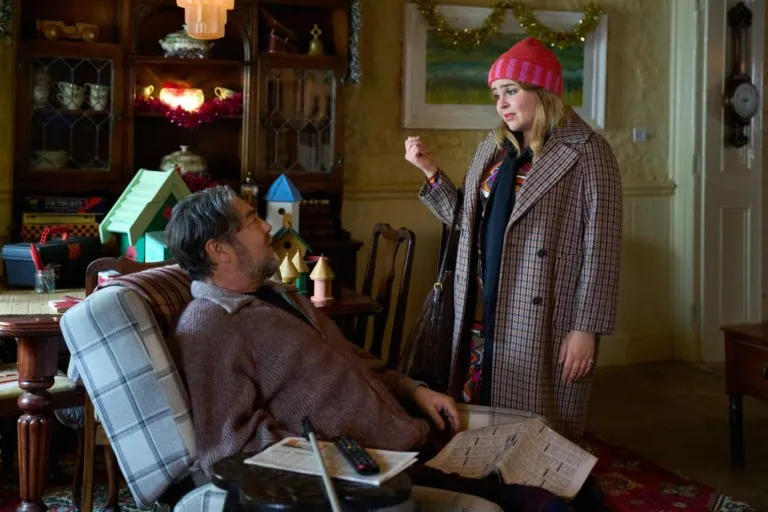
The narrative scaffolding grows stronger with the inclusion of a parallel, later-in-life romance between Mac and his friend Evelyn (Jane Seymour). This thread does more than fill space between dates. It operates as a reflective surface, offering Kate a nearby example of a healthy, second-chance relationship. Nathaniel Parker and Jane Seymour establish an easy, lived-in chemistry that makes their progression feel gentle and believable.
Mac, who initially appears withdrawn and dependent, draws energy from Kate’s participation in the dating scheme and finds the courage to seek his own adventure. The show uses this to underline the idea that the protagonist’s choices send ripples through other lives and that romance remains available beyond youth.
The broader ensemble, including Parker, McDonnell, and Seymour, gives the supporting roles a sense of fullness. Kate’s friends Laura and Callum (Lucy Eaton and Julian Morris) work effectively as narrative catalysts. Their methods can seem heavy-handed, yet they supply the necessary push that pulls Kate out of her static routine. They embody the social pressure that sometimes has to exist before long-standing personal inertia begins to shift.
The Episodic Structure and Tonal Nuance
The “Twelve Dates” format operates as the show’s central storytelling engine, an episodic structure that repeats and reconfigures familiar holiday motifs. Each date functions less as a simple romantic success or failure and more as an experiment designed to peel back Kate’s assumptions about partnership.

The writers move through a range of dating types, from the painstakingly organized family man to the emotionally volatile ex, while staging these encounters through heightened set-pieces: a baking contest modeled on a recognizable reality show format, a mishap on the ice, a carriage outing that goes wrong. These episodes supply clear narrative beats and visually memorable incidents.
Tonally, the series carves out a specific place within seasonal romance. It retains the expected festive glow while threading the dialogue and situations with dry, self-aware humor. Much of the comedy comes from the characters’ sharp commentary on the absurd rituals of contemporary dating rather than from broad slapstick. Callum’s joking remark about Kate collecting “twelve possible horror stories” captures the series’ sly, slightly morbid sense of fun. The mixture of sentiment and sarcasm allows the show to tease the conventions it relies on while maintaining emotional sincerity.
The central narrative puzzle lies in making a familiar, love-averse setup feel uncertain in its outcome. The series addresses this by delaying the effective arrival of the primary romantic figure. Richard, the man who failed to appear for the first date, returns as an unresolved presence, with flowers and a vague apology. This reframes the suspense. The main question shifts away from the identity of the endgame partner and toward Kate’s decision to accept or reject a hazy, emotionally risky possibility. His measured, patient pursuit, set against a sequence of brisk, chaotic dating misfires, shapes a contrast that keeps the dynamic from feeling like a copy of other entries in this genre.
Intertwined Themes and Visual Language
The series finds its strength in the way it uses romance to probe themes of stasis and renewal. The primary conflict plays out inside Kate. She does not face a concrete antagonist or overwhelming external obstacle; her limitations come from a long-standing habit of placing responsibility above desire, to the point where she almost erases herself. The key thematic concern centers on the shift from a tightly defined role, such as caretaker or employee, to a life that includes risk, play, and emotional openness. Her early resistance to the dating scheme reflects a fear of disturbing a fragile equilibrium.

The writing builds clear psychological links between Kate’s commitment fears and the model provided by her parents. The lasting effects of their separation, together with her mother’s distant, thrill-seeking pattern of behavior, shape Kate’s protective instincts. The dating storyline chips away at those defenses by repeatedly demonstrating that emotional exposure does not automatically produce abandonment.
This strand of the story extends to the ensemble. The ongoing complications among Oliver, Sarah, and Callum show that love lives operate in a messy social ecosystem rather than in isolation. Kate’s involvement in their turmoil, uncomfortable as it may be, broadens her understanding of adult intimacy.
The dates also serve a defined structural purpose: they teach Kate how to articulate her own criteria. Each encounter clarifies something she firmly rejects, from the rigid expectations of a partner with a fully scripted life plan to the insecurity of someone who has not resolved past heartbreak. These experiences carve out negative space that prepares her to see a healthier connection with more clarity when it finally presents itself. She learns to recognize her own limits, which positions her to respond to Richard’s quiet, steady effort with more intention.
On a visual level, the show leans into the sensory pleasures of holiday romance. The production design builds a “twinkly, idyllic English village” and uses the winter setting to heighten the atmosphere around the relationships. Elaborate, occasionally whimsical date settings, such as dinners in decorated igloos or contests in a stylized kitchen, speak directly to the appeal of seasonal viewing. This consistent visual language works as a soft frame around the emotional arcs, giving the characters a beautiful stage on which their dramas can play out.
A Holistic Assessment of Execution
Twelve Dates ‘Til Christmas functions as a confident example of the seasonal romantic comedy template. Its effectiveness comes from its attention to character complexity and its readiness to complicate a straightforward plotline. Mae Whitman leads the series with a layered performance that makes both Kate’s sharp skepticism and her latent warmth feel credible. The choice to rely on a strong ensemble, particularly Jane Seymour and Nathaniel Parker, expands the emotional field of the story beyond the central couple.
The script leans on sharp observations about dating culture, delivered through dialogue that stays witty and dry rather than syrupy. The creative team understands that satisfying emotion emerges from gradual, earned movement instead of from engineered happy endings.
The show uses its central device, the enforced series of dates, to explore self-care, emotional patterns passed down through families, and the deliberate act of embracing vulnerability. It offers holiday escapism wrapped around a clear, thoughtfully constructed examination of what it means to stop merely existing and to choose a life that makes room for love.
The romantic comedy limited series, Twelve Dates ‘Til Christmas, is a Hallmark Channel original that premiered on Friday, December 5, 2025, during the network’s “Countdown to Christmas” programming event. The series is a six-episode adaptation of the novel The Twelve Dates of Christmas by Jenni Bayliss. Viewers in the United States can watch new episodes weekly on the Hallmark Channel, with episodes available to stream the following day on the Hallmark+ streaming service.
Full Credits
Title: Twelve Dates ‘Til Christmas
Distributor: Hallmark Channel, Hallmark+
Release date: December 5, 2025
Rating: TV-G
Running time: Six episodes (approximately 42 minutes per episode)
Writers: Erin Rodman, Davah Avena (Developed for television based on the novel by Jenni Bayliss)
Producers and Executive Producers: Erin Rodman, Davah Avena, Carrie Stein, Dan March, David McLoughlin, John Wallace (Producer)
Cast: Mae Whitman, Julian Morris, Jane Seymour, Nathaniel Parker, Mary McDonnell, Toby Sandeman, Lucy Eaton, Eimear Morrissey, Zephani Idoko, Jake Solari
The Review
Twelve Dates ‘Til Christmas
Twelve Dates ‘Til Christmas successfully revitalizes the seasonal romance framework through sharp writing and a strong, versatile cast. Mae Whitman anchors the series, providing a protagonist whose cynicism is earned and whose growth feels authentic. The episodic structure skillfully avoids stagnation, using holiday traditions to deepen Kate's self-discovery. It blends cheer with dry wit, offering an entertaining and surprisingly insightful look at emotional vulnerability. A rewarding watch.
PROS
- Mae Whitman’s layered, witty lead performance.
- The heartwarming, parallel older-adult romance (Mac and Evelyn).
- The show's dry, self-aware sense of humor.
- Strong structural use of the "Twelve Dates" as emotional tests.
- Gorgeous, high-production-value English village setting.
CONS
- The overall premise is initially familiar.
- Some dates rely on awkward or cringeworthy comedy (e.g., the tearful kiss).
- The supporting drama involving Oliver and Sarah is sometimes convoluted.
- The resolution, while earned, follows a classic rom-com trajectory.