




























Consume Me presents itself as something far removed from traditional gaming experiences. This semi-autobiographical project from Jenny Jiao Hsia and AP Thomson transforms the developer’s personal struggle with eating disorders into an interactive narrative that earned the prestigious Seumas McNally Grand Prize at the 2025 Independent Games Festival Awards. The game follows teenager Jenny through the treacherous landscape of senior year and beyond, where societal pressures and family expectations converge into a dangerous obsession with self-control.
The developers have crafted something that sits comfortably between life simulation and interactive memoir. Jenny’s story unfolds from the summer before her final year of high school, extending through college and culminating in an epilogue set a decade later. What makes this approach particularly effective is how the game addresses its sensitive subject matter head-on, opening with a thoughtful content warning while maintaining its commitment to authentic storytelling.
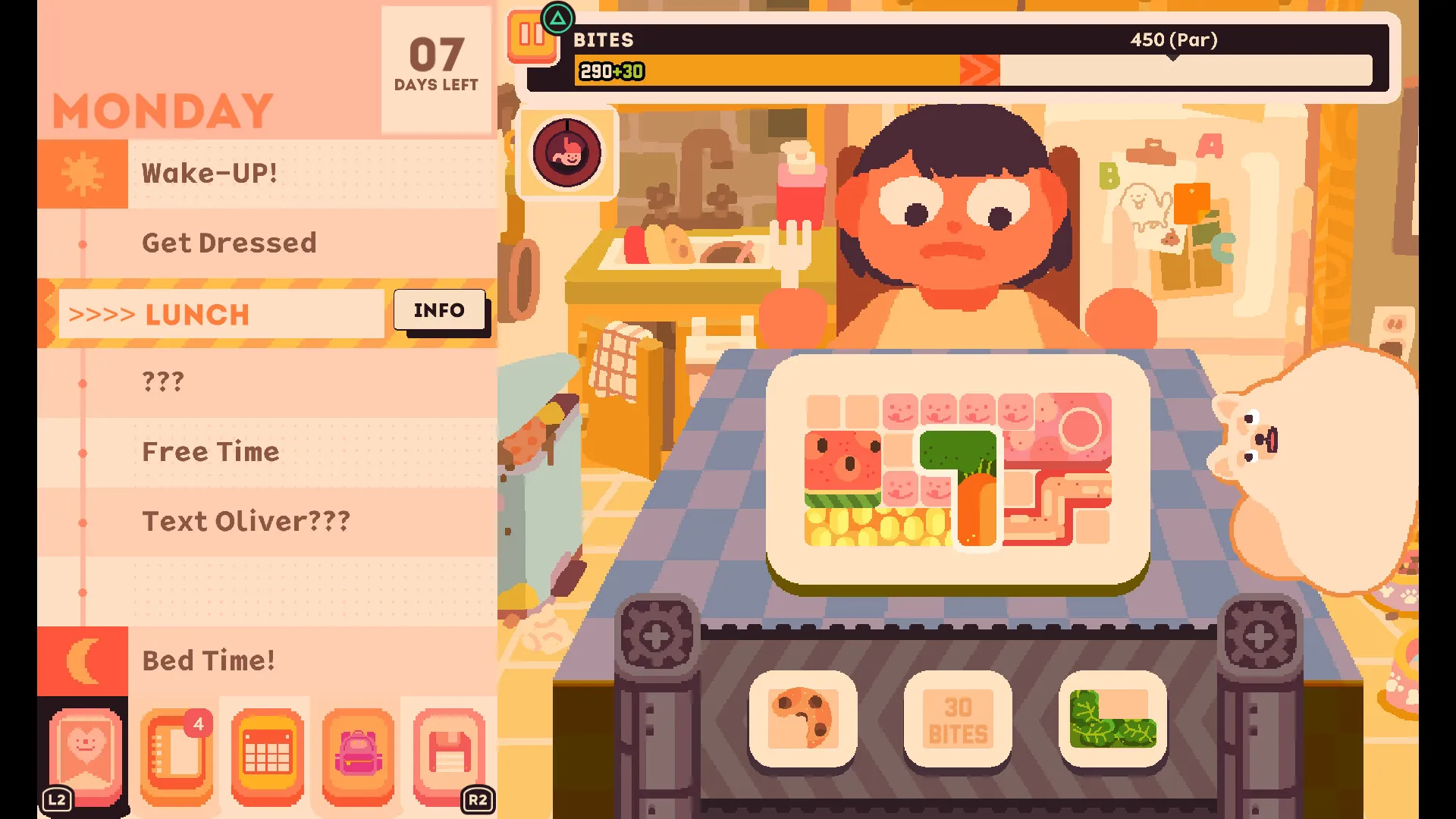
Rather than confronting players with clinical terminology, the game creates its own vocabulary. Daily food intake becomes measured in “bites” rather than calories, while weigh-ins deliver simple thumbs up or down verdicts instead of numerical judgments. These design choices demonstrate a careful consideration for player wellbeing while preserving the emotional authenticity of Jenny’s experience. The art style strikes a deliberate balance between charm and chaos, using bright colors and playful animations to make difficult themes more approachable without diminishing their impact.
Systems of Struggle and Growth
The mechanical foundation of Consume Me revolves around a deceptively complex web of interconnected systems that mirror the overwhelming nature of adolescent responsibility. Players must manage Jenny’s Joy, Energy, and Guts statistics while adhering to daily bite limits and completing weekly objectives. This RPG-inspired approach transforms abstract emotional states into tangible gameplay elements, making Jenny’s internal struggles externally visible and mechanically relevant.
Each day grants Jenny limited Free Time slots, forcing players into the same impossible calculations that define her mindset. Exceeding your bite allocation means sacrificing precious time for exercise, while neglecting social obligations can tank your mood and make other activities more difficult. The weekly goal structure adds another layer of pressure, with mandatory dieting objectives sitting alongside academic requirements, social expectations, and family responsibilities.
The minigames themselves deserve particular attention for how they translate abstract concepts into concrete interactions. The meal planning system uses Tetris-like mechanics where oddly-shaped food blocks must cover hunger zones on Jenny’s plate. This seemingly simple puzzle becomes a exercise in rationalization, as players learn to manipulate portions and food choices to meet arbitrary restrictions. The exercise minigame employs physics-based controls that make Jenny’s body feel awkward and unwieldy, her limbs flopping toward targets in ways that capture the disconnect many feel with their physical selves.
Study sessions require rotating Jenny’s head to focus on books while avoiding distraction clouds, a mechanic that perfectly encapsulates the mental effort required to concentrate when your mind is preoccupied with body image concerns. Even mundane activities like applying makeup or walking the dog become mini-challenges with their own risk-reward calculations.
The progression system adds strategic depth through outfit selection and skill development. Different clothing combinations provide mechanical benefits for specific activities, while leveling up abilities can unlock combinations like studying while exercising. These systems create a metagame around optimization that reflects how eating disorders can transform every daily decision into a calculation of efficiency and control.
Visual Poetry and Emotional Resonance
The artistic presentation of Consume Me operates on multiple levels, using visual metaphors and character animation to communicate emotional states that dialogue alone couldn’t convey. Jenny’s relationship with her reflection serves as both narrative device and mechanical interface, with her mirror image representing the harsh internal voice that drives her destructive behaviors. These conversations between Jenny and her reflection feel authentic to the experience of negative self-talk, avoiding clinical exposition in favor of recognizable internal dialogue.
The character animations embrace intentional clumsiness that makes Jenny feel genuinely teenage. Her movements during exercise routines appear awkward and uncoordinated, while her reactions to stress manifest as literal visual metaphors like melting into the couch or sudden bursts into tears. These choices avoid the polished perfection common in most games, instead capturing the genuine awkwardness of adolescence.
Family dynamics receive careful attention through both dialogue and environmental storytelling. Jenny’s mother appears as a complex figure whose well-intentioned comments reveal the cultural and generational pressures that fuel eating disorders. The romance subplot integrates naturally into the broader narrative, showing how external validation becomes entangled with self-worth in ways that feel specific to teenage experience.
The epilogue’s meta-textual elements represent perhaps the game’s most ambitious narrative choice. When Jenny becomes a game developer working on the very experience we’ve been playing, the story shifts into reflection mode. The art style becomes deliberately more primitive during these sequences, suggesting earlier development iterations while the mechanical systems fade away. This transition from rigid structure to creative freedom serves as both narrative resolution and commentary on the development process itself.
The 90s-influenced chiptune soundtrack amplifies the chaotic energy of Jenny’s daily routine while the sound design makes each minigame feel satisfying to complete. These audio choices create a sense of nostalgic familiarity that helps ground players in Jenny’s specific cultural moment while maintaining the timeless aspects of her struggle.
Meaningful Choices Within Constrained Systems
Consume Me succeeds most notably in how it uses mechanical constraints to generate empathy. The difficulty balance proves surprisingly generous in most chapters, allowing dedicated players to meet Jenny’s goals through careful planning and resource management. This accessibility serves the narrative by preventing mechanical frustration from overshadowing emotional engagement, though some players may find the lack of failure states diminishes the sense of genuine struggle.
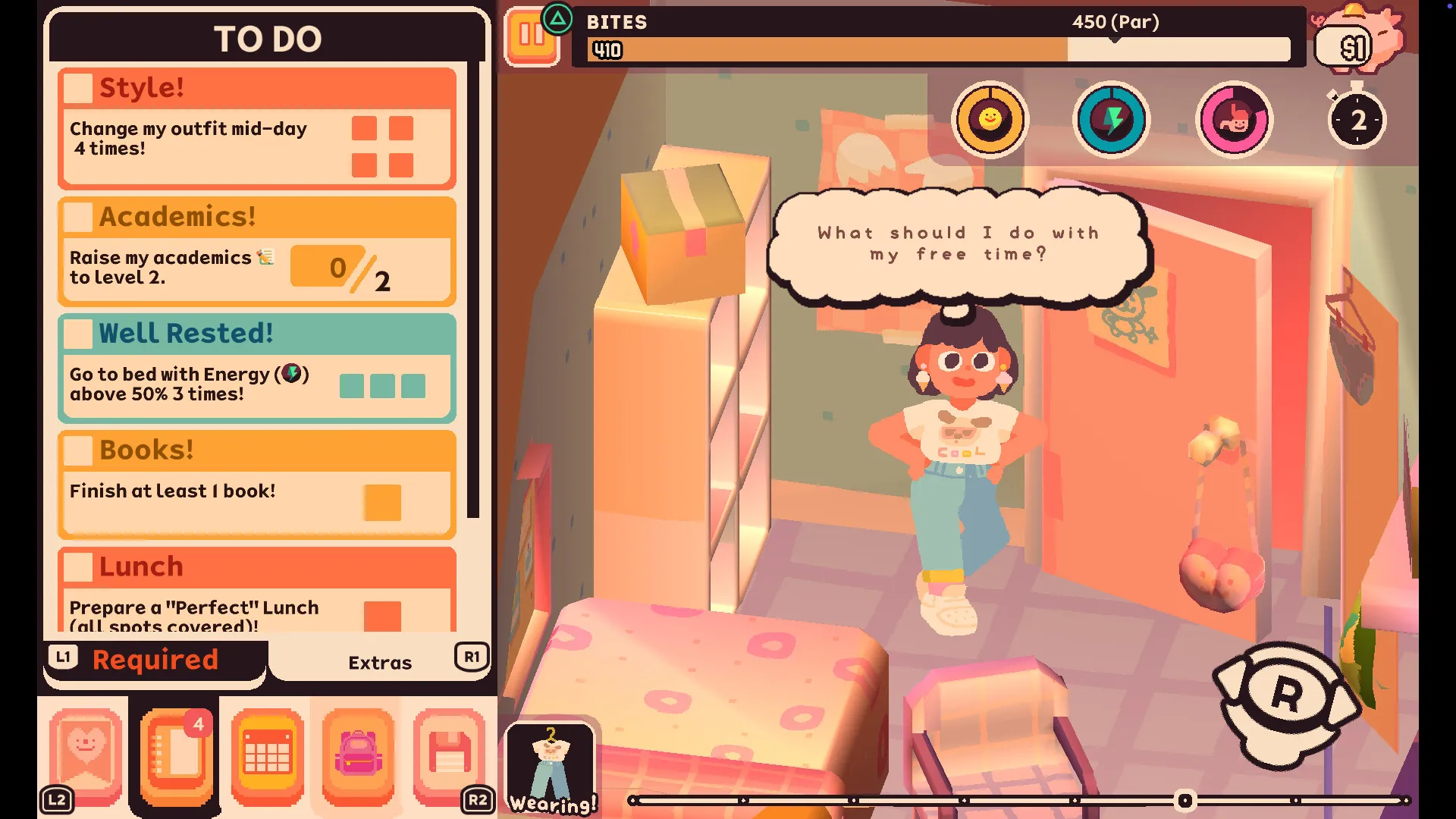
The game’s approach to player choice operates within deliberately narrow parameters that reflect Jenny’s limited agency within her circumstances. While players can choose which optional goals to pursue or how to spend Free Time, the core dieting objective remains non-negotiable. This design mirrors how eating disorders create the illusion of control while actually restricting genuine choice.
The 5-6 hour runtime feels appropriately paced for the emotional weight of the material. Each chapter introduces new complications that prevent the mechanical loop from becoming repetitive, while the episodic structure allows for natural stopping points that respect player emotional bandwidth. The game recognizes that interactive experiences dealing with mental health require different pacing considerations than traditional entertainment.
Where Consume Me faces its greatest challenge is in how it resolves Jenny’s journey. The ending suggests recovery through a somewhat abrupt narrative shift that may feel unsatisfying to players expecting more explicit confrontation with the disorder’s consequences. Some may find that the game’s relatively forgiving mechanics don’t fully capture the destructive potential of the behaviors it depicts.
This creates a work that functions better as empathy-building exercise than cautionary tale. Players who have experienced similar struggles will likely find profound recognition in Jenny’s story, while those without direct experience gain insight into thought patterns and pressures they might not have previously understood. The game’s innovation lies in its ability to make internal experiences external and interactive, creating a form of digital empathy that few games have attempted with such care and specificity.
Consume Me represents a significant achievement in narrative design that uses every aspect of the interactive medium to create understanding. While its approach to resolution may leave some questions unanswered, its commitment to authentic portrayal of adolescent struggle makes it essential playing for anyone interested in games as vehicles for personal storytelling.
The Review
Consume Me
Consume Me transforms personal trauma into interactive empathy with remarkable skill. The mechanical systems perfectly mirror the psychological constraints of eating disorders, while the charming art style makes difficult themes accessible without diminishing their impact. Though the resolution feels somewhat abrupt and the difficulty may be too forgiving for some, this semi-autobiographical experience succeeds brilliantly as both innovative storytelling and emotional education.
PROS
- Innovative mechanics that create genuine empathy
- Authentic semi-autobiographical storytelling
- Thoughtful approach to sensitive subject matter
- Charming art style that balances darkness with accessibility
- Clever minigames that serve narrative purposes
CONS
- Resolution feels somewhat rushed
- Difficulty balance may be too easy for some
- Limited replay value
- Some may find the subject matter triggering despite warnings