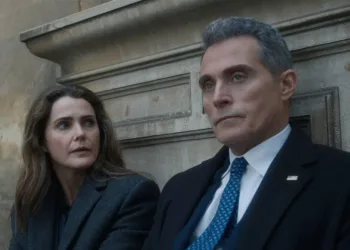
















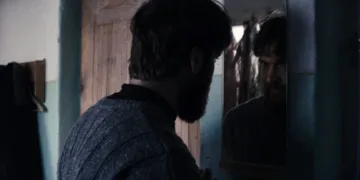
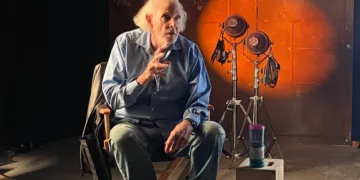











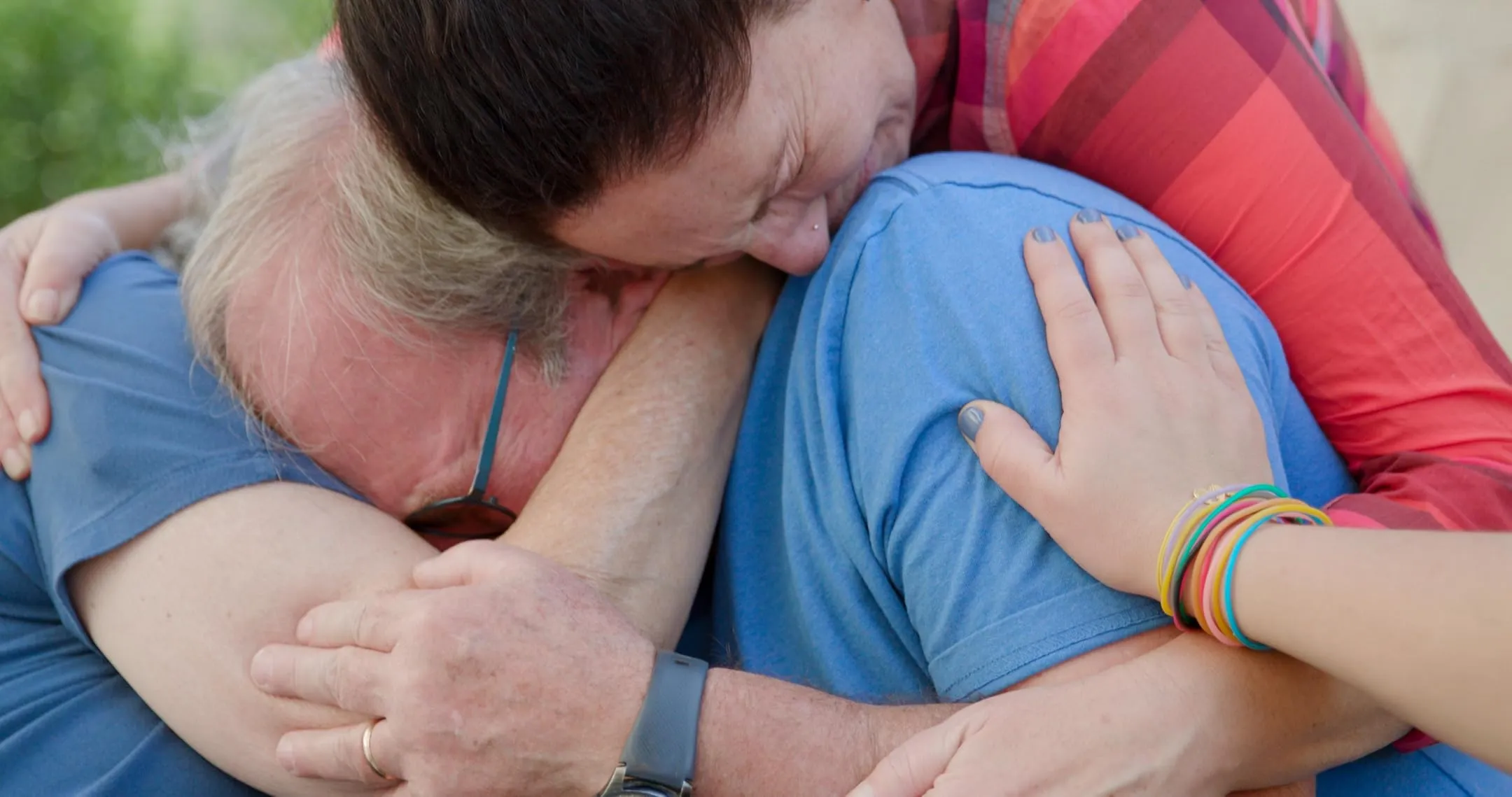
The ordinary world is a thin membrane, stretched taut over a void of unnameable possibilities. We live our days assuming its integrity, until a single moment of violence punctures the surface and the abyss rushes in. Such a perforation occurred on October 7th. Brandon Kramer’s documentary, Holding Liat, resides within that puncture, examining the lives of those pulled through the tear.
It is less a report on an event and more a meditation on the texture of its aftermath. For the elderly parents of Liat Beinin Atzili, Yehuda and Chaya, time itself is fractured. Their home is no longer a sanctuary but a waiting room suspended between hope and dread. The film observes this new state of being, where the familiar architecture of a life now frames an unbearable absence, and every moment is a negotiation with a silence that threatens to become permanent.
The Agony of a Borrowed Voice
In the political sphere, personal tragedy is a raw material to be refined into fuel. Yehuda Beinin discovers this truth with a slow, dawning horror. He is not, we quickly learn, a man of simple sentiment. His identity is built upon a lifetime of liberal conviction, a worldview symbolized by a Bernie Sanders sticker, now starkly out of place in a world demanding absolute loyalties.
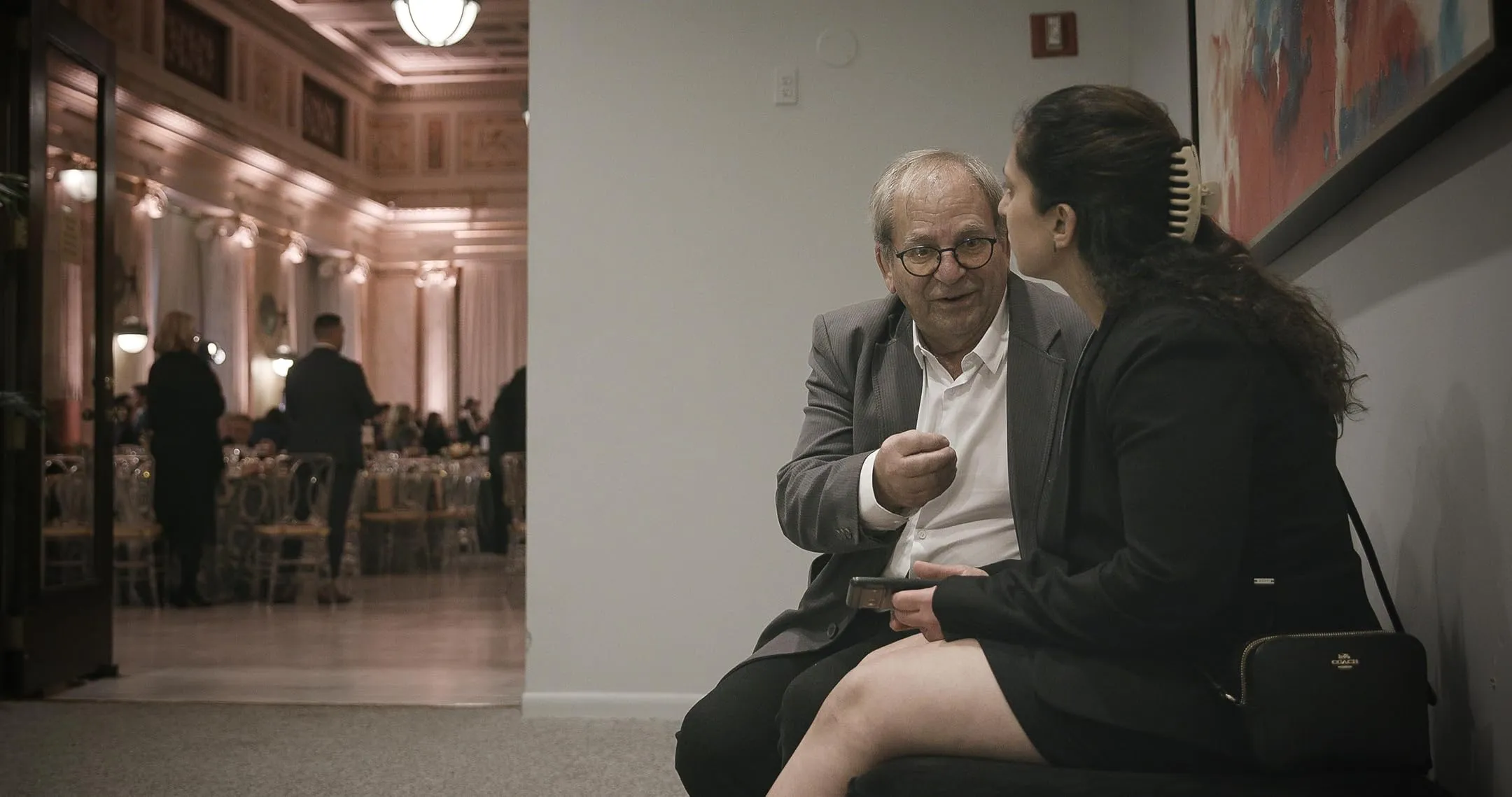
His journey to America to lobby for his daughter’s release is not a pilgrimage toward hope but a descent into a disorienting performance. He is asked to become a living embodiment of Israeli suffering, a curated icon of pain for senators and news cameras. His own nuanced thoughts, his deep-seated opposition to the Netanyahu government, and his acknowledgements of Palestinian history are treated as inconvenient deviations from the script.
He must hollow himself out, allowing his grief to be poured into a vessel shaped by a hawkish agenda he abhors. This dissonance is the film’s philosophical core. We watch a man struggling to retain his soul while his image is co-opted. In the sterile corridors of power, his anguish is a currency, and he is appalled by the transaction. A brief, whispered exchange with a Palestinian advocate becomes the film’s most authentic moment, a fleeting recognition of shared loss in a landscape of calculated rhetoric before the walls of identity and politics slide back into place.
Shattered Prisms
A single cataclysm refracts through a family, casting a spectrum of irreconcilable responses. The Beinin household becomes a microcosm of a society at war with its own conscience. The film patiently maps this internal geometry of grief, where every member occupies a different, lonely point. Liat’s son Netta, having survived the attack, embodies a pure, primal rage.

His desire for vengeance is an attempt to impose a brutal, simple order upon an experience that has shattered all meaning. His anger is a shield against the complexities his grandfather insists on confronting. Yehuda’s intellectualism, his need to place the horror within a historical and political framework, isolates him. His arguments with his wife Chaya reveal the chasm between the need to understand and the simple, crushing need to endure.
For her, his political analysis is a distraction from the singular, agonizing focus of their daughter’s absence. The arrival of Yehuda’s brother Joel, a historian, introduces another layer of cold reality. His academic perspective sees the current tragedy as an inevitable outcome of a longer, darker history, viewing the kibbutz itself as a settlement on stolen land. This viewpoint offers a kind of truth but denies all comfort, framing human lives as subject to vast, impersonal forces and challenging the very foundations of Yehuda’s liberal humanism.
The Burden of Seeing
The film denies its audience the catharsis of a simple resolution. When news finally arrives, it is a hybrid of relief and desolation. Liat is to be freed, but her husband Aviv is dead. The ending is not an ending at all, but a reconfiguration of pain. The focus shifts to Liat, who returns from the void not as a fragile victim but as a clear-eyed witness.
She refuses the simple narrative offered to her, speaking of the strange humanity she found in her captors’ family, an observation that scrambles the neat categories of good and evil. Her perspective is a radical act of seeing, a refusal to un-see the humanity of the other. It is this burden of seeing that forms the film’s closing statement.
At Yad Vashem, a space dedicated to the structured memory of a past atrocity, Liat guides a tour. She speaks of the Warsaw Ghetto, of the smoke rising, visible to the city outside. The camera lingers, and the parallel hangs heavy and unspoken in the air. The film doesn’t offer a conclusion; it leaves us with an indictment of willed blindness, a quiet but devastating question about what we see from behind our own walls, and the moral cost of looking away.
Holding Liat is a 2025 American documentary film directed by Brandon Kramer. The film chronicles the ordeal of Liat Beinin Atzili and her family after she and her husband, Aviv Atzili, were kidnapped from their kibbutz during the October 7 attacks. It follows Liat’s parents, Yehuda and Chaya Beinin, as they deal with their fear, grief, and conflicting emotions while advocating for their daughter’s return. Produced by companies including Protozoa Pictures and Meridian Hill Pictures, the film had its world premiere at the 75th Berlin International Film Festival on February 16, 2025, where it won the Berlinale Documentary Film Award. It subsequently had its North American premiere at the Tribeca Festival on June 9, 2025.
Full Credits
Director: Brandon Kramer
Writers: Ra’anan Alexandrowicz, Carol Dysinger, Gordon Quinn
Producers: Lance Kramer, Darren Aronofsky, Ari Handel, Yoni Brook, Justin A. Gonçalves
Executive Producers: Elliott Joseph, Janine Frier, Alexandra Shiva, Ted Haddock, Albert Wenger, Gigi Danziger, Sarena Snider
Cast: Liat Beinin Atzili, Yehuda Beinin, Chaya Beinin, Tal Beinin, Netta Atzili, Joel Beinin, Aviv Atzili
Director of Photography (Cinematographer): Yoni Brook, Omer Manor
Editors: Jeff Gilbert
Composer: Jordan Dykstra
The Review
Holding Liat
Holding Liat is an essential, disquieting work. It forgoes easy political statements to explore something more fundamental: the anatomy of grief in a world that demands allegiance. The film is a raw, philosophically dense portrait of a family, and a nation, arguing with its own soul. It offers no solace, only the profound and necessary burden of seeing complexity where we crave simplicity. It is a document of profound moral and emotional weight, demanding to be witnessed.
PROS
- An intimate and unflinching look at a family's ordeal.
- Examines the difficult intersection of personal grief and political mechanization.
- Presents a multifaceted view of Israeli perspectives.
- Intellectually rigorous and emotionally affecting.
CONS
- Its tight focus on one family necessarily limits the broader scope.
- The observational style may feel unresolved to some viewers.
- The subject matter is emotionally demanding and bleak.