

























![Kingdom Hearts Collection [I-III] Review](https://gazettely.com/wp-content/uploads/2026/10/Kingdom-Hearts-Collection-I-III-1-360x180.webp "Kingdom Hearts Collection [I-III] Review: KHII Holds Steady as Newer Entries Fluctuate 37")





Forty consecutive dates should make a city feel crowded; here, Houston keeps shrinking around one man. Andy Delaney’s 40 Dates and 40 Nights, written by Sarah Howard, accepts romantic comedy formula with almost touching obedience. Leah, played by Bailee Madison, is broke, unlucky in love, and newly abandoned by a roommate whose exit leaves the rent sitting in the room like a second landlord.
Her grandmother Gigi, played by Annie Potts, offers help through an eccentric bargain: Leah must go on forty dates in forty days, abstain from any “hanky-panky,” and prove that she has at least tried to find love before Gigi covers a year of rent.
The wager has the shape of comic abundance. It suggests a carousel of incompatible men, a social map of app-era loneliness, and a heroine forced to recognize her own patterns through repetition. The film prefers a gentler mission. It wants the comfort of inevitability, with just enough embarrassment to keep the machine humming. The result is pleasant, sometimes funny, and often far too careful for a premise built on romantic chaos.
Public Shame as Meet-Cute
The film’s sharpest instinct arrives early, before the bet begins. Leah is on a video call with her best friend Bianca when her latest hookup wanders into view and informs her, with catastrophic calm, that she is a “solid six” and that his condom snapped. The insult and the emergency belong to the same breath. It is a neat introduction to Leah’s romantic weather: bad sex, worse candor, and the sort of morning that requires a pharmacy trip before breakfast has had a chance to become breakfast.
At the pharmacy, Leah tries to buy Baby Free, only for the staff to turn her private panic into a public announcement. The comedy is broad, but it has bite because the humiliation is specific. Leah is not embarrassed by desire itself; she is embarrassed by the bureaucratic loudspeaker of retail life, where everyone’s crisis becomes everyone’s business.
Mason, played by Joel Courtney, first appears here, noticing the scene and softening it by asking for extra-large condoms. It is a knowingly ridiculous gesture, but Courtney plays it with enough relaxed tact that Mason seems less like a punchline and closer to a man who understands that embarrassment sometimes needs company.
Madison carries this opening beautifully. She does not turn Leah into a manic rom-com cyclone. Her deadpan timing gives the character a self-protective dryness, especially when she absorbs the hookup’s insult or tries to disappear under pharmacy fluorescent lights. The performance gives the scene a human temperature the writing cannot always sustain.
The Wager That Runs Out of Men
Gigi’s bet is meant to be meddling with a grandmotherly glow, and Potts sells the affection even when the premise creaks. Leah needs money. Gigi wants Leah to find love. The contract between them exists because the movie needs an engine, and the script does not hide the gears very well. Since Gigi appears willing to help Leah regardless, the financial stakes soften almost immediately. What remains is a dating challenge with rules, but few consequences.
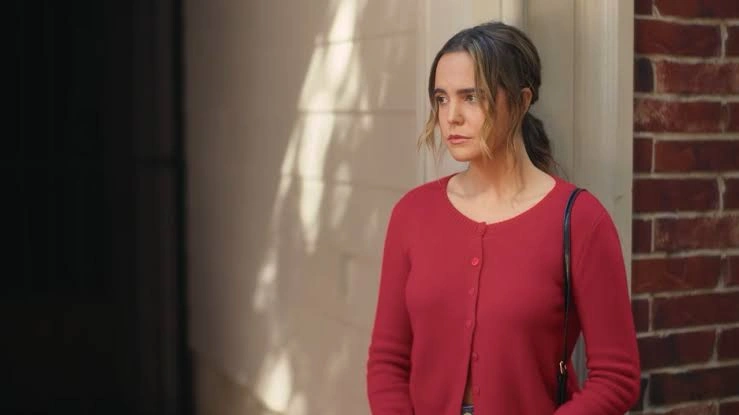
The “no hanky-panky” clause is one of the film’s stranger signals. After opening with contraception, casual sex, and a woman calling out a man’s assumptions about her sex life, the movie retreats into an oddly chaste structure where intimacy becomes something to police. It is not puritanical in any severe sense. It is simply cautious, as if the film wants the spark of sexual frankness without the disorder that might follow from it.
The larger disappointment is the dating montage itself. A forty-date premise should be an invitation to invention, a chance to make each encounter reveal a new absurdity in courtship. The film gives Leah men who eat spaghetti with alarming force, sniff her, drown conversation in ex-wife whiskey, panic over appetizer prices, or turn cat photos into a personality. One date takes her to a church and tries to marry her immediately, which is the rare gag with genuine lunacy. Too many others feel like sketches abandoned after the first trait.
Steven, the waiter at Lymbar played by Jai Rodriguez, helps the rhythm. He watches, refills, comments, and occasionally rescues the evening from silence. Rodriguez understands the social function of a good supporting rom-com character: he gives the protagonist an audience without stealing the room. Still, the restaurant starts to feel less like a comic arena than a holding pen for underdeveloped bits.
The Man Houston Keeps Returning
Mason’s recurrence becomes the film’s true structure. He meets Leah at the pharmacy, appears again as date number twenty, runs into her at a bar after their bad dinner, collides with her at a bookstore while standing near her old high school bully, then arrives at her workplace to pitch the toy company where she works. Houston, under this screenplay’s supervision, has the population density of a family dinner.
Romantic comedy lives on coincidence, but coincidence needs texture. In classic form, chance gives characters one opening; choices reveal what they do with it. Here, chance keeps doing the labor long after Leah and Mason could simply exchange numbers.
Their bookstore encounter hints at a sweeter film, since they discover a shared interest in manga, but the idea barely has time to breathe before the plot moves on. Their workplace scene works better. Leah helps Mason prepare for his pitch by removing his tie, a small physical gesture that carries what several pages of banter do not: trust, attention, and the beginning of ease.
The enemies-to-lovers machinery is less persuasive. Leah cuts their blind date short because Mason remembers the pharmacy embarrassment, and their friction grows through snark, spilled drinks, defensive pride, and the usual refusal to admit what the audience recognized upon his second appearance. The trouble is not predictability. Predictability can be a rom-com virtue when the steps have personality. The trouble is that Mason has no serious romantic flaw. He is charming, sarcastic, available, and conveniently employed by the plot.
Joel Courtney makes him warmer than the page might suggest. He keeps Mason’s teasing from hardening into smugness, especially during the blind date and the after-work drink that follows his pitch. Across from Madison, his timing has a soft bounce. Their chemistry does not reinvent the genre, but it gives the film a pulse. When Leah resists his romantic advance because accepting it might violate Gigi’s deal, the obstacle feels imposed from outside the characters. The film has to keep them apart because the calendar has pages left.
Jackson, date number twenty-seven, briefly threatens to become a real alternative. He enters with champagne, polish, and the visual confidence of a man designed to irritate the male lead by existing. Then the script lets him fade. His later appearances near Leah and Mason suggest triangulation, but the film lacks the appetite for mess. Jackson is less a romantic rival than a reminder of the sharper structure the movie declined.
Charm Against Formula
The cast keeps 40 Dates and 40 Nights buoyant across stretches where the writing is content to circle familiar territory. Madison is the essential reason Leah remains appealing. Watch how she handles embarrassment in three registers: the pharmacy scene is mortification, the Mason date is defensive irritation, and the later scenes with him carry the nervous pleasure of someone realizing her sarcasm has stopped protecting her. She gives Leah a continuity the screenplay sometimes forgets to provide.
Courtney matches her without flattening her. He lets Mason be amused by Leah without treating her as a puzzle to solve, which matters in a genre that often mistakes male patience for emotional depth. Potts brings Gigi a familiar warmth, and the familiarity is part of the point. She can make a manipulative premise feel like a grandmother’s overdecorated act of care. Luxy Banner’s Bianca has less to do, mostly functioning as Leah’s complaint receiver, but she gives the early scenes a necessary social bounce.
Delaney’s direction is clean and bright, designed for ease rather than surprise. The film looks and moves like a streaming rom-com that knows exactly which shelf it will occupy. Its weakest recurring visual idea is Leah’s aerial silks practice, which seems intended to mirror her romantic persistence through awkward suspension, failed balance, and bodily risk. The metaphor sits there, visible and underfed. A stronger film would have made those attempts change with Leah’s self-understanding. This one returns to them as decoration with a thesis attached by string.
What remains is a romance with one excellent meet-cute, two compatible leads, and a premise that keeps promising comic range while narrowing itself toward the safest answer. The title offers forty nights of possibility. The film spends most of them waiting for Leah to catch up with the casting department.
The romantic comedy 40 Dates and 40 Nights made its debut in select boutique theaters via Brainstorm Media on June 26, 2026, with an official digital and premium video-on-demand release scheduled for June 30, 2026. Directed by Andy Delaney, the story centers on a burnt-out young romantic who accepts an outrageous financial challenge from her eccentric grandmother to endure forty consecutive dates in forty nights in exchange for a full year of rent. Audiences looking to watch the film can find it across major streaming rent-and-buy platforms, including Apple TV and Amazon Video.
Where to Watch 40 Dates and 40 Nights (2026) Online





Full Credits
Title: 40 Dates and 40 Nights
Distributor: Brainstorm Media
Release date: June 26, 2026 (United States Theatrical Release), June 30, 2026 (Digital and VOD Release)
Running time: 101 minutes
Director: Andy Delaney
Writers: Sarah Howard
Producers and Executive Producers: Randy Wayne, Bailee Madison, Talia Bella, John Atamian, Kimberly Hines, Larry Hines, Michael J. Luisi
Cast: Bailee Madison, Joel Courtney, Annie Potts, Jai Rodriguez, Jack Schumacher, Eric Nelsen, Bethany Geaber, Mia Challis, Sterling Knight, Mark Hapka, Jennifer Griffin
Director of Photography (Cinematographer): Eric Zimmerman
Editors: Sandra Adair
Composer: Luke Branch, Jennifer O’Neil
The Review
40 Dates and 40 Nights
40 Dates and 40 Nights treats modern dating less as social chaos than as a conveyor belt of mild humiliations, and the film’s caution keeps biting into its own premise. The 40-date wager promises comic abundance, then gives most of its men the weight of calendar entries. Still, Bailee Madison and Joel Courtney make the central pairing warmer than the machinery around them, while Annie Potts and Jai Rodriguez keep the edges pleasant. It is thin, familiar, and watchable.
PROS
- Bailee Madison’s deadpan comic timing
- Warm chemistry with Joel Courtney
- Funny pharmacy meet-cute
- Jai Rodriguez’s steady support
- Annie Potts sells Gigi’s meddling
CONS
- 40-date premise feels underused
- Too many convenient Mason encounters
- Jackson subplot goes nowhere
- Thin enemies-to-lovers conflict
- Aerial silks metaphor lacks shape







