











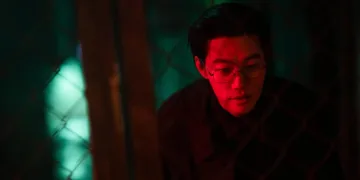

















Red ink has rarely looked this needy. Professor Heo Mun-oh grades his students’ writing with the wounded fury of a man who has mistaken bitterness for taste, and Notes from the Last Row knows exactly how funny that is before it lets the joke curdle. The series, directed by Kim Gyu-tae and written by Jang Myung-woo, turns a university writing class into a psychological trap where every assignment sounds like evidence and every compliment has a hook under it.
Mun-oh, played by Choi Min-sik, is a failed novelist who treats his students like an insult delivered in bulk. When a student objects to him calling her work “trash,” he doubles down, which is terrible teaching and very efficient character writing.
His own creative wound sits elsewhere: a flashback shows his old friend Kim Su-hun refusing to write a testimonial for Mun-oh’s novel, then making the kind of dismissive remark that can freeze a career for twenty years. Mun-oh has been teaching literature since then, or punishing literature for not loving him back. Then Lee Kang sits in the last row and hands him a reason to feel alive again. Dangerous sentence, that.
The Student Who Knows the Room
Kang first catches Mun-oh’s attention by correcting him during a discussion of Goethe’s The Sorrows of Young Werther, which is a bold move in any class and a slightly suicidal one in this class. Soon Mun-oh is reading Kang’s assignments after hours with the focus of a man discovering oxygen. The writing follows Kang’s deliberate approach to Kim Se-yun, a wealthy classmate whose life Kang studies with unsettling care.
Kang does not stumble into Se-yun’s world. He builds a route. He enrolls in the same courses, offers coding help, gets invited home, meets the family, and starts turning their private life into prose. The show’s sharpest discomfort comes from the way it makes literary talent feel like trespassing. Kang’s sentences do not simply describe Se-yun’s house; they enter it.
The bedroom scene is the clearest warning. Kang wanders through the house, ends up in Se-yun’s parents’ room, and is caught looking at Eun-joo’s lingerie. He claims embarrassment, and maybe he feels some. He also keeps writing. That is the Kang problem in miniature: every shame becomes material, every boundary becomes a draft. Mun-oh sees danger, then keeps asking for the next chapter. Professors, famously, love a deadline.
Also Read





Mentorship With a Body Count Pending
The relationship between Mun-oh and Kang works because neither man is cleanly in charge. Mun-oh thinks he is shaping a young writer. Kang seems to understand, almost from the start, that Mun-oh can be led by flattery, withheld pages, and the promise of reflected genius. When Mun-oh offers to pay Kang the equivalent of his part-time wages so he can attend private writing sessions, the mentorship has already gone rancid.

The stolen coding paper is the series’ best comic-thriller set piece. Kang wants access to the questions so he can keep tutoring Se-yun and remain inside the family. Mun-oh discovers the papers can be reached through Park Hyung-jong’s computer. He fakes a heart attack, sends his friend running for medication, copies the file, and escapes into his office laughing with joy.
Choi Min-sik plays the laugh beautifully: not evil mastermind laughter, closer to a middle-aged man realizing he still has a pulse and that the pulse is humiliating. What makes the act sting is not the cheating itself. It is Mun-oh’s exhilaration. Kang has not corrupted a moral giant; he has handed a bored failure an errand and called it destiny.
Family Drama as Literary Bait
Once Kang moves closer to Se-yun’s family, Notes from the Last Row shifts into a class thriller with soapier plumbing. Kang tells the family about his mother leaving when he was eight, his father’s accident, his father’s dementia, and the nursing home bills he pays while studying. The scene is effective because the show refuses to certify it as confession or performance. The Kims pity him. Kang notices the pity working.
The housemaid Min-hui becomes a threat because she sees the hierarchy Kang is trying to climb. Their shared outsider status does not create solidarity; it creates competition. Kang plants Eun-joo’s expensive scarf in Min-hui’s bag, nudging the family into suspicion. Then the story swerves again: Se-yun’s father is having an affair with Min-hui, and he is revealed to be Kim Su-hun, Mun-oh’s old literary rival.
That twist is tidy in the best way, for a while. Kang’s manuscript is no longer just a story about envy inside a rich home. It is a weapon pointed at the man who once broke Mun-oh’s confidence. Mun-oh wanted a student. What he gets is revenge with footnotes.
Actors in a Slow Trap
Choi Min-sik gives the series its damaged engine. His Mun-oh is arrogant in public, brittle at home, thrilled by bad behavior, and foolish enough to confuse obsession with purpose. Watch him in the classroom, where every insult sounds rehearsed, then in the private sessions with Kang, where he looks younger because he has something to crave. It is a performance built from tiny moral leaks.
Choi Hyun-wook plays Kang with a stillness that keeps moving the target. He rarely lets a reaction finish where expected. A polite answer can feel like bait; a vulnerable story can sound rehearsed; a blank stare can read as either trauma or calculation.
Jin Kyung brings a sadder counterweight as Jo Hyun-suk, Mun-oh’s therapist wife, whose long-dormant marriage gets disturbed by Kang’s presence. When Kang asks about Mun-oh’s first novel and the woman behind it, the question slips into the house like smoke.
The six-episode shape suits the slow burn until the final hour starts tidying the room too loudly. Kang’s motivation gets explained with less elegance than his earlier assignments suggested, and Hyun-suk’s late trajectory asks for a little too much patience from a show that had been so good at making patience feel dangerous. Still, the damage has already been done, and the best scenes keep their poison. In this class, the homework is never late. It is lying in wait.
The South Korean psychological suspense drama series Notes from the Last Row premiered globally on Netflix on June 26, 2026, offering a thrilling six-episode season available entirely on the platform. The story follows a disillusioned, failed novelist turned literature professor who discovers the brilliant writing of a quiet engineering student and becomes dangerously obsessed with mentoring him.
Where to Watch Notes from the Last Row Online


Full Credits
Title: Notes from the Last Row
Distributor: Netflix
Release date: June 26, 2026
Rating: TV-MA
Running time: 60 minutes per episode
Director: Kim Kyu-tae
Writers: Jang Myung-woo
Producers and Executive Producers: Kakao Entertainment, GTist
Cast: Choi Min-sik, Choi Hyun-wook, Huh Joon-ho, Yunjin Kim, Jin Kyung, Han Ji-eun, Lee Jin-woo, Jo Han-chul
Director of Photography (Cinematographer): Kim Chun-seok
Editors: Kim Sun-min
Composer: Mowg
The Review
Notes from the Last Row
Notes from the Last Row turns a writing seminar into a moral trap, and Choi Min-sik makes every bad decision look both pathetic and weirdly invigorating. Its best episodes let Kang’s assignments infect Mun-oh’s life one chapter at a time, with the stolen coding paper as the deliciously stupid point of no return. The finale talks too much, and a few suspicion cycles repeat like a professor stalling after the bell. Still, the mind games bite hard.
PROS
- Choi Min-sik’s prickly performance
- Kang’s unreadable manipulation
- Strong mentor-student tension
- Clever Su-hun reveal
- Class envy with teeth
CONS
- Exposition-heavy finale
- Some repeated suspicion beats
- Hyun-suk’s arc feels convenient
- Slower stretches drag