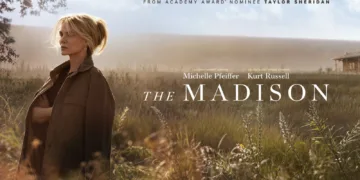



























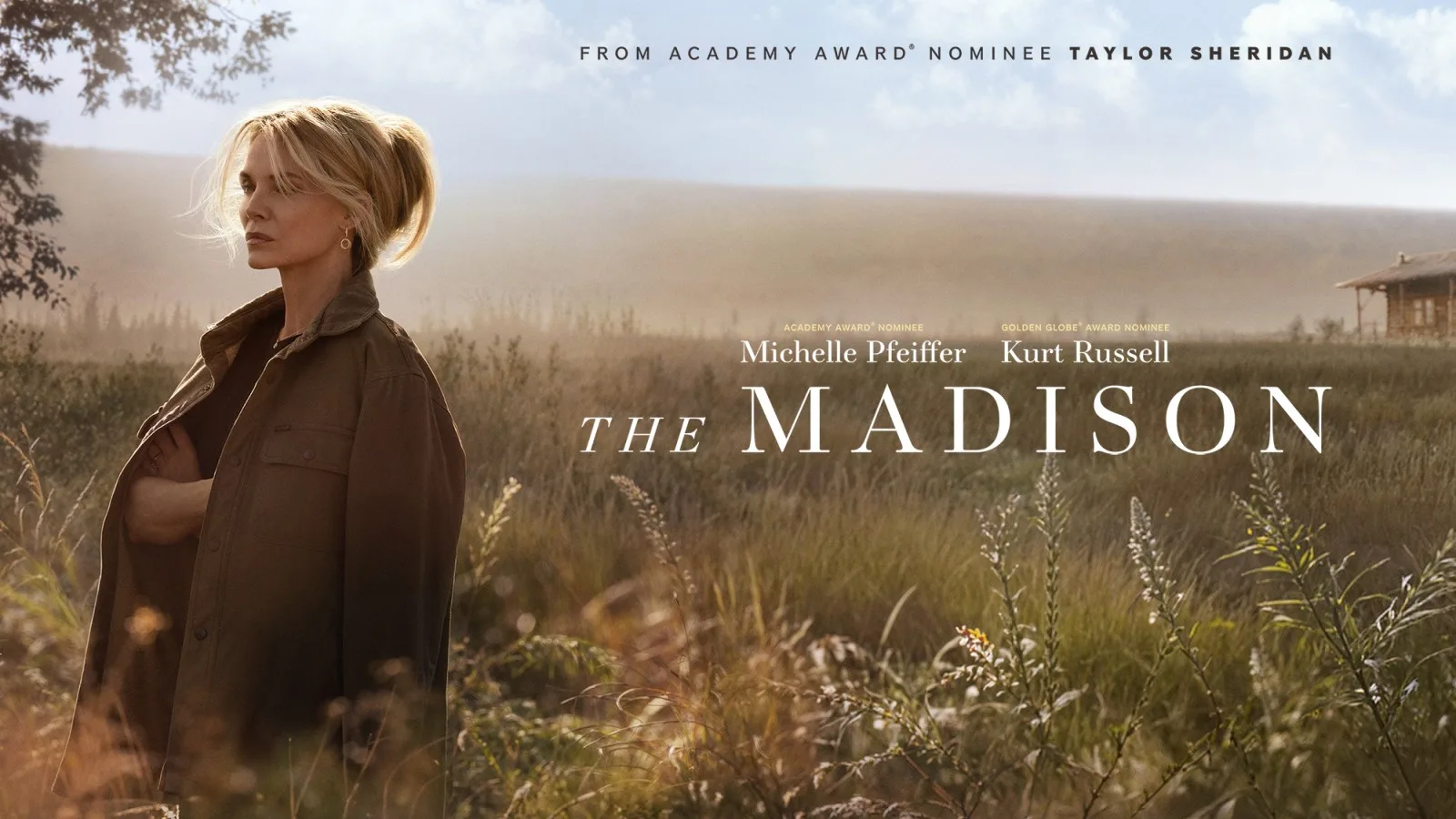

Taylor Sheridan has built a television empire on wide skies, stoic men, and the mythology of the American West. From his early screenwriting work on Sicario and Hell or High Water through the sprawling Yellowstone franchise, his name carries a specific set of expectations: rugged terrain, moral certainty, and the particular romance of frontier life. The Madison, a thirteen-episode Paramount+ series, arrives carrying all of those associations and then quietly sets most of them aside.
Originally conceived as a Yellowstone spin-off, the series found its own identity before a single frame was shot, repositioning itself as a stand-alone family drama centred on the Clyburns, a wealthy Manhattan family forced by tragedy to spend time on a remote property in Montana’s Madison River Valley. Sheridan created the show and wrote key episodes, but the series is shaped equally by Christina Alexandra Voros, who directs and photographs all thirteen episodes. What distinguishes The Madison from its predecessors is its register: grief-driven, intimate, and deliberately still. The frontier here is emotional, not geographical.
A Pressure Cooker Set to Simmer
The Clyburn family exists in two separate orbits. Preston (Kurt Russell) and his younger brother Paul (Matthew Fox) are rooted in Montana, bonded by fishing, silence, and a shared rejection of the urban machinery that funds their extended family’s life. Back in Manhattan, Preston’s wife Stacy (Michelle Pfeiffer) and their adult daughters Abigail (Beau Garrett) and Paige (Elle Chapman) move through a world of fine restaurants, charity functions, and the ambient noise of a city that never quite stops performing. A family tragedy collapses the distance between these worlds and deposits the entire Clyburn family on Montana soil, many of them for the first time.
The series moves between present-day Montana and flashbacks to life in New York, and this structural contrast is the engine driving the storytelling. The flashbacks do more than fill in backstory; they show the texture of a life built for appearance rather than meaning, making the emotional fractures visible long before the characters themselves acknowledge them. The juxtaposition is deliberate and Sheridan leans into it with conviction, even when it tips toward caricature.
By Sheridan’s standards, The Madison is a slow burn. There are no gunfights, no criminal empires, and very little of the testosterone-fuelled standoffs that made Yellowstone appointment viewing for millions. The show asks audiences to sit with discomfort, to watch people process grief badly and incrementally improve. The thirteen-episode run gives the story room to breathe, and the additional episodes allow certain emotional payoffs to land with proper weight, though the middle stretch occasionally loses momentum as revelations find their rhythm. The personal grief story keeps the show’s political undercurrents from swallowing the drama whole.
The Weight They Carry
Taylor Sheridan wrote the role of Stacy Clyburn specifically for Michelle Pfeiffer, and the series earns that origin story. Pfeiffer’s performance is the gravitational centre around which everything else orbits. Stacy is a woman who built a life in the city because it suited her, and the Montana setting strips that conviction away episode by episode. Pfeiffer plays the dismantling of Stacy’s certainty with extraordinary precision: controlled and formidable in group confrontations, privately devastated in quieter scenes.
A sequence in which she reads from Preston’s journal, grief moving across her face in slow, restrained waves, is the kind of acting that reminds you how rare it is to see a screen actress given material this demanding and fully capable of meeting it. The question of why Pfeiffer is not routinely placed alongside Helen Mirren and Meryl Streep in conversations about the great performers of her generation is one The Madison raises implicitly with every scene she commands.
Kurt Russell’s Preston is a different kind of Sheridan protagonist. He has no villain to defeat, no land to defend, no empire at stake. He loves his wife, his brother, and a good trout stream, and Russell plays that simplicity without apology or irony. The reunion of Russell and Pfeiffer on screen, 37 years after Tequila Sunrise, carries a particular kind of movie-star warmth that television rarely manufactures. Their scenes together, including those conducted entirely by phone across a thousand miles, generate real heat.
Matthew Fox, largely absent from screens for some years, brings a lived-in quietness to Paul that makes him the show’s moral anchor. His scenes with Russell are among the season’s most understated and affecting.
The ensemble around them does the harder work of earning complexity from thinner material. Beau Garrett and Elle Chapman begin as recognisable Sheridan archetypes and the season gives both women room to grow into something less schematic. Patrick J. Adams as son-in-law Russell provides well-calibrated comic relief, playing a man who is earnest, occasionally hapless, and entirely sincere. The role looks slight on paper; Adams makes it land with real warmth. By the season’s end, every significant pairing in the ensemble has had a meaningful exchange, and the Clyburns register as a family rather than a collection of types.
What the Camera Knows
Christina Alexandra Voros directs and photographs all thirteen episodes of The Madison, and that decision shapes the series as profoundly as any writing choice. Visual consistency of this kind is rare in prestige television, where multiple directors typically produce tonal variation across a season. Here, the Montana sequences carry a sustained visual intelligence. Voros, who previously worked as director and cinematographer on Yellowstone and 1883, brings a depth of feeling to the landscape that goes well beyond scenic photography.
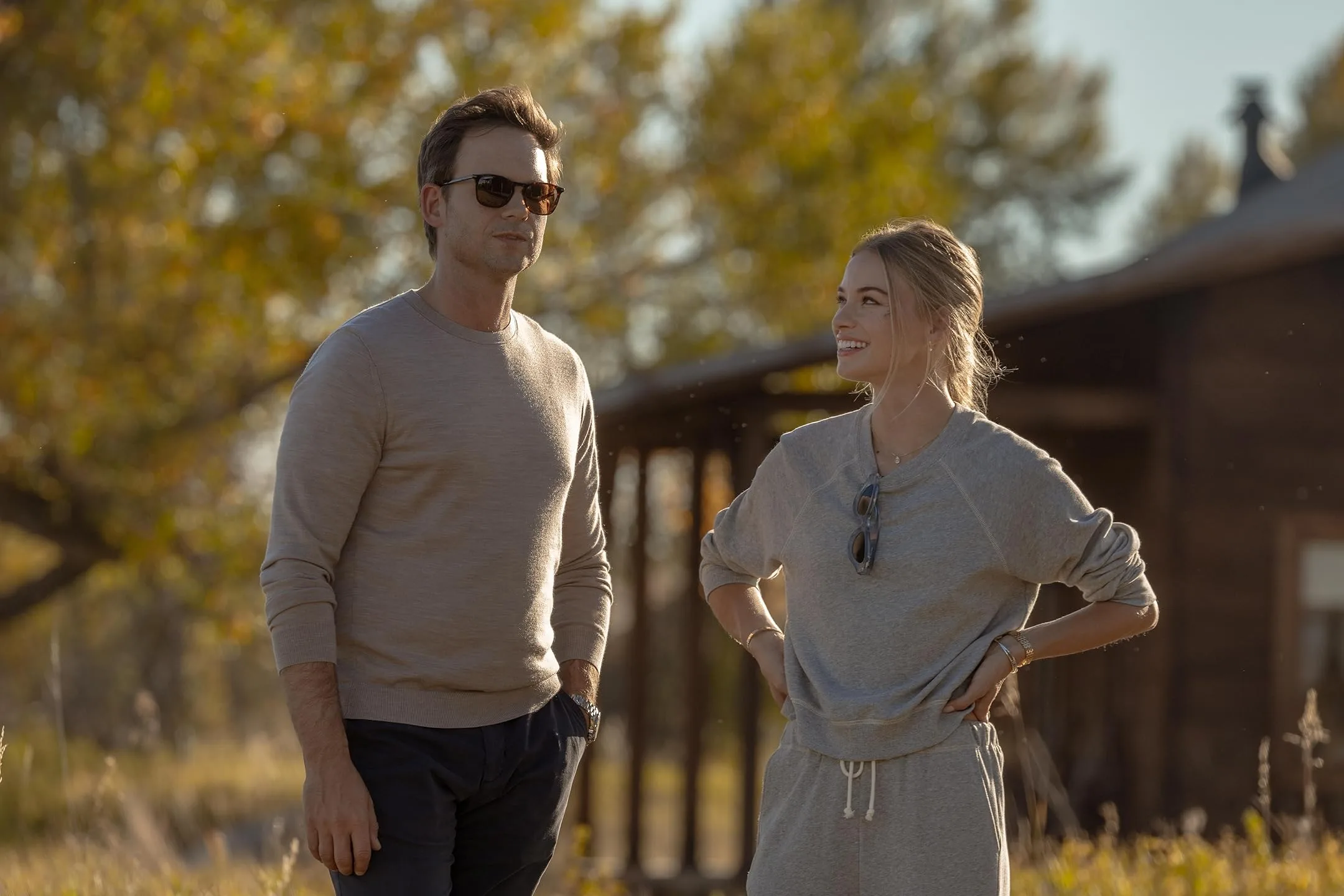
The Madison River Valley is treated as a living entity. Voros films sunrises, rushing water, bugling elk, and mountain ridgelines with patience and precision, holding shots long enough for the environment to register emotionally rather than simply visually. The sound design operates on the same principle: coffee percolating in a cabin, water moving over stones, wind bending through trees.
These sounds are set against the urban noise of the New York sequences, sirens and traffic and the general pressure of a city that never stops demanding attention. The contrast is built into the fabric of the production rather than imposed by the edit. Voros achieves something close to a Terrence Malick quality without any of the abstraction; the visuals remain emotionally legible throughout.
The New York sequences present a genuine limitation. Filmed in Dallas and Fort Worth standing in for Manhattan, the cityscape establishing shots carry a generic quality that the performances have to compensate for. The substitution is serviceable but unconvincing to anyone familiar with the real city. Voros is, by her own evident instincts, a filmmaker of wide spaces, and the series is at its most assured when the mountains are in frame.
The Wilderness as Mirror
The tragedy that initiates The Madison’s story is the show’s emotional fulcrum, and Sheridan structures the season around a single question: how do people process loss when they have spent years avoiding any experience that cannot be managed, curated, or escaped? The Clyburn women, raised in abundance and insulated from discomfort, find grief particularly foreign. Stacy’s arc is the most fully realised answer the show offers: she moves from controlled devastation toward the beginning of acceptance, and the Montana environment functions as the agent of that change. The land does not allow performance. It simply is, and eventually that plainness becomes its own kind of instruction.
The show represents a genuine shift in how Sheridan writes women. The Madison is majority female in its cast and shaped behind the camera by Voros, whose lens frames these women with attention and dignity rather than spectacle. Kurt Russell described the series as a “female gaze-oriented show,” and that description holds. The daughters and granddaughters begin as broad types, but the season gives them the kind of interiority that Sheridan’s other series have often withheld from female characters. Stacy’s confrontations with her children are the dramatic centrepiece of the season, and Pfeiffer plays them with a severity that never tips into melodrama.
The city-versus-wilderness binary is vintage Sheridan, but The Madison frames it as a psychological argument rather than a purely political one. Manhattan breeds performance and distraction; Montana demands presence. The show’s sharpest suggestion is that the screen-saturated rhythms of modern urban life produce something that resembles living without quite being it.
Sheridan is far from subtle: New York is depicted as crime-ridden, its residents shallow and neurotic, while Montana’s residents are generous, grounded, and uncomplicated. The cultural provocations are deliberate, a mugging on Fifth Avenue, a heated argument over the phrase “Indian tacos,” and Sheridan raises these tensions while declining to resolve them neatly. That restraint is both an honest instinct and occasionally a frustrating one.
Running through every episode is the warmth of Preston and Stacy’s marriage. Their love is unforced and lived-in, and the parenting debate shadowing their relationship, about what abundance costs children in terms of resilience, gives their dynamic genuine dramatic weight.
A Quieter Frequency
The Madison shares Taylor Sheridan’s genetic material with everything else he has made: landscape worship, family loyalty, the instinct that rural virtue is both real and disappearing. What it does differently is remove the genre machinery. There are no criminal empires, no political conspiracies, no body counts. The drama is domestic and internal, and that choice suits the material.
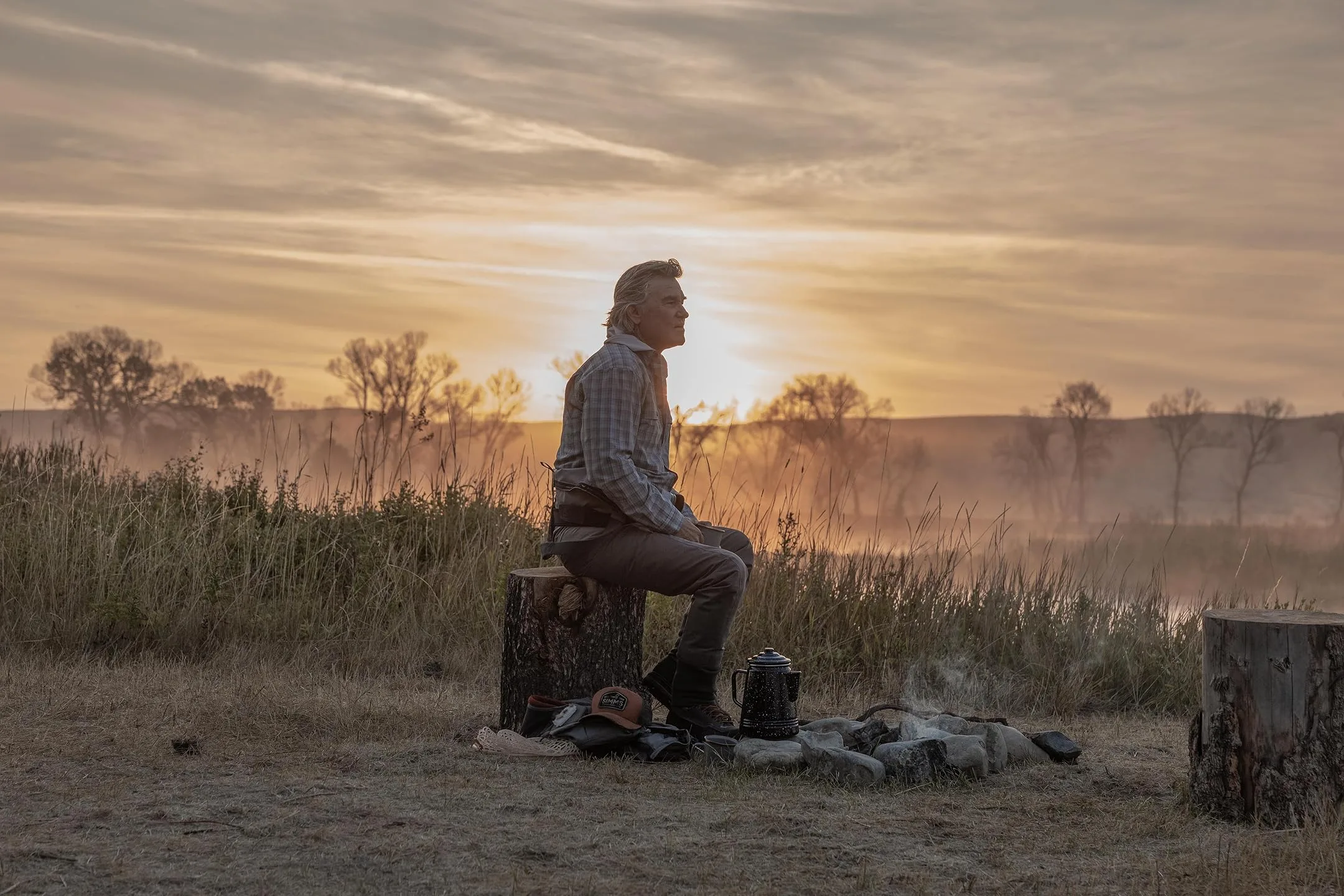
Sheridan has described The Madison as his most personal project, and that claim carries visible weight on screen. The show feels less calculated than his other series, more willing to sit with feeling rather than resolve it through incident. Season 2 has completed filming, which suggests confidence in the story’s future.
The real test is if the show can sustain its quieter emotional register once the initial shock of the family tragedy has receded, and if Sheridan can continue resisting the genre impulses that have always been his most reliable and most limiting defaults.
Created by the prolific Taylor Sheridan, The Madison premiered on Paramount+ on March 14, 2026. The series serves as a poignant exploration of grief and human connection, following a wealthy New York City family, the Clyburns, as they relocate to the rugged Madison River Valley in central Montana. Following a sudden family tragedy, the matriarch, played by Michelle Pfeiffer, must navigate the stark culture shock of the West while attempting to keep her grieving daughters and grandchildren together. The show offers a more intimate, character-driven lens compared to Sheridan’s usual neo-western thrillers and is currently available to stream exclusively on Paramount+.
Where to Watch The Madison Online








Full Credits
Title: The Madison
Distributor: Paramount+
Release date: March 14, 2026
Rating: TV-MA
Running time: 60 minutes
Director: Christina Alexandra Voros
Writers: Taylor Sheridan
Producers and Executive Producers: Taylor Sheridan, Michelle Pfeiffer, Kurt Russell, David C. Glasser, John Linson, Art Linson, Ron Burkle, Bob Yari, David Hutkin, Christina Alexandra Voros, Michael Friedman, Keith Cox
Cast: Michelle Pfeiffer, Kurt Russell, Beau Garrett, Patrick J. Adams, Elle Chapman, Amiah Miller, Alaina Pollack, Ben Schnetzer, Kevin Zegers, Rebecca Spence, Danielle Vasinova, Matthew Fox, Will Arnett
Director of Photography (Cinematographer): Christina Alexandra Voros
Editors: Chad Galster, Michael J. Smith
Composer: Brian Tyler, Breton Vivian
The Review
The Madison
The Madison is Taylor Sheridan's most emotionally honest television work. Anchored by a career-best Michelle Pfeiffer and elevated by Christina Alexandra Voros's breathtaking cinematography, the series trades Sheridan's usual genre fireworks for something quieter and more affecting: a family study in grief, love, and the cost of comfortable living. The cultural provocations are familiar, the city portrayal is exaggerated, and some characters arrive as types before becoming people. Still, the series rewards patience.
PROS
- Pfeiffer delivers a performance of rare emotional precision
- Voros's direction and cinematography are consistently extraordinary
- Preston and Stacy's marriage feels genuinely warm and lived-in
- A meaningful step forward in Sheridan's portrayal of women
- The ensemble chemistry deepens across the season
CONS
- New York sequences lack visual authenticity
- Urban stereotyping is heavy-handed at times
- Some characters take too long to escape their initial archetypes
- Middle episodes lose some momentum