






























Protocol does most of the talking in A Royal Setting, which is a problem for a romance built around people who are meant to feel trapped by it. The Hallmark royal fantasy has returned to its familiar kingdom: a tiny European monarchy, a prince with reformist instincts, a commoner whose professional skill somehow doubles as emotional liberation, and a palace full of people saying “tradition” with the solemnity of a constitutional crisis.
Ruby Robinson arrives from New York with a reputation grand enough to land her on the cover of Gemologist Quarterly. Prince Luca of Gullion hires her to restore the royal jewels before his coronation, hoping to display them publicly after years in storage. Queen Ivy and Countess Fenella prefer the old arrangement: jewels hidden, behavior controlled, marriage steered toward Fenella’s daughter Jory. The stage is set for change, romance, and a great deal of dialogue about palace rules.
The film’s central idea has promise. A monarchy that cannot show its own jewels has become a museum of itself, preserving power by locking away beauty. Luca’s wish to move the Garden Lights ceremony outside the royal grounds gives the story its clearest political gesture. The people of Gullion are allowed to share in a ritual that had belonged to the palace. The gesture is simple, but Hallmark simplicity can work when it is tied to a concrete act. Here, a public garden ceremony says what Luca cannot quite say to his mother: reverence without access is vanity.
The Plot Moves Faster Than Ruby Can Work
Ruby’s arrival gives the movie its cleanest romantic mechanism. Her cab gets a flat tire on the way to the castle, Luca appears as a helpful jogger, and she reaches the palace without knowing the man carrying her luggage is the prince who hired her.
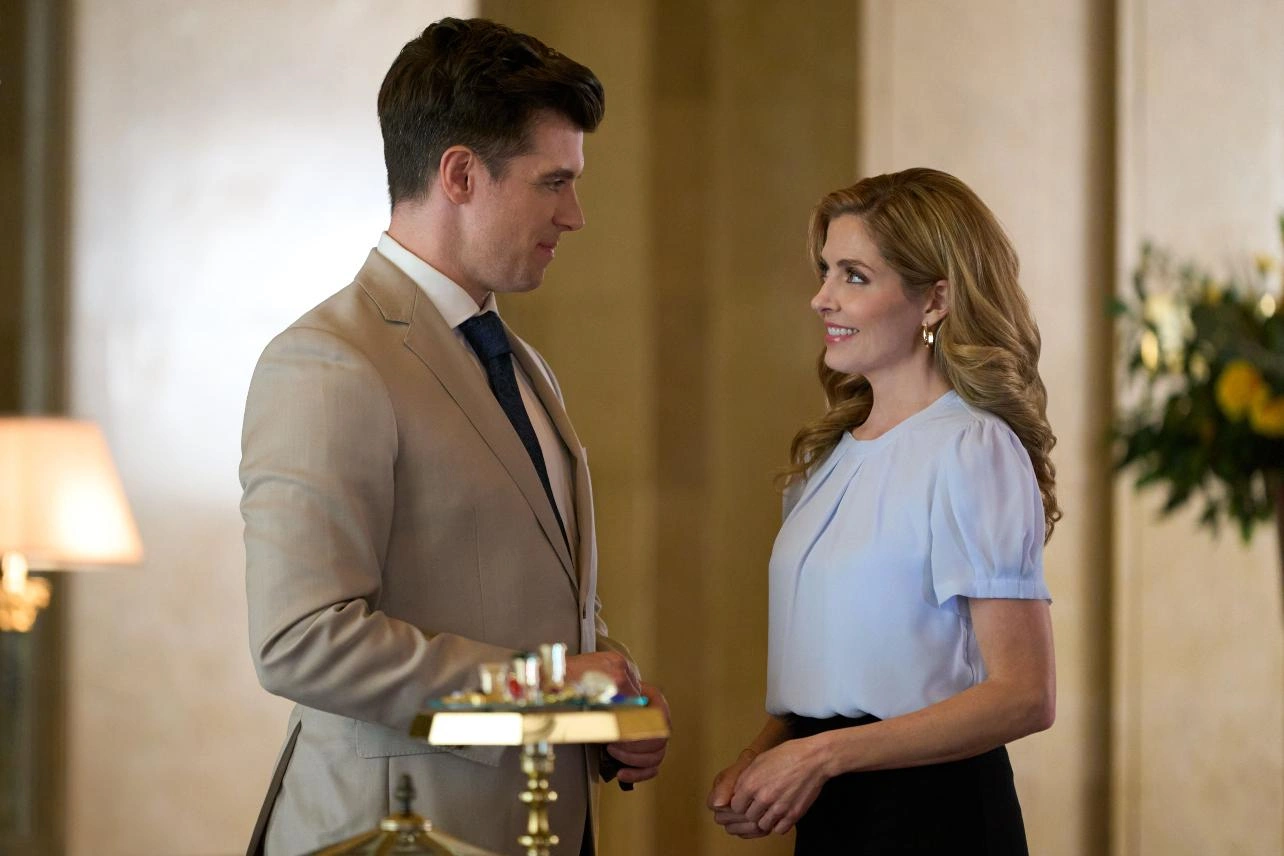
It is a useful meet-cute, built on etiquette failure rather than deception. Ruby then stumbles through protocol, reaches Queen Ivy before her proper introduction, and turns social embarrassment into the first sign that palace order might be shakier than Fenella admits.
The trouble comes once the work begins. Ruby is hired to restore over a thousand gemstones in less than a week, a professional challenge the film keeps forgetting. She tours the kingdom, flirts with Luca, helps Jory and Zander hide their affection, attends the Garden Lights ceremony, and still finishes the jewels with time to spare. The screenplay wants Ruby’s expertise to matter, yet it rarely shows her at work long enough to create tension. A few lists of remaining stones cannot replace the drama of labor.
That weakness spreads into the romance. Ruby and Luca are charming together, but their connection is hurried through the required stations: accidental meeting, palace tour, shared idealism, forbidden attachment, forced departure, last-minute pursuit. The film does not need a radical plot. It does need scenes that let attraction gather weight. Instead, every beat arrives already labeled.
Jory and Zander fare better because their conflict is cleaner. She is the noblewoman expected to pair with Luca; he is Luca’s right-hand man, placed socially beneath her by the palace’s old hierarchy. Their secret dinner, interrupted by Fenella, gives the movie one of its few moments where etiquette becomes active danger. They must pretend Zander is showing Jory the jewels because her position at the royal museum gives the lie a believable shape. For once, protocol is not merely discussed. It corners people.
A Cast Trying to Warm a Cold Formula
Jen Lilley gives Ruby the sunny poise the role requires, and her performance keeps the character from becoming a moving plot device with a jewelry kit. Ruby’s teasing of the silent guard she names Fred is a risky comic thread. The repeated attempts to break his composure can feel childish, especially since he is doing his job while she is meant to be doing hers. Yet the final payoff, when he speaks as she leaves and gives his real name, lands because Lilley plays Ruby’s surprise with softness rather than triumph. The moment suggests a whole quieter film about attention, class, and palace labor.
Dan Jeannotte gives Luca a gentle awkwardness that suits a prince caught between ceremony and conscience. His scenes with Zander help him most. Their friendship makes Luca’s reformist talk feel personal, especially once he recognizes Zander’s love for Jory. Yet Luca is often written as a man waiting for the script to grant him courage. He can move a royal ceremony into town, but he struggles to confront Fenella or Queen Ivy with force until the final stretch.
Ferelith Young and Ed Pinker bring the strongest emotional charge. Young gives Jory a visible brightness around Zander, then tightens her expression when marriage expectations close in. Pinker plays Zander with enough restraint to make his position believable; he is close to Luca, but never free from the social line separating service from royalty. Their exchange about remaining in each other’s hearts carries a melancholy the central romance rarely reaches.
Laurie Paton gives Fenella the brittle authority of someone who has mistaken control for duty. Sarah Orenstein’s Queen Ivy softens late, especially after realizing that sending Ruby away was a cruelty rather than a correction, but the character spends too long repeating the same attachment to old rules.
Polished Rooms, Reused Walls
Bradley Walsh directs with the clean competence expected of Hallmark’s royal romances, but Gullion rarely feels like a living country. The repeated castle shots flatten place into stock atmosphere. The palace interiors, filmed at the Fairmont Chateau Laurier, too often read as a hotel lobby with royal décor. The Great Room has the odd bustle of a public building, which clashes with the film’s insistence that these jewels have been hidden from ordinary view.
The jewel display creates its own accidental comedy. Velvet ropes sit too close to protect anything. Glass cases are arranged in a way that suggests a hotel event rather than a royal archive. Luca placing his own jewel and leaving the case open weakens the supposed gravity of the collection. For a story about national symbols, the objects themselves need stricter handling.
The music presses even harder. Romantic, sad, hopeful, ceremonial: too many scenes seem covered by the same soft emotional wash. Instead of guiding feeling, the score announces it. By the final chase after Ruby’s troubled cab, the music has become another palace rule, insisting on sentiment before the scene earns it.
A Royal Setting has a valid argument buried under its polished routine: institutions survive by changing the way they let people see them. The Garden Lights ceremony understands that. Jory standing up to Fenella understands it. Ruby’s last exchange with the guard understands it. The rest of the film keeps placing old jewels in familiar boxes and asking them to shine on command.
The cozy romantic comedy television film A Royal Setting premiered on the Hallmark Channel on March 28, 2026, as part of the network’s annual “Spring Into Love” programming block, and remains available for on-demand streaming via the Hallmark+ platform and Amazon Prime Video. The story stars Jen Lilley as an accomplished American gemologist who travels to the European kingdom of Gullion to restore the monarchy’s historic crown jewels, unexpectedly sparking a modern romance with the visionary crown prince.
Where to Watch A Royal Setting (2026) Online





Full Credits
Title: A Royal Setting
Distributor: Hallmark Channel, Hallmark+
Release date: March 28, 2026
Rating: TV-G
Running time: 84 minutes
Director: Bradley Walsh
Writers: Ansley Gordon, W. Stewart
Producers and Executive Producers: David Anselmo, W. Michael Beard, Susie Belzberg, Amy Krell, Brad Krevoy, Dattaguru Mahabal, Kelly Martin
Cast: Jen Lilley, Dan Jeannotte, Mark Lambert, Brenda Fricker
Director of Photography (Cinematographer): Hallmark Production Crew
Editors: Hallmark Post-Production Team
Composer: Hallmark Music Team
The Review
A Royal Setting
A Royal Setting treats tradition as a cage, then decorates the bars with jewels and palace lighting. The sentiment is sound, but the drama is thin: Ruby’s impossible workload, Luca’s timid rebellion, and the rushed romances make the film feel assembled from royal-romance leftovers. The cast gives it warmth, especially Jory and Zander, yet the script keeps mistaking protocol speeches for conflict. Pleasant, polished, and too familiar to sparkle.
PROS
- Stronger Jory and Zander subplot
- Warm cast chemistry
- Sweet guard payoff
- Clear tradition-versus-change theme
CONS
- Rushed romance
- Implausible gem restoration timeline
- Recycled royal plot beats
- Repetitive music
- Distracting palace staging