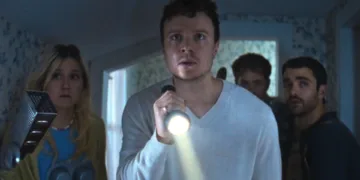










The most dangerous person inside Sam’s secluded vacation home may be the one holding a knife. The camera is less certain. Ian Faria’s Big Break repeatedly frames professional desperation as the greater threat, placing three struggling comedians in a blue-lit cabin where every shadow suggests violence and every conversation becomes an audition.
Written by Samuel Lanier, the film reunites the former members of Simple Town in heightened versions of themselves. Caroline, Felipe, and Will visit their estranged collaborator Sam, who abandoned the group after achieving success with The Gummy Bear Movie. A sequel is now moving forward, and the reunion’s stated purpose, repairing an old friendship, quickly collapses under the weight of their real objective. They want roles.
A victim has already fled through the surrounding woods. Another person is tied up in the basement. The visitors remain focused on impressing Sam. It is a clean comic premise with a cruel moral geometry: danger occupies the same house as opportunity, and these characters keep walking toward whichever room might contain a casting decision.
The Scarcity Room
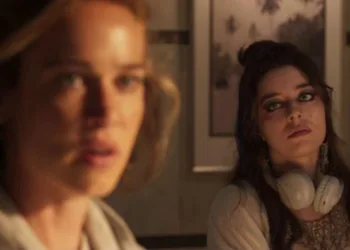
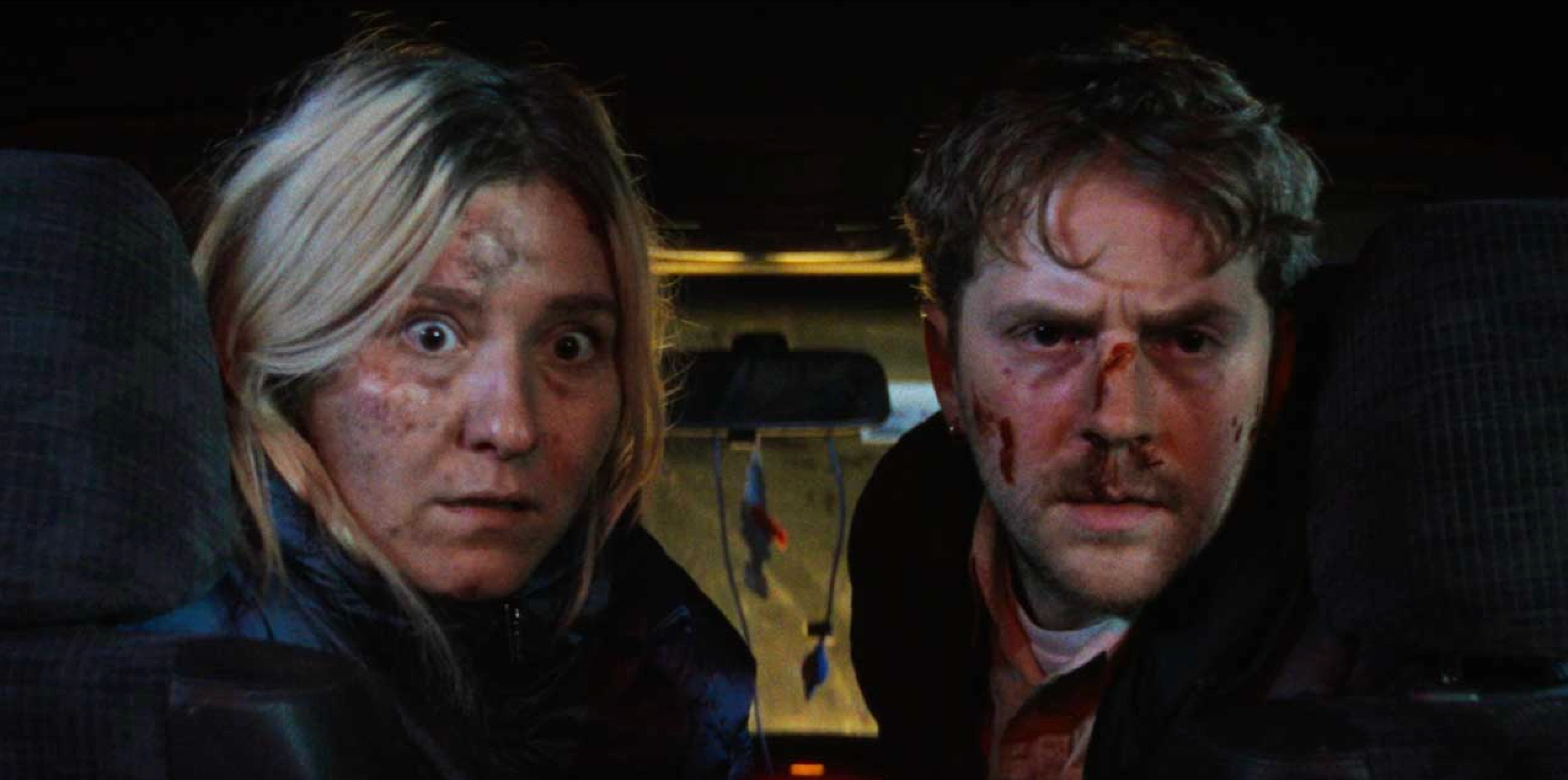
Sam’s home functions like a warped noir mansion, a place where wealth conceals rot and hospitality carries the texture of interrogation. The film replaces venetian-blind shadows with dramatically blue interiors, yet the old grammar remains recognizable. Light divides the room according to status. Sam belongs there. His guests seem temporarily admitted.
His success has produced the familiar affectations of the Hollywood survivor: IV drips, famous acquaintances, expensive alcohol, and the weary posture of someone eager to describe privilege as an exhausting burden. Lanier plays him with loose physical arrogance. Even an absent-minded dance while bending over becomes an assertion of control, ridiculous and faintly threatening.
Caroline, Felipe, and Will arrive carrying different versions of failure. Caroline lives from her car while insisting that tutoring offers satisfaction. Felipe clings to Adobe Premiere as a professional credential and dates a 19-year-old undergraduate, a personal choice that makes his stalled adulthood impossible to ignore. Will believes he possesses social instincts that his every sentence disproves.
Their requests for work grow steadily less disguised. The film’s sharpest running joke has them pleading for Sam’s approval while evidence of violence sits directly before them. The humor comes from misrecognition, a classic noir condition stripped of glamour. These people can identify resentment, humiliation, and status in a glance. They cannot identify a killer when employment is nearby.
Dinner Under Interrogation Light
Simple Town’s long comic history gives the dinner sequence its pressure. The group tries to prepare food and sustain conversation while behaving like nervous performers imitating friendship. Pauses stretch. Compliments arrive too quickly. Small gestures become territorial claims.
Faria often holds the camera long enough for a joke to decay into discomfort. That extra beat is where the film finds its personality. Veiled hostility accumulates through non-sequiturs and forced enthusiasm, while the secluded setting turns every failed exchange into a minor captivity scene. Nobody is physically restrained at the table. Social need performs the same function.
Will Niedmann makes Will sympathetic through constant verbal self-sabotage. Once alcohol weakens his remaining restraint, his campaign for a role becomes startlingly direct. He cannot stop speaking, partly because silence might force him to understand the room.
Caro Yost gives Caroline the film’s clearest moral intelligence. She recognizes the absurdity of the reunion and still participates in it. Her delivery of “open-relationship rap battle” compresses private embarrassment, professional bitterness, and exhausted disbelief into a single line. Felipe Di Poi Tamargo brings a messier energy, caught between loyalty, self-interest, and the consequences of choices he would rather treat as background noise.
The cast members know how to injure one another with timing. A delayed response lands like accusation. A glance across the table becomes evidence. The knife is almost redundant.
A Slasher Losing Its Nerve
The horror structure is strongest when the group divides. One set of characters attempts to manage a captive or conceal a death. Elsewhere, Caroline, Felipe, and Will continue discussing jobs. Faria cuts between physical danger and professional anxiety, allowing each side to expose the absurdity of the other.
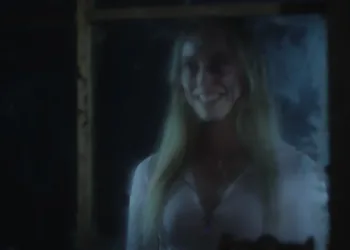
Music stings and blue lighting announce menace with blunt genre efficiency. The opening pursuit through the woods establishes a conventional slasher threat, and later stabbings and a brutal head impact provide genuine physical force. The film rarely sustains that tension for long. Its attention keeps returning to conversation, embarrassment, and old resentment.
That choice suits the satire, yet it weakens the thriller. Repeated shifts between the killer’s actions and the guests’ career maneuvers start to flatten the suspense. Some deadpan exchanges linger past their strongest beat, and the editing occasionally preserves the loose rhythm of a sketch when the scene requires escalation.
The limited body count is not the real issue. A slasher can survive on anticipation. Big Break often interrupts its anticipation before fear has time to settle. The blue shadows promise a harsher film than the pacing delivers.
Still, the visual conflict remains pointed. Sam’s home looks prepared to expose guilt, yet everyone enters hoping it will validate them. The killer carries the weapon. The room has already passed judgment.
This horror-comedy film premiered at the Fantasia International Film Festival in July 2026. The story follows members of a disbanded sketch comedy troupe who visit their former collaborator at his isolated vacation home to secure a role in his upcoming project, only to realize a dark and terrifying threat looms in the woods.
Full Credits
Title: Big Break
Distributor: Fantasia International Film Festival
Release date: July 2026
Director: Ian Faria
Writers: Samuel Lanier
Producers and Executive Producers: Richie Doyle, Conor Hannon, Graham Mason, Ani Schroeter, Sarah Wilson
Cast: Samuel Lanier, Will Niedmann, Caroline Yost, Felipe Di Poi Tamargo, Lena Engelstein, Jefferson White
Director of Photography (Cinematographer): Alex Bliss
Composer: Kyle Rodriguez
The Review
Big Break
Big Break finds its sharpest horror in the blue-lit cabin where friendship becomes an audition and mortal danger registers as a scheduling conflict. Ian Faria’s uneven pacing weakens the slasher machinery, yet Simple Town’s lived-in chemistry keeps each forced dinner exchange, drunken appeal, and concealed resentment uncomfortably alive. The killer carries the blade. Hollywood supplies the motive.
PROS
- Sharp Hollywood satire
- Lived-in ensemble chemistry
- Effective cringe comedy
- Strong character-specific performances
- Clever use of slasher imagery
CONS
- Uneven tonal transitions
- Limited sustained suspense
- Occasional slack pacing
- Horror remains underdeveloped